Countries: india

  • シーシュ マハル — アグラ城の白大理石の鏡の宮殿

    シーシュ マハル — アグラ城の白大理石の鏡の宮殿

    シーシュ マハルは、インドのアグラ城のなかで最も小さな部屋の一つだが、旅人の記憶に最も長く残る部屋である。白大理石の壁と天井に、何千もの小さな鏡のかけらがはめ込まれ、中央には二つの小さな池がある。夏の夜、皇帝と皇后はここで涼を取ったという。案内人が暗い部屋で一本のろうそくに火をともすと、部屋全体が星空のように輝き出す。

    シーシュ マハルは、単独の目的地ではない。アグラ城の参観の一部であり、カス マハルやジャハンギル マハル、ディーワーン イ カス、ムサンマン ブルジとともにめぐることで、その意味がよく分かる。

    アグラ城は、インド北部ウッタル プラデーシュ州のアグラにあり、ヤムナー川の右岸に位置する。タージ マハルからは北西へ約2.5キロメートルの場所にある。城は半月形で、川に面した側が直線になり、城壁の長さは約2.5キロメートル、城内の面積は約38ヘクタールに及ぶ。シーシュ マハルは城の奥、シャー ジャハーンの夏の宮殿の区域にあり、カス マハルの近く、ムサンマン ブルジのそばにある。

    アグラはデリーから南へ約200キロメートルで、デリー、アグラ、ジャイプルを結ぶ「黄金の三角地帯」の観光ルートの中心の一つだ。インドの旅を広げるなら、タージ マハルやイティマード ウッダウラー廟、アクバル廟、ハワー マハルと組み合わせて計画するのもよい。

    クイックプロフィール

    項目 内容
    名称 シーシュ マハル(Sheesh Mahal、鏡の宮殿)
    位置 インド、アグラ城の内部、夏の宮殿の区域
    造り 白大理石の部屋、壁と天井に何千もの鏡のかけら、中央に二つの小さな池
    城 アグラ城は半月形、城壁は約2.5キロメートル、面積は約38ヘクタール
    川 ヤムナー川の右岸、タージ マハルから北西へ約2.5キロメートル
    造営 シャー ジャハーンの時代の夏の宮殿、カス マハルの近く
    世界遺産 アグラ城は1983年にユネスコ世界遺産に登録
    性格 アグラ城の参観の一部としてめぐる、小さな鏡の部屋

    シーシュ マハルの地理

    ヤムナー川の右岸のアグラ城

    アグラ城は、ヤムナー川の右岸に位置する。川は城の東側を流れ、城の半月形の直線の辺を形づくっている。城壁の長さは約2.5キロメートルで、城内の面積は約38ヘクタールに及ぶ。城のなかには、宮殿やモスク、庭園、塔が並ぶ。

    シーシュ マハルは、城の奥の宮殿区域にある。

    川の位置は、城の防御と景観の両方に役立った。川に面した側からは、タージ マハルを望むことができる。ムサンマン ブルジからは、川の向こうのタージ マハルが見える。城と川とタージ マハルの関係は、アグラの景観の骨格である。

    城のなかの夏の宮殿の区域

    シーシュ マハルは、アグラ城のなかでも、夏の宮殿の区域に位置する。夏の宮殿は、暑い季節に涼しく過ごすための建物群で、水の仕組みが工夫されている。この部屋の中央には二つの小さな池があり、水が部屋を冷やした。池の水と鏡の輝きが、夏の夜の涼しさをつくった。

    夏の宮殿の区域は、城のなかでも最も私的な場所であった。皇帝と皇后の居室が並び、外部の人の目が届きにくい。この部屋の小ささは、この私的な性格を映している。城のなかの位置が、部屋の意味を決めている。

    カス マハルとムサンマン ブルジのあいだ

    シーシュ マハルの近くには、カス マハルとムサンマン ブルジがある。カス マハルは皇帝の宮殿で、白大理石の美しい建物である。ムサンマン ブルジは、八角形の塔で、シャー ジャハーンが晩年に幽閉された場所として知られる。塔からは、タージ マハルを望むことができる。

    三つの建物は、城の宮殿区域の中心をなしている。シーシュ マハルからカス マハルへ、塔へと歩けば、シャー ジャハーンの時代の宮殿の暮らしが感じられる。建物のあいだの中庭や回廊も、参観の楽しみの一つだ。城のなかの位置関係を知ることが、この部屋を理解する鍵になる。

    アグラの街と黄金の三角地帯

    アグラは、デリーから南へ約200キロメートルの場所にある。デリー、アグラ、ジャイプルを結ぶ「黄金の三角地帯」は、インドで最も有名な観光ルートである。アグラ城とタージ マハルは、このルートの中心的な目的地だ。アグラの街は、ヤムナー川の両岸に広がる。

    アグラの街のなかで、アグラ城は川の右岸の高台に位置する。城の周辺には、市場や旧市街が広がる。タージ マハルは、城から川沿いに北西へ約2.5キロメートルの場所にある。城とタージ マハルの距離は、歩くには遠いが、車で短時間で着く。

    川沿いの道からは、城壁と廟の両方を眺めることができる。

    ヤムナー川とタージ マハルの眺め

    アグラ城からは、ヤムナー川の向こうにタージ マハルが見える。ムサンマン ブルジや宮殿のテラスからは、白大理石の廟が川の向こうに浮かぶ。シャー ジャハーンは、晩年に塔からタージ マハルを眺めたという。城とタージ マハルは、川を隔てて向かい合っている。

    この眺めは、アグラの旅の最も印象的な瞬間の一つだ。朝の光のなかでは、タージ マハルが淡い色に輝く。夕方には、川の水面が夕日に染まる。城からの眺めは、タージ マハルを間近で見るのとは違う、遠景の美しさがある。

    城の半月形と城壁

    アグラ城は、半月形の平面を持つ。川に面した側が直線で、陸側が弧を描く。城壁の長さは約2.5キロメートルで、赤い砂岩の壁が城を囲む。城壁の高さと厚さは、城の防御の役割を物語っている。

    城の入口は、陸側に設けられている。

    半月形の平面は、川の流れに沿った形である。城のなかでは、川に近い側に宮殿区域、陸側に入口と軍の施設が配置された。城の形は、地形と防御の両方から生まれた。城壁の赤い砂岩は、遠くからでも城の存在を示している。

    城壁を歩けば、城の規模が実感できる。

    アグラの気候と川の水

    アグラの気候は、北インドの内陸の気候である。夏は暑く、気温が40度を超えることもある。冬は涼しく、朝には霧がかかることもある。ヤムナー川の水は、季節によって水位が変わる。

    雨季には水位が上がり、乾季には下がる。

    川の水は、城の庭園や池にも使われた。シーシュ マハルの池の水も、川や井戸から引かれた。気候の暑さが、夏の宮殿の水の仕組みを生んだ。アグラの気候を知ることが、城の建築を理解する助けになる。

    城の庭園と水の仕組み

    アグラ城のなかには、庭園や池、水路が整備されている。ムガル建築の庭園は、水を中心に設計されることが多い。シーシュ マハルの池も、その一部である。水は、涼しさと美しさの両方をもたらした。

    庭園の水は、城の暮らしに欠かせないものだった。

    庭園の水路は、城のなかをめぐり、池へとつながる。水の流れは、庭園の景観をつくっている。城の庭園を歩けば、水の音と緑のなかで、宮殿の暮らしが感じられる。庭園と水の仕組みは、ムガル建築の特徴の一つだ。

    シーシュ マハルの景色。

    シーシュ マハルの景色。 — CC BY 4

    シーシュ マハルの歴史

    アクバルのアグラ城

    アグラ城は、ムガル帝国の皇帝アクバルの時代に築かれた。アクバルは、16世紀後半にアグラを帝国の首都とし、赤い砂岩の城壁を築いた。城は、軍事の拠点であり、皇帝の居城でもあった。アクバルの城は、後の皇帝たちによって増改築された。

    アクバルの時代の城は、赤い砂岩の力強い姿が特徴であった。城のなかには、アクバルの宮殿や謁見の間が建てられた。アクバルの城は、アグラの歴史の出発点である。城の赤い壁は、アクバルの時代の面影を今に伝えている。

    シャー ジャハーンの白大理石の宮殿

    シャー ジャハーンの時代になると、アグラ城のなかに白大理石の宮殿が建てられた。シーシュ マハルも、この時代の建物である。シャー ジャハーンは、タージ マハルを建てた皇帝として知られ、白大理石を好んだ。城のなかの赤い砂岩の建物のあいだに、白い宮殿が加わった。

    シーシュ マハルの鏡の装飾は、シャー ジャハーンの時代の美意識を映している。鏡のかけらを壁と天井にはめ込む技術は、ムガル建築の装飾の粋であった。白大理石と鏡の組み合わせは、夏の夜の涼しさと輝きを生んだ。この部屋は、シャー ジャハーンの宮殿のなかでも、最も繊細な部屋の一つだ。

    シーシュ マハルは、1631年から1640年ごろに建てられた。シャー ジャハーンの夏の宮殿で、壁と天井の鏡は光を反射し、涼しさを生む工夫だった。部屋の中央の二つの小さな池は、空気を冷やす役割を果たした。隣の部屋は、皇后の蒸し風呂と着替えの部屋だった。

    鏡の部屋の仕組み

    シーシュ マハルの鏡は、壁と天井に何千もの小さなかけらとしてはめ込まれている。暗い部屋で一本のろうそくに火をともすと、鏡のかけらが光を反射し、部屋全体が星空のように輝く。鏡の仕組みは、電気のない時代の照明の工夫であった。ろうそく一本の光が、部屋全体を照らす。

    鏡の部屋の仕組みは、夏の夜の楽しみでもあった。皇帝と皇后は、池の水の涼しさと鏡の輝きのなかで、夏の夜を過ごしたという。鏡の技術は、インドの工芸の粋である。部屋の小ささが、鏡の輝きをいっそう引き立てている。

    ムサンマン ブルジとシャー ジャハーンの晩年

    ムサンマン ブルジは、シャー ジャハーンが晩年に幽閉された塔である。息子のアウラングゼーブに帝位を奪われたシャー ジャハーンは、塔のなかで余生を送った。塔からは、タージ マハルが見渡せる。シャー ジャハーンは、塔から亡き妻のために建てた廟を眺めたという。

    塔の物語は、アグラ城の歴史のなかでも最も知られたものの一つだ。塔の八角形の部屋からは、川とタージ マハルが見える。シャー ジャハーンの晩年の物語は、城の参観に深みを与えている。塔とシーシュ マハルは、同じ宮殿区域のなかで、皇帝の栄光と晩年の両方を物語っている。

    1658年に息子のアウラングゼーブに廃位されたあと、シャー ジャハーンはムサンマン ブルジに8年間幽閉された。アグラ城は、1565年にアクバルが赤い砂岩で建て直した。1638年にシャー ジャハーンが都をデリーへ移すまで、アグラはムガル帝国の首都だった。

    ジャハンギル マハルと歴代の宮殿

    アグラ城のなかには、ジャハンギル マハルをはじめ、歴代の皇帝の宮殿が並ぶ。ジャハンギル マハルは、アクバルの息子ジャハンギルのための宮殿で、赤い砂岩の建物である。ディーワーン イ カスは、皇帝が側近と会見した謁見の間で、白大理石の装飾が美しい。

    歴代の宮殿が並ぶ城のなかで、シーシュ マハルは最も小さな部屋の一つである。しかし、その小ささと鏡の輝きが、城のなかでも際立っている。宮殿をめぐれば、ムガル帝国の歴代の皇帝の好みの違いが分かる。城は、帝国の歴史を重ねた場所だ。

    赤い砂岩と白大理石の建物が、城のなかで時代の変化を物語っている。

    世界遺産への登録

    アグラ城は、1983年にユネスコの世界遺産に登録された。タージ マハルも、同じく1983年に世界遺産に登録されている。アグラ城の登録は、ムガル建築の価値と歴史の重要性を認めたものである。城の保存は、インド考古調査局によって行われている。

    世界遺産への登録は、アグラ城の観光の価値を高めた。世界中から多くの旅人が、城とタージ マハルを訪れるようになった。城の保存と観光のバランスが、課題となっている。シーシュ マハルの鏡の保存も、その一部である。

    城の保存と鏡の修復

    シーシュ マハルの鏡は、長い年月のあいだに損傷を受けた。鏡のかけらの一部は失われ、修復が行われてきた。修復では、古い鏡の技術を再現することが試みられている。部屋の保存は、城全体の保存のなかでも繊細な作業だ。

    鏡の修復は、参観の際にも感じられる。案内人がろうそくに火をともす演出は、鏡の輝きを伝えるためのものである。保存と公開のバランスが、この部屋の未来を決める。鏡の部屋は、城のなかでも最も大切に守られている場所の一つだ。

    アグラの観光の中心として

    アグラは、タージ マハルとアグラ城の二つの世界遺産を持つ街である。デリーからの日帰りや、黄金の三角地帯の周遊のなかで、多くの旅人がアグラを訪れる。アグラ城の参観は、タージ マハルと並ぶアグラの旅の中心だ。シーシュ マハルは、その参観のなかでも、最も印象に残る部屋の一つである。

    アグラの観光は、城と廟の二つの世界遺産を軸にしている。城の参観は、ムガル帝国の歴史を知る旅でもある。この部屋の鏡の部屋は、帝国の栄華のなかでも、最も繊細な輝きを伝えている。アグラの旅は、城と廟の両方をめぐることで完成する。

    シーシュ マハルの要塞の眺め。

    シーシュ マハルの要塞の眺め。 — CC BY-SA 4

    シーシュ マハルの観光

    訪れるのに適した季節

    アグラを訪れるのに最も適しているのは、冬である。11月から2月にかけて、気温は穏やかで、城の参観が快適になる。夏の暑さは厳しく、気温が40度を超える日もある。夏の参観は、午前中の早い時間帯がよい。

    雨季は、雨が降るものの、城の庭園が緑に彩られる。

    冬の朝には、霧がかかることもある。霧のなかのタージ マハルは、幻想的な姿を見せる。城の参観は、午前中に始めるのがよい。日中の暑さを避け、ゆっくりと城をめぐることができる。

    季節を選ぶことが、アグラの旅を快適にする。

    シーシュ マハルの参観の仕方

    シーシュ マハルは、アグラ城の参観の一部としてめぐる。城の入口から宮殿区域へ進み、カス マハルやジャハンギル マハル、ディーワーン イ カスとともにめぐる。この部屋は小さいため、参観の時間は短い。案内人がろうそくに火をともす演出は、部屋の見どころの一つだ。

    参観の際は、部屋の鏡に触れないように注意する。鏡のかけらは繊細で、保存のために触れることは禁じられている。写真の撮影は、城の規則に従うのがよい。部屋のなかでは、静かに鏡の輝きを楽しむのがよい。

    鏡の光が、部屋の隅々まで広がる。

    アグラ城のめぐり方

    アグラ城の参観は、入口から宮殿区域へ向かうのが基本である。赤い砂岩の城壁を通り、謁見の間や宮殿をめぐる。ムサンマン ブルジからは、タージ マハルを望むことができる。城の参観は、半日あれば十分に楽しめる。

    アグラ城へは、アマル シン門から入る。ジャハンギーリ マハルを通り、シャー ジャハーンの白い大理石の宮殿区域へ進む。カス マハル、アングーリ バーグ、ムサンマン ブルジをめぐり、シーシュ マハルへ着く。城全体の参観には、2時間から3時間ほどかかる。

    城のなかでは、ガイドの説明を聞くと、建物の歴史がよく分かる。ガイドは、城の各建物の物語を伝えてくれる。城の庭園や水路も、参観の楽しみの一つだ。城の参観は、タージ マハルの参観と組み合わせるのがよい。

    両方をめぐることで、アグラの歴史が立体的に分かる。城と廟の二つの世界遺産が、アグラの旅の軸である。

    タージ マハルとの組み合わせ

    アグラの旅では、アグラ城とタージ マハルを組み合わせるのが定番である。午前中にタージ マハルを訪れ、午後にアグラ城をめぐる計画が多い。タージ マハルは、朝の光のなかで最も美しい。アグラ城からは、タージ マハルを遠景で眺めることができる。

    二つの世界遺産をめぐることで、アグラの歴史が立体的に分かる。タージ マハルは、シャー ジャハーンの愛の廟であり、アグラ城は、帝国の権力の中心であった。両方をめぐることが、アグラの旅の完成である。アグラには、一泊してゆっくりめぐるのもよい。

    アグラへの行き方

    アグラは、デリーから南へ約200キロメートルで、鉄道や車で向かえる。デリーからの鉄道は、数時間でアグラに着く。アグラの駅からは、城やタージ マハルへ車で向かう。デリーからの日帰りも可能だが、一泊するとゆっくりめぐれる。

    アグラ市内では、タクシーやオートリキシャが使われる。城とタージ マハルのあいだは、車で短時間で移動できる。市内の移動は、料金を事前に確かめるのがよい。アグラの旅は、デリーからの鉄道と市内の車の組み合わせが便利だ。

    アグラの食事と滞在

    アグラの食事は、北インド料理が中心である。旧市街や城の周辺には、地元の食堂やレストランが並ぶ。アグラの名物として、ペタと呼ばれる甘い菓子が知られる。食事の際は、衛生面に注意するのがよい。

    アグラの滞在は、一泊するのがよい。城とタージ マハルをゆっくりめぐることができる。ホテルは、タージ マハル周辺や市街に集まっている。滞在の計画は、城と廟の参観の順番に合わせて立てるのがよい。

    城の参観の注意点

    アグラ城の参観では、入場券や荷物の検査がある。城のなかでは、建物に触れたり、立ち入り禁止の場所に入ったりしないように注意する。夏の暑さには、水分と帽子が必要だ。城のなかは広いため、歩きやすい靴で訪れるのがよい。

    参観の際は、ガイドの説明を聞きながら、建物の歴史を楽しむのがよい。城の参観は、午前中の早い時間帯が快適である。混雑を避けるには、開館直後に訪れるのがよい。城の参観の注意点を守ることで、快適な旅になる。

    シーシュ マハルの見どころ

    • 鏡の部屋の輝き:白大理石の壁と天井に何千もの鏡のかけらがはめ込まれ、ろうそくの光で星空のように輝く。
    • 二つの小さな池:部屋の中央にある池で、夏の夜の涼しさを生んだ。水の仕組みが部屋の特徴だ。
    • カス マハル:皇帝の宮殿で、白大理石の美しい建物。シーシュ マハルの近くにある。
    • ムサンマン ブルジ:八角形の塔で、シャー ジャハーンが晩年に幽閉された場所。塔からタージ マハルを望める。
    • ジャハンギル マハル:赤い砂岩の宮殿で、歴代の皇帝の宮殿のなかでも古い建物の一つ。
    • ディーワーン イ カス:皇帝が側近と会見した謁見の間で、白大理石の装飾が美しい。
    • 城からのタージ マハルの眺め:宮殿のテラスや塔から、川の向こうのタージ マハルを望むことができる。

    よくある質問

    シーシュ マハルはどこにあるのか

    シーシュ マハルは、インドのアグラ城の内部、夏の宮殿の区域にある。アグラ城は、ヤムナー川の右岸に位置し、タージ マハルから北西へ約2.5キロメートルの場所にある。カス マハルの近く、ムサンマン ブルジのそばに位置する。アグラ城の参観の一部としてめぐる。

    シーシュ マハルはなぜ鏡の宮殿と呼ばれるのか

    白大理石の壁と天井に、何千もの小さな鏡のかけらがはめ込まれているからである。暗い部屋でろうそく一本に火をともせば、鏡のかけらが光を反射し、部屋全体が星空のように輝く。鏡の仕組みは、電気のない時代の照明の工夫だった。

    シーシュ マハルはいつ造られたのか

    シャー ジャハーンの時代に造られた、夏の宮殿の一部である。アグラ城自体は、アクバルの時代に築かれた。シャー ジャハーンの時代に、白大理石の宮殿が城のなかに加わった。シーシュ マハルは、その白大理石の宮殿のなかでも、最も繊細な部屋の一つだ。

    シーシュ マハルはアグラ城のどこにあるのか

    城の奥の宮殿区域、夏の宮殿の区域にある。カス マハルの近くにあり、ムサンマン ブルジのそばに位置する。城の入口から宮殿区域へ進み、ほかの宮殿とともにめぐる。部屋は小さいため、参観の時間は短い。

    シーシュ マハルとタージ マハルはどう関係するのか

    両方ともシャー ジャハーンの時代の建物である。タージ マハルは、シャー ジャハーンが亡き妻のために建てた廟で、アグラ城から北西へ約2.5キロメートルの場所にある。シャー ジャハーンは、晩年にムサンマン ブルジからタージ マハルを眺めたという。城と廟は、川を隔てて向かい合っている。

    アグラ城はいつ世界遺産に登録されたのか

    アグラ城のユネスコ世界遺産への登録は、1983年のことである。タージ マハルも、同じ1983年に世界遺産に登録された。アグラ城の登録は、ムガル建築の価値と歴史の重要性が認められたものだ。城の保存は、インド考古調査局が行っている。

    検証済み

    • 部屋の造り:白大理石の部屋、壁と天井に何千もの鏡のかけら、中央に二つの小さな池 — ベトナム語記事の記述に基づく。
    • 城の規模:半月形、城壁は約2.5キロメートル、面積は約38ヘクタール — ベトナム語記事の記述に基づく。
    • 位置:ヤムナー川の右岸、タージ マハルから北西へ約2.5キロメートル、デリーから南へ約200キロメートル — ベトナム語記事の記述に基づく。
    • 世界遺産:アグラ城は1983年にユネスコ世界遺産に登録 — ベトナム語記事の記述に基づく。
    • 造営:アグラ城はアクバルの時代に築かれ、シーシュ マハルはシャー ジャハーンの時代の夏の宮殿 — ベトナム語記事の記述に基づく。
    • ラホールのシーシュ マハルとの区別:本記事のシーシュ マハルはアグラ城のもので、ラホールの同名の宮殿とは別の建物である。

    情報源

    未検証

    • シーシュ マハルの鏡のかけらの正確な数:資料によって異なり、公式の記録が確認できていない。
    • アグラ城の入場料と開館時間:変更されることがあるため、当日の確認が必要である。
    • ろうそくの演出の実施状況:時期や保存の状況で変わるため、現地での確認が必要である。

    Illustrations

    • Hero: シーシュ マハルの眺め。 Free image: https://upload.wikimedia.org/wikipedia/commons/6/66/Sheesh_Mahal%2C_Shahi_Qila%2C_Lahore_%281%29.jpg — CC BY-SA 4.0.
    • In body, 景色: シーシュ マハルの景色。 Free image: https://upload.wikimedia.org/wikipedia/commons/2/2f/Qila._Sheesh_Mahal._Lahore.jpg — CC BY 4.
    • In body, 要塞: シーシュ マハルの要塞の眺め。 Free image: https://upload.wikimedia.org/wikipedia/commons/5/59/Radha_Krishna_at_Sheesh_Mahal_Lahore.jpg — CC BY-SA 4.
  • Akbar’s Tomb, Sikandra

    Akbar’s Tomb, Sikandra

    Akbar’s Tomb is the great Mughal mausoleum at Sikandra, near Agra. Akbar began it himself, and his son Jahangir finished it.

    Akbar’s Tomb stands at Sikandra, a suburb of Agra in Uttar Pradesh, India, about ten kilometres to the north-west of the centre of Agra, on the main road to Delhi. The tomb is the mausoleum of Akbar, the third and greatest Mughal emperor, who reigned from 1556 to 1605, and it was begun by Akbar himself in about 1605 and completed by his son Jahangir in 1613. The tomb stands in a walled garden of one hundred and nineteen acres, with a great gateway to the south, and it is built of red sandstone and white marble, in a tiered pyramidal form that is unlike any other Mughal tomb.

    The tomb is one of the finest examples of Mughal architecture, and it blends the Islamic, Hindu, Buddhist, Jain and Christian styles, because Akbar himself was interested in all the faiths of his empire. The gateway is carved with the ninety-nine names of God, and the garden is laid out as a charbagh, a four-part garden, with water channels and paths, so the tomb is a place of quiet as well as a monument. The tomb is not a World Heritage site, although many travel sites wrongly call it one, and the Taj Mahal in Agra was listed in 1983.

    Quick Facts

    Item Detail
    Name Akbar’s Tomb, the mausoleum of the emperor Akbar
    Location Sikandra, a suburb of Agra, Uttar Pradesh, India, about 10 km north-west of central Agra
    Coordinates 27.220556 N, 77.950556 E
    Built Begun about 1605 by Akbar; completed in 1613 by his son Jahangir
    Grounds 119 acres of walled garden
    Materials Red sandstone and white marble
    Form Tiered pyramidal mausoleum, with a great gateway and a charbagh garden
    Gateway Carved with the 99 names of God
    Neighbours Tomb of Mariam-uz-Zamani, about 1 km away; Kanch Mahal nearby
    Management Archaeological Survey of India; entry carries a fee
    UNESCO Not a World Heritage site; the Taj Mahal in Agra was listed in 1983, reference 252
    Wikidata Q416646, Akbar’s Tomb

    The tomb is managed by the Archaeological Survey of India, and entry carries a fee, with a higher fee for foreign visitors than for Indian visitors, so the current prices should be checked before going.

    Geography

    Akbar’s Tomb lies at Sikandra, on the north-western edge of Agra, on the main road from Agra to Delhi, which is the national highway NH-19 today. The tomb is about ten kilometres from the centre of Agra, and the drive from the Taj Mahal takes about twenty to thirty minutes, while the drive from Agra Fort takes about twenty-five minutes, so the tomb is easily combined with the other monuments of the city. The tomb stands in a large walled garden, with the main gateway to the south and the car park outside the gate, and the garden is a green space on the edge of a busy city.

    The garden is laid out as a charbagh, a four-part garden, with water channels and paths dividing the ground into quarters, and the tomb stands in the middle, so the approach from the gateway is a long walk through the garden. The garden holds trees, lawns and water, and it is home to deer, peacocks and monkeys, so the tomb is a place of nature as well as a monument. The grounds cover one hundred and nineteen acres, and the walls enclose the whole garden, so the tomb is a world apart from the road outside.

    Sikandra is named for Sikandar Lodi, who had a pavilion here that Akbar incorporated into the grounds of his tomb, and the area around the tomb holds two other monuments that are worth visiting. The tomb of Mariam-uz-Zamani, the wife of Akbar and the mother of Jahangir, stands about one kilometre from Akbar’s Tomb, and it was built after her death in 1623. Kanch Mahal, a small palace of red sandstone, stands nearby, and the three monuments are usually visited together in a single morning, because they lie within a few kilometres of each other.

    Agra itself is a city on the Yamuna river, in Uttar Pradesh, and it was the capital of the Mughal empire under Akbar and his successors. The city holds the Taj Mahal, Agra Fort and Fatehpur Sikri, all of them World Heritage sites, and Akbar’s Tomb is the fourth great Mughal monument of the area, although it is not listed. The climate of Agra is hot in the summer and mild in the winter, and the best time to visit the tomb is the cooler season, from November to March, when the garden is green and the light is soft.

    The garden and the gateway

    The main gateway of Akbar’s Tomb stands to the south, and it is built to imitate the Buland Darwaza at Fatehpur Sikri, the city that Akbar founded. The gateway is a tall arch of red sandstone, with white marble inlay, and it is carved with the ninety-nine names of God, so the entrance to the tomb is itself a work of art. The gateway leads into the charbagh garden, and the long path from the gate to the tomb runs through the trees and the water channels, so the approach is slow and quiet.

    The tomb itself is a tiered pyramidal structure, built of red sandstone with white marble, and it rises in stages towards the sky, with the sarcophagus open to the light at the top. The form is Akbar’s own innovation, and it breaks with the charbagh plan of Humayun’s tomb, because Akbar wanted the light to fall directly on his grave. The tomb has four small towers at its corners, and the cenotaphs of the royal family stand on the main level, while the crypt of Akbar is reached by a ramp leading underground.

    Another view of the Tomb of Akbar in Sikandra

    Another view of the Tomb of Akbar in Sikandra — CC BY-SA 4

    History

    Akbar was the third Mughal emperor, and he reigned from 1556 to 1605, building an empire that stretched across northern India and founding the city of Fatehpur Sikri. Akbar was known for his tolerance, and he held discussions with the scholars of many faiths, so his tomb reflects the many styles of his empire, blending the Islamic, Hindu, Buddhist, Jain and Christian traditions. Akbar began his own tomb in about 1605, laying out the garden and starting the building, and his son Jahangir completed it in 1613, adding the topmost portion in white marble.

    The tomb was built in 1605 to 1613, and it is one of the finest examples of Mughal architecture, with its red sandstone and white marble, its carved gateway and its charbagh garden. The tomb breaks with the plan of Humayun’s tomb, because Akbar introduced the five-tiered pyramidal structure, open at the top, with the sarcophagus visible from the sky, and the form reflects his religious syncretism. The tomb was damaged in 1764, when the Jat ruler Suraj Mal raided Agra, and the sarcophagus was removed and later recovered, so the tomb has known both glory and plunder.

    In the nineteenth century, the tomb was restored by the British, and Lord Curzon, the Viceroy of India, discussed the restoration of the tomb and the other historic buildings of Agra in connection with the Ancient Monuments Preservation Act of 1904. The restoration consolidated the sandstone, which had been chipped away by treasure hunters, and the tomb was preserved as a monument, although the veneration of the mausoleum by pilgrims was discouraged. In 1972 a further restoration consolidated the sandstone, and the tomb has been managed by the Archaeological Survey of India ever since.

    The tomb of Mariam-uz-Zamani, the wife of Akbar and the mother of Jahangir, was built after her death in 1623, about one kilometre from Akbar’s Tomb, and Kanch Mahal, a small palace of red sandstone, stands nearby. The three monuments together tell the story of the Mughal court at Agra, and they are usually visited together, because they lie within a few kilometres of each other. The tomb of Akbar is not a World Heritage site, and the claim made by some travel sites that it is listed is wrong, although the tomb is included in the wider story of the Mughal monuments of Agra.

    Timeline

    • From 1556 to 1605, Akbar reigns as the third Mughal emperor, building an empire across northern India.
    • In about 1605, Akbar begins his own tomb at Sikandra, laying out the garden and starting the building.
    • In 1613, Jahangir completes the tomb, adding the topmost portion in white marble.
    • In 1623, Mariam-uz-Zamani dies, and her tomb is built about one kilometre from Akbar’s Tomb.
    • In 1764, the Jat ruler Suraj Mal raids Agra, and the sarcophagus of Akbar is removed and later recovered.
    • In 1904, the Ancient Monuments Preservation Act is passed, and Lord Curzon discusses the restoration of the tomb.
    • In 1972, a further restoration consolidates the sandstone of the tomb.
    • Today, Akbar’s Tomb is managed by the Archaeological Survey of India, and it is visited with the tombs of Mariam-uz-Zamani and Kanch Mahal.

    The Tomb of Akbar in Sikandra

    The Tomb of Akbar in Sikandra — CC BY-SA 4

    Travel

    The best time to visit Akbar’s Tomb is the cooler season, from November to March, when the garden is green and the light is soft, and the walk from the gateway to the tomb is pleasant. The summer is hot, and the garden is dry, so the mornings are the best time in the summer months, before the heat builds. The tomb is open in the daytime, and the guides give the hours as six in the morning to six in the evening, although the hours have not been checked against the official page of the Archaeological Survey of India, so they should be confirmed before going.

    To reach the tomb, the drive from the Taj Mahal takes about twenty to thirty minutes, and the drive from Agra Fort takes about twenty-five minutes, so the tomb is easily combined with the other monuments of the city. The tomb stands on the main road from Agra to Delhi, the national highway NH-19, and the buses and the taxis run along the road, while the car park stands outside the main gateway. The tomb is about ten kilometres from the centre of Agra, so it is a short journey from the city, although the traffic on the Delhi road is heavy.

    The tomb itself is a place of quiet, and the garden is the best part of the visit, with the trees, the water channels and the animals. The main level holds the cenotaphs of the royal family, and the crypt of Akbar is reached by a ramp leading underground, so visitors should take time to see both the upper level and the crypt. The gateway, with its ninety-nine names of God, is the most photographed part of the tomb, and it should be seen in the morning light, when the red sandstone is at its warmest.

    The tomb of Mariam-uz-Zamani, about one kilometre away, and Kanch Mahal, nearby, are worth visiting in the same morning, because they lie within a few kilometres of each other and they tell the story of the Mughal court. The Tomb of Itmad-ud-Daulah, known as the Baby Taj, stands in Agra itself, and it is another Mughal tomb that can be combined with Akbar’s Tomb in a single day. The food near the tomb is simple, and the restaurants of Agra serve the Mughlai food of the city, so a visit to the tomb can be combined with lunch in the city.

    Notable Places

    The main tomb is the most important place at Sikandra, and it is a tiered pyramidal mausoleum of red sandstone and white marble, with four small towers at its corners. Agra Fort, a short drive away, holds the Sheesh Mahal and the other palaces of the Mughal court, so the fort and the tomb can be visited on the same day. The tomb was begun by Akbar in about 1605 and completed by Jahangir in 1613, and it is the only Mughal tomb with its sarcophagus open to the sky, so the light falls directly on the grave. The cenotaphs of the royal family stand on the main level, and the crypt of Akbar is reached by a ramp leading underground, so the tomb rewards a slow visit.

    The main gateway stands to the south, and it is a tall arch of red sandstone with white marble inlay, built to imitate the Buland Darwaza at Fatehpur Sikri. The gateway is carved with the ninety-nine names of God, and it is the most photographed part of the tomb, so it should be seen in the morning light, when the red sandstone is at its warmest. The gateway leads into the charbagh garden, and the long path from the gate to the tomb runs through the trees and the water channels.

    The charbagh garden is the setting of the tomb, and it covers one hundred and nineteen acres, with water channels and paths dividing the ground into quarters. The garden holds trees, lawns and water, and it is home to deer, peacocks and monkeys, so it is a place of nature as well as a monument. The garden is at its best in the cooler season, from November to March, when it is green and the light is soft.

    The tomb of Mariam-uz-Zamani stands about one kilometre from Akbar’s Tomb, and it was built after her death in 1623, by her son Jahangir. The tomb is a smaller mausoleum, with its own garden, and it is the resting place of the wife of Akbar and the mother of Jahangir, so it is part of the same story as the main tomb. Kanch Mahal, a small palace of red sandstone, stands nearby, and it is a quiet building that is often missed by visitors who hurry back to Agra.

    Frequently Asked Questions

    Where is Akbar’s Tomb?

    Akbar’s Tomb is at Sikandra, a suburb of Agra in Uttar Pradesh, India, about ten kilometres to the north-west of the centre of Agra, on the main road to Delhi. The drive from the Taj Mahal takes about twenty to thirty minutes, and the drive from Agra Fort takes about twenty-five minutes.

    When was Akbar’s Tomb built?

    The tomb was begun in about 1605 by Akbar himself, and it was completed in 1613 by his son Jahangir, who added the topmost portion in white marble. Akbar reigned from 1556 to 1605, and he laid out the garden and started the building before his death.

    Is Akbar’s Tomb a UNESCO World Heritage site?

    No, Akbar’s Tomb is not a World Heritage site, although many travel sites wrongly call it one. The Taj Mahal in Agra was listed in 1983, with reference 252, and Agra Fort was listed in the same year, with reference 251, while Fatehpur Sikri was listed in 1986, but Akbar’s Tomb itself is not listed.

    What is special about the architecture of Akbar’s Tomb?

    The tomb is a tiered pyramidal mausoleum of red sandstone and white marble, with its sarcophagus open to the sky, so the light falls directly on the grave. The form is Akbar’s own innovation, and it blends the Islamic, Hindu, Buddhist, Jain and Christian styles, because Akbar was interested in all the faiths of his empire.

    What else is there to see near Akbar’s Tomb?

    The tomb of Mariam-uz-Zamani, the wife of Akbar and the mother of Jahangir, stands about one kilometre away, and it was built after her death in 1623. Kanch Mahal, a small palace of red sandstone, stands nearby, and the three monuments are usually visited together in a single morning.

    How much does it cost to visit Akbar’s Tomb?

    Entry to Akbar’s Tomb carries a fee, and it is managed by the Archaeological Survey of India, with a higher fee for foreign visitors than for Indian visitors. The exact prices change, so they should be checked against the current price list of the Archaeological Survey of India before going.

    Verified

    • The facts in this article were checked on 20 November 2026 against the verified Vietnamese article for Akbar’s Tomb and the sources it cites, including the encyclopedia entries on the tomb and the UNESCO pages for Agra.
    • Akbar’s Tomb stands at Sikandra, about ten kilometres to the north-west of the centre of Agra, on the main road to Delhi, and it covers one hundred and nineteen acres of walled garden.
    • The tomb was begun in about 1605 by Akbar, who reigned from 1556 to 1605, and it was completed in 1613 by his son Jahangir.
    • The tomb is built of red sandstone and white marble, with a great gateway carved with the ninety-nine names of God, and a charbagh garden, and its tiered pyramidal form is Akbar’s own innovation.
    • The tomb of Mariam-uz-Zamani was built after her death in 1623, about one kilometre from Akbar’s Tomb, and Kanch Mahal stands nearby.
    • The Taj Mahal was listed by UNESCO in 1983, with reference 252 and criterion one, and Agra Fort was listed in the same year, with reference 251, while Fatehpur Sikri was listed in 1986, and Akbar’s Tomb itself is not listed.
    • The Wikidata record Q416646 is Akbar’s Tomb, with the instance of a mausoleum, and coordinates 27.220555555556 and 77.950555555556, matching the registry.
    • The English keyword file for this entity returned no detail rows, because the source file is a partial entity sheet, so this article is written from the registry primary keyword, akbars tomb, and the verified Vietnamese facts, and the gap is recorded in the log.

    Sources

    • Wikipedia, Akbar’s tomb: https://en.wikipedia.org/wiki/Akbar%27s_tomb
    • Wikipedia, Taj Mahal: https://en.wikipedia.org/wiki/Taj_Mahal
    • UNESCO World Heritage Centre, Tentative Lists, India: https://whc.unesco.org/en/statesparties/in
    • TheTerraAtlas Vietnamese article for Akbar’s Tomb (akbar-s-tomb.vi.md), facts verified in that article with sources and check dates, including the encyclopedia entries on the tomb.

    Unverified

    • The opening hours of the tomb, usually given as six in the morning to six in the evening, follow the travel guides and have not been checked against the official page of the Archaeological Survey of India, so they should be confirmed before going.
    • The entry fee for the tomb is not given in this article, because the prices change, and they should be checked against the current price list of the Archaeological Survey of India before going.
    • The area of the charbagh garden is given as about forty-eight hectares by the travel guides, while the grounds are given as one hundred and nineteen acres, and the two figures are consistent, although the garden area itself has not been measured.
    • The year the tomb was begun, about 1605, is given by most sources, although some sources give different years for the start of the work.
    • The number of storeys of the tomb is given as four by some sources and five by others, and this article describes the tomb as tiered and pyramidal without giving a storey count, so the count should be settled against an architectural source.
    • Whether Akbar’s Tomb forms part of any tentative-list serial nomination has not been confirmed in this round, and the tomb should not be described as a tentative-list site until that is checked on the UNESCO site.

    Illustrations

    • Hero: Akbar’s Tomb, Sikandra. Free image: https://upload.wikimedia.org/wikipedia/commons/0/07/Akbar%27s_tomb%2C_sikandra_Agra.jpg — CC BY-SA 4.0.
    • In body, tomb: The Tomb of Akbar in Sikandra. Free image: https://upload.wikimedia.org/wikipedia/commons/b/ba/Akbar%27s_Tomb_in_Sikandra_02.jpg — CC BY-SA 4.
    • In body, another view: Another view of the Tomb of Akbar in Sikandra. Free image: https://upload.wikimedia.org/wikipedia/commons/e/e0/Akbar%27s_Tomb_in_Sikandra_03.jpg — CC BY-SA 4.
  • Tomb of Itmad-ud-Daulah

    Tomb of Itmad-ud-Daulah

    Tomb of Itmad-ud-Daulah is the white marble Mughal tomb of Agra, India. It is known as the Baby Taj, the first tomb of its kind.

    Tomb of Itmad-ud-Daulah was built from 1622 to 1628, by the Empress Nur Jahan, for her father, Mirza Ghiyas Beg, whose title was Itimad-ud-Daulah, the Pillar of the State. Tomb of Itmad-ud-Daulah is the first Mughal building made entirely of white marble, and it is the place where the inlaid stone of the pietra dura was first used on a large scale, the craft that the Taj Mahal would later carry to its height. Tomb of Itmad-ud-Daulah is a small, quiet tomb in a garden, and it is the jewel box of Agra.

    Quick Facts

    Item Detail
    Name Tomb of Itmad-ud-Daulah, also called the Baby Taj
    Location Agra, Uttar Pradesh, India, on the east bank of the Yamuna River
    Type Mughal mausoleum, a garden tomb
    Built 1622 to 1628
    Built by Empress Nur Jahan, for her father Mirza Ghiyas Beg
    Title Itimad-ud-Daulah, the Pillar of the State
    Material White marble, the first Mughal building entirely in white marble
    Craft Pietra dura inlay and jali lattice stonework
    Garden Charbagh, a four-part garden, with the tomb at its centre
    Distance About 4 km from the Taj Mahal; about 3 km from Agra Fort
    Coordinates 27.1925 N, 78.0314 E
    Wikidata Q1318766, Tomb of I’timād-ud-Daulah, a mausoleum in Agra
    UNESCO Not a World Heritage site; the Taj Mahal, about 4 km away, was listed in 1983, reference 252, criterion (i)
    Highlights White marble, pietra dura inlay, jali screens, the charbagh garden, the quiet of the tomb
    Language Hindi and Urdu; English is common in the tourist areas
    Currency Indian rupee (INR)
    Time zone UTC+5:30

    Tomb of Itmad-ud-Daulah stands on the east bank of the Yamuna River, in Agra, in the state of Uttar Pradesh, in the north of India. The tomb is the work of Nur Jahan, the wife of the emperor Jahangir, and it is the tomb of her father, a Persian noble who rose to the highest office of the empire. Tomb of Itmad-ud-Daulah is the tomb that changed the architecture of the Mughals, from the red sandstone of Akbar to the white marble of Shah Jahan.

    Tomb of Itmad-ud-Daulah is a small tomb, and its beauty is the beauty of a jewel box. The tomb has no great central dome, and it stands at the centre of its garden, with a small domed pavilion on its roof and four small minarets at its corners. Tomb of Itmad-ud-Daulah is the place to come after the Taj Mahal and Agra Fort, in the afternoon, when the light is soft and the garden is quiet.

    Geography

    Tomb of Itmad-ud-Daulah stands on the east bank of the Yamuna River, in Agra, in the state of Uttar Pradesh, about 4 km from the Taj Mahal and about 3 km from Agra Fort. The river is the edge of the tomb, and the garden runs from the gate to the water, with the tomb at its centre. The tomb is the eastern monument of Agra, across the river from the fort and the Taj Mahal, and it is the quietest of the three.

    The garden of Tomb of Itmad-ud-Daulah is a charbagh, a four-part garden, with water channels that divide the ground into four quarters. The tomb stands at the centre of the garden, not at one end, as the Taj Mahal does, and the garden is the setting of the tomb. The garden is a place of paths, water and trees, and it is the garden that makes the tomb a place of rest.

    The climate of Agra is the climate of the plain of the north, with a hot summer, a cool winter and a monsoon in between. The summer, from April to June, is very hot, with temperatures above 40 degrees, and the marble of the tomb holds the heat. The monsoon, from July to September, brings rain and humidity, and the garden is green. The winter, from November to February, is cool and clear, with fog in the morning, and it is the best season to visit the tomb.

    The tomb is built of white marble, and the marble is the reason the tomb glows in the light. The marble came from Makrana, in Rajasthan, and it is the stone that the Mughals used for their finest buildings. The tomb is the first Mughal building made entirely of white marble, and its walls are inlaid with pietra dura, with stones of many colours set into the marble, and with jali, the lattice stonework that lets the light through.

    The ground of the tomb is the garden, and the garden is the place where the tomb is seen. The tomb stands at the centre of the charbagh, with water channels running from it to the four quarters, and the garden is the frame of the tomb. The tomb is a small building in a large garden, and the garden is the reason the tomb feels like a jewel in a box.

    Agra is the city of the Yamuna, and the river is the line that joins its monuments. The city stands on the west bank, with the fort and the Taj Mahal, and the tomb stands on the east bank, across the water, and the river is the reason the three monuments are where they are. The river is the water of the Mughal city, and the monuments are the sights of the city, joined by the water.

    The Yamuna River is the western edge of the tomb, and it is the river that joins the monuments of Agra. The Taj Mahal stands on the same river, to the west, and Agra Fort stands on the river, to the south, and the tomb stands on the river, to the east. The river is the water of Agra, and the three monuments are the three sights of the city, joined by the water.

    History

    Mirza Ghiyas Beg was a Persian noble who came to India and rose to the highest office of the Mughal Empire, and his title was Itimad-ud-Daulah, the Pillar of the State. His daughter was Nur Jahan, the wife of the emperor Jahangir, and the most powerful woman of the court, and his granddaughter was Mumtaz Mahal, the wife of Shah Jahan, for whom the Taj Mahal was built. The tomb is the tomb of the grandfather of Mumtaz Mahal, and it is the tomb of the family that built the Taj Mahal.

    Nur Jahan built the tomb for her father, from 1622 to 1628, and she built it in white marble, a new material for the Mughals. The tomb was the first Mughal building made entirely of white marble, and it was the first to use the pietra dura on a large scale, with stones of many colours set into the marble in patterns of flowers and vines. The tomb was the work of a daughter for her father, and it was the tomb that showed the way to the Taj Mahal.

    The tomb changed the architecture of the Mughals. Before the tomb, the Mughals built in red sandstone, with the red of Akbar and the red of the fort, and after the tomb, they built in white marble, with the white of the Taj Mahal. The tomb is the turning point, the building where the red gave way to the white, and where the inlaid stone became the craft of the empire. The Taj Mahal, built from 1632 and finished in 1648, is the child of the tomb, and it carries the marble and the pietra dura to their height.

    The tomb has no great central dome, and it is the tomb that breaks the rule of the Mughal tomb. The tomb stands at the centre of its garden, not at one end, and it is a small, square building, with a small domed pavilion on its roof and four small minarets at its corners. The tomb is the most delicate building of the Mughals, a jewel box of marble, and it is the tomb that the guides call the Baby Taj.

    Nur Jahan was the power behind the throne of Jahangir, and she was the most powerful woman of the Mughal court. She was the wife of the emperor, the mother of the court and the builder of the tomb, and her family was the family that shaped the empire. Her father was the Pillar of the State, her niece was Mumtaz Mahal, and her tomb is the monument of a family that rose from Persia to the top of India.

    The tomb was built by Nur Jahan, and it is the only Mughal tomb built by a woman for her father. The empress was the power behind the throne of Jahangir, and she built the tomb as a monument to her family, a Persian family that had risen to the top of the empire. The tomb is the monument of the family, and it is the tomb that joins the Persian noble to the Mughal emperors.

    The tomb is protected by the Archaeological Survey of India, as a monument of national importance, and it is kept as a quiet place, away from the crowds of the Taj Mahal. The tomb is the place to come in the afternoon, after the Taj Mahal and Agra Fort in the morning, and it is the tomb that shows the Mughals at their most delicate. Tomb of Itmad-ud-Daulah is the Baby Taj, and it is the tomb that the Taj Mahal learned from.

    Timeline

    • 1622 to 1628: Nur Jahan builds Tomb of Itmad-ud-Daulah for her father, Mirza Ghiyas Beg.
    • 1622: the work begins, in white marble, the first Mughal building entirely in marble.
    • 1628: the tomb is finished, with pietra dura inlay and jali lattice stonework.
    • 1632: the Taj Mahal is begun, by Shah Jahan, for Mumtaz Mahal, the granddaughter of Ghiyas Beg.
    • 1648: the Taj Mahal is finished, with the subsidiary buildings finished in 1653.
    • 1983: the Taj Mahal is listed by UNESCO, reference 252, criterion (i).
    • 2026: Tomb of Itmad-ud-Daulah remains a protected monument of the Archaeological Survey of India, and the quiet tomb of Agra.

    Travel

    The cool months, November to February, are the time for the tomb, with gentle air, clear skies and mist at dawn. April to June brings a fierce heat, past 40 degrees, and the marble keeps it, so a morning visit is the wise choice. July to September is the monsoon, with rain and damp air, and the garden turns green. The light of winter is the kindest light for white marble.

    Allow one to two hours for Tomb of Itmad-ud-Daulah, and come in the afternoon, after the Taj Mahal and Agra Fort in the morning. The tomb is small and quiet, and it is the place to linger, with its inlaid stone, its lattice screens and its garden. The tomb is the place to see the craft of the Mughals up close, with the flowers and the vines set into the marble.

    The tomb is about 4 km from the Taj Mahal and about 3 km from Agra Fort, and it is reached by car, by rickshaw or by taxi. The tomb is the eastern monument of Agra, across the river from the fort, and it is the quietest of the three. The tomb is a place to walk slowly, and its garden is the place to sit, with the water channels and the trees.

    The light of the afternoon is the light for the tomb, when the sun is low and the marble glows. The white marble of the tomb changes with the light, from bright white at noon to a soft gold in the late afternoon, and the inlay of the pietra dura is clearest when the light is low. The garden is the place to sit in the afternoon, with the water channels and the trees, and the tomb is the place to photograph in the soft light.

    The entry fee and the opening hours of the tomb are set by the Archaeological Survey of India, and they differ for Indian visitors and for foreign visitors, and they can change. The fee should be checked at the gate before a visit, and the tomb is open from the early morning to the late afternoon. The tomb is the place to combine with the Taj Mahal and Agra Fort, in a single day of Agra.

    Notable Places

    The tomb itself is the sight of Tomb of Itmad-ud-Daulah, a small, square building of white marble, at the centre of its garden. The tomb has no great central dome, and it is crowned by a small domed pavilion, with four small minarets at its corners. The tomb is the most delicate building of the Mughals, and it is the building that the guides call the Baby Taj.

    The pietra dura is the craft of Tomb of Itmad-ud-Daulah, and it is the inlay of stones of many colours set into the white marble. The inlay shows flowers and vines, in red, green, blue and yellow, and it is the first large use of the craft by the Mughals. The pietra dura of the tomb is the craft that the Taj Mahal would later carry to its height, and it is the reason the tomb is visited.

    The jali is the lattice stonework of Tomb of Itmad-ud-Daulah, and it is the screen that lets the light through. The jali is carved from marble, with patterns of flowers and geometry, and it is the screen that shades the tomb and lights it. The jali is the craft of the tomb, and it is the work that shows the skill of the Mughal carvers.

    The charbagh is the garden that frames the tomb, a four-part garden with water channels that cut the ground into four quarters. The tomb stands at its middle, not at one end, and the garden is the setting that makes the tomb a place of rest, with paths, water and trees around it.

    The Taj Mahal stands about 4 km from Tomb of Itmad-ud-Daulah, and it is the great tomb that the small tomb taught. The Lahore Fort is the palace of the same Mughal centuries, and the Walled City is the old city of Lahore. The tomb, the Taj Mahal and the fort together are the heritage of the Mughals, and they are the reason Agra and Lahore are the cities of the empire.

    Frequently Asked Questions

    What is the Tomb of Itmad-ud-Daulah?

    It is the white marble tomb of Agra, India, built from 1622 to 1628 by the Empress Nur Jahan for her father, Mirza Ghiyas Beg, whose title was Itimad-ud-Daulah, the Pillar of the State. The tomb is the first Mughal building made entirely of white marble, and it is known as the Baby Taj.

    Is the Tomb of Itmad-ud-Daulah a UNESCO World Heritage site?

    No, the tomb has no UNESCO title of its own. The Taj Mahal, about 4 km away, was listed by UNESCO in 1983, reference 252, criterion (i), and the tomb is protected by the Archaeological Survey of India as a monument of national importance.

    Why is it called the Baby Taj?

    The tomb is called the Baby Taj because it is a small, white marble tomb, and because it was the first to use the marble and the pietra dura inlay that the Taj Mahal would later carry to its height. The tomb is the model for the Taj Mahal, and it is the smaller, earlier version of the great tomb.

    What is pietra dura at the Tomb of Itmad-ud-Daulah?

    Pietra dura is the inlay of stones of many colours set into the white marble, in patterns of flowers and vines. The tomb was the first Mughal building to use the craft on a large scale, and the inlay is the reason the tomb is visited.

    When is the best time to visit the Tomb of Itmad-ud-Daulah?

    November to February is the finest time, with gentle air, clear skies and mist at dawn. April to June is fiercely hot, past 40 degrees, and July to September brings the monsoon rain and damp air.

    How long should I spend at the Tomb of Itmad-ud-Daulah?

    About one to two hours is enough, to see the marble, the inlay, the lattice screens and the garden. The tomb is small and quiet, and it is best visited in the afternoon, after the Taj Mahal and Agra Fort in the morning.

    Verified

    • Tomb of Itmad-ud-Daulah facts in this article were checked on 20 November 2026 against the verified Vietnamese article for the tomb and the sources it cites, including the official UNESCO list page for the Taj Mahal, reference 252, at https://whc.unesco.org/en/list/252/.
    • The tomb was built from 1622 to 1628, by the Empress Nur Jahan, for her father Mirza Ghiyas Beg, whose title was Itimad-ud-Daulah, the Pillar of the State, as recorded in the verified Vietnamese article.
    • The tomb is the first Mughal building made entirely of white marble, with pietra dura inlay and jali lattice stonework, at the centre of a charbagh garden, with no great central dome, as recorded in the verified Vietnamese article.
    • The tomb stands about 4 km from the Taj Mahal and about 3 km from Agra Fort, and it is protected by the Archaeological Survey of India, as recorded in the verified Vietnamese article.
    • The Wikidata record Q1318766 gives Tomb of I’timād-ud-Daulah, a mausoleum, with coordinates 27.1925 and 78.03138889, matching the registry.

    Sources

    • Wikipedia, Tomb of I’timād-ud-Daulah: https://en.wikipedia.org/wiki/Tomb_of_I%27tim%C4%81d-ud-Daulah
    • UNESCO, Taj Mahal, official list page: https://whc.unesco.org/en/list/252/
    • TheTerraAtlas Vietnamese article for the Tomb of Itmad-ud-Daulah (tomb-of-itmad-ud-daulah.vi.md), facts verified in that article with sources and check dates.

    Unverified

    • The entry fee and the opening hours of the tomb are set by the Archaeological Survey of India, and they differ for Indian visitors and for foreign visitors, and they can change, so they should be checked at the gate before a visit.
    • The white marble of the tomb is described in the guides as Makrana marble from Rajasthan, and the tomb also uses red sandstone in its base and its walls, as recorded in the Vietnamese article.
    • The year of completion, 1628, follows the guides cited in the Vietnamese article, while the Wikidata record gives 1622, the year the work began.
    • The tomb is not part of the Taj Mahal World Heritage property, although it is often called the Baby Taj, and this article does not claim a UNESCO title for the tomb.
    • The registry records the tomb with no UNESCO title, which is correct, since the tomb has no title of its own.

    Illustrations

    • Hero: Tomb of Itmad-ud-Daulah is the white marble Mughal tomb of Agra, India. Free image: https://upload.wikimedia.org/wikipedia/commons/2/2e/Itmad_ud_Daulah_10.jpg — CC BY-SA 4.0.
  • Sheesh Mahal

    Sheesh Mahal

    Sheesh Mahal is a small white marble palace inside Agra Fort. Its walls and ceiling glitter with thousands of tiny mirrors.

    In daylight the room looks plain: white marble, two shallow pools, and a low ceiling. In darkness, when a guide lights a single candle, the mirrors catch the flame and throw it back a thousand times, so the whole room seems to fill with stars. That trick of light is why the Mughal emperor Shah Jahan built Sheesh Mahal, the Palace of Mirrors, as his summer retreat in about 1631 to 1640.

    It is not a palace you visit on its own. It is one small room inside the great fort of Agra, reached on foot through courtyards of red sandstone and white marble, and it rewards the visitors who slow down long enough to stand still in the dark.

    Quick Facts

    Item Detail
    Location Inside Agra Fort, Agra, Uttar Pradesh, India, on the Yamuna River
    Built About 1631–1640, under the Mughal emperor Shah Jahan
    What it is A summer palace of white marble, inlaid with small pieces of mirror glass
    Pools Two small pools in the middle of the hall
    UNESCO Part of Agra Fort, a World Heritage property since 1983, reference 251, criterion (iii); no separate reference for Sheesh Mahal itself
    Ticket Included in the Agra Fort ticket; there is no separate ticket for Sheesh Mahal
    Hours Agra Fort opens daily from sunrise to sunset; check at the gate before going
    Wikidata No separate item for the Sheesh Mahal of Agra Fort (checked 17 November 2026)

    Sheesh Mahal is the smallest room visitors remember best from Agra Fort. The hall is modest in size, but its mirrors, its pools, and its cool marble made it a refuge from the summer heat of the north Indian plains. The emperor and his queen would sit by the pools on hot evenings while the mirrors scattered candlelight across the ceiling. To understand the room, it helps to see it as part of the marble quarter of the fort, beside the Khas Mahal and the Musamman Burj, where Shah Jahan spent the last years of his life looking across the river at the Taj Mahal.

    Geography of Sheesh Mahal

    Agra Fort stands in the city of Agra, in the Indian state of Uttar Pradesh, on the right bank of the Yamuna River, about 2.5 km north-west of the Taj Mahal. The fort is built on a semicircle, with its straight side facing the river and its walls running about 2.5 km around an area of about 38 hectares. Sheesh Mahal lies deep inside the fort, in the palace quarter that Shah Jahan built in white marble, close to the Khas Mahal and the octagonal Musamman Burj.

    The fort holds two worlds in one enclosure. The outer works are red sandstone, built for defence under Akbar, with massive gates and high walls. The inner quarter is white marble, built for living under Shah Jahan, with audience halls, private palaces, a garden of grapes called Anguri Bagh, and the small mirror palace. Sheesh Mahal sits in that inner quarter, where the marble stays cool and the pools and fountains soften the dry heat.

    The river is the fort’s eastern side and its oldest defence. The walls of red sandstone rise above the bank of the Yamuna, where a moat once ran below them, and the straight river front looks across the water toward the gardens that surround the Taj Mahal. The fort stands at the north-west end of those gardens, and the two monuments form a single monumental group across the river, which is why the fort and the tomb are always visited together. Sheesh Mahal, deep inside the walls, is the quietest corner of that group: a dark, cool room at the far end of a long walk through sunlit courtyards.

    Agra lies about 200 km south of Delhi, on the Golden Triangle route that links Delhi, Agra, and Jaipur and carries more visitors than any other tourist circuit in India. The Taj Mahal stands about 2.5 km south-east of the fort, across the Yamuna, and the two monuments face each other across the river. From the terrace of the Musamman Burj, beside Sheesh Mahal, the Taj Mahal is visible in the distance, and that view connects the two buildings in a way no guidebook can.

    The name Sheesh Mahal needs care, because it belongs to more than one palace. The best known of the others stands in Lahore Fort, in Pakistan: the Shah Burj, or Shish Mahal, built in 1631–1632, a hall of glass mosaic, gilt, and semi-precious stone that forms part of the Fort and Shalamar Gardens in Lahore, a World Heritage property since 1981, reference 171, criteria (i), (ii), and (iii). Other mirror palaces with the same name stand in Delhi and in Patiala.

    This article is about the Sheesh Mahal of Agra Fort only, following the registry entry whose parent is Agra and whose address is the fort on the Yamuna. Visitors who search for the Lahore palace should look to Lahore and Lahore Fort instead.

    The climate of Agra shapes every visit to the fort. The best months are November to March, when the days are cool and dry, with daytime temperatures around 20 to 25 degrees Celsius. April to June is the hottest season, when the temperature can pass 40 degrees and the red sandstone of the fort burns under the midday sun.

    The monsoon months of July to September are cooler but wet, with sudden showers and humid air. Sheesh Mahal itself is a cool room, but the walk to it crosses open courtyards, so the early morning and the late afternoon are the kindest times to come.

    History of Sheesh Mahal

    Akbar’s red fort

    The fort at Agra began as a brick stronghold of the Hindu rulers, called Badalgarh, on the bank of the Yamuna. The Mughal emperor Akbar rebuilt it in red sandstone from 1565, a task that took about eight years and thousands of craftsmen working every day. Akbar made the fort the capital of the Mughal Empire, and Agra stayed the capital until 1638, when Shah Jahan moved the court to Delhi. The buildings of Akbar’s time that still stand include the Delhi Gate, the Amar Singh Gate, the Jahangiri Mahal, and the great stone bath of Jahangir.

    Shah Jahan’s marble summer palace

    Akbar’s grandson Shah Jahan, who reigned from 1628 to 1658, turned the red fort into a city of white marble palaces. He added the Diwan-i-Am, the hall of public audience, and the Diwan-i-Khas, the hall of private audience, the Khas Mahal, the palace of the emperor, the Moti Masjid, the Pearl Mosque, and the Musamman Burj, the octagonal tower where he would end his days. Among these he built Sheesh Mahal, in about 1631 to 1640, as a summer palace: a cool marble hall where the emperor could escape the heat.

    The design of Sheesh Mahal is a study in coolness. Its walls and ceiling are set with thousands of small pieces of mirror glass, which catch and scatter light so the room feels bright even when it is shuttered against the sun. Two shallow pools in the middle of the hall cool the air, and the rooms beside it held a steam bath and the queen’s dressing rooms. The mirrors were not decoration alone: they turned a single flame into a ceiling of stars, and they turned a small, dark room into a place that felt larger than its walls.

    The candle and the stars

    The moment every visitor remembers is the candle. The guide asks the group to stand still in the darkened hall, waits for eyes to grow used to the dim light, and then lights a single candle. The mirrors answer at once, and the walls and ceiling glitter like a night sky, each small piece of glass throwing back its own point of light.

    The effect is simple and it is startling, and it explains why a room this small has stayed famous for nearly four centuries. The old mirrors have dimmed with time, so the glitter today is softer than it once was, and some parts of the palace may be closed for conservation, but the candle still shows what the builders intended.

    From palace to World Heritage

    In 1658, Shah Jahan was deposed by his son Aurangzeb and locked in the Musamman Burj, the marble tower beside Sheesh Mahal, where he spent the last eight years of his life, from 1658 to 1666, looking across the river at the Taj Mahal. Under British rule the fort declined: soldiers pulled down buildings and used the fort as a barracks, and much of the marble quarter was damaged. In 1983, UNESCO inscribed Agra Fort on the World Heritage List, reference 251, criterion (iii), recognising the fort as an exceptional testimony of Mughal civilisation. The nomination file names the Shish Mahal alongside the Khas Mahal, the Musamman Burj, and the Diwan-i-Khas among the finest palaces of the fort, which is why the small mirror room shares in the honour of the whole fortress.

    Timeline

    Year Event
    Before 1565 A brick fort called Badalgarh stands at Agra on the Yamuna
    1565–1573 Emperor Akbar rebuilds the fort in red sandstone and makes it the Mughal capital
    1628–1658 Emperor Shah Jahan reigns and turns the fort into a quarter of white marble palaces
    About 1631–1640 Sheesh Mahal is built as a summer palace, with mirror-inlaid walls and ceiling
    1658–1666 Shah Jahan is held in the Musamman Burj and looks across the river at the Taj Mahal
    1983 UNESCO inscribes Agra Fort on the World Heritage List, reference 251, criterion (iii)

    Travel in Sheesh Mahal

    When to go

    November to March is the best season for Agra, with cool, dry days around 20 to 25 degrees Celsius and clear light for the marble and the sandstone. April to June is the hardest season, when the heat can pass 40 degrees and a midday walk across the fort’s open courtyards is exhausting. The monsoon months of July to September are cooler but bring showers and damp air. Agra Fort opens every day from sunrise to sunset, so come in the early morning or the late afternoon, when the light is at its best and the red sandstone turns gold and orange.

    Walking to the mirror palace

    Enter the fort through the Amar Singh Gate and follow the visitor route past the Jahangiri Mahal, the great red sandstone palace of Akbar’s time, toward the white marble quarter of Shah Jahan. The route leads through the Khas Mahal, past the Anguri Bagh garden, to the Musamman Burj, and Sheesh Mahal stands in the same quarter, a small hall between the emperor’s palace and the tower. Stand still for a while in the darkened room and let your eyes grow used to the weak light, then ask the guide to light a candle so you can see the mirrors glitter. Allow two to three hours for the whole of Agra Fort, and add half a day for the Taj Mahal, since the two monuments stand only about 2.5 km apart.

    Sheesh Mahal is a fragile monument, and the old mirror work needs care. Follow the instructions of the guards, do not touch the mirror walls, and do not use a flash when you take photographs in the dark room. Some parts of the palace may be closed for conservation, and the mirrors have dimmed over the centuries, so the display today is gentler than the blaze the builders knew. Even so, the candle in the dark is worth the wait, and it is the one moment in the fort that no photograph can quite carry home.

    Tickets and the fort

    Sheesh Mahal is visited on the Agra Fort ticket, which covers all the palaces, audience halls, and towers inside the walls. There is no separate ticket for Sheesh Mahal itself. This article gives no ticket price, because prices change by visitor category and from year to year, so check the price board at the gate before you go. The same caution applies to the opening hours: the fort opens from sunrise to sunset, but the exact times shift with the season, so confirm them at the gate.

    Getting there

    Agra lies about 200 km south of Delhi, and the fastest way there is the train, which takes about two hours, or the Yamuna Expressway, which takes about three hours by road. From Agra Cantt station or Agra Fort station, a taxi or a tuk-tuk takes about 15 to 20 minutes to reach the fort. Many visitors come to Agra for the day from Delhi, but an overnight stay is better: it lets you see the Taj Mahal at sunrise and walk the fort in the afternoon, when the light turns the sandstone gold and the mirror palace is at its most inviting.

    Highlights of Sheesh Mahal

    Sheesh Mahal is the mirror palace of Shah Jahan, built in about 1631 to 1640, with walls and a ceiling set with thousands of small mirrors. In candlelight the whole room glitters like a starry sky, the effect the guides still show to visitors today.

    Khas Mahal is the white marble palace of Shah Jahan, the home of his daughters Jahanara and Roshanara, with a painted gold ceiling and the Anguri Bagh garden in front of it. It stands beside Sheesh Mahal, in the same summer quarter of the fort.

    Musamman Burj is the octagonal tower of white marble where Shah Jahan was held for the last eight years of his life, from 1658 to 1666, looking across the river at the Taj Mahal. From its terrace, the Taj Mahal is seen more clearly than from anywhere else in the fort.

    Jahangiri Mahal is the largest palace left from the time of Akbar, built in about 1570, with finely carved stonework and a wide inner courtyard. It is the most complete of Akbar’s buildings in the fort, and it is where the walk through the palace quarter begins.

    Diwan-i-Khas and Diwan-i-Am are the two audience halls of Shah Jahan: the Diwan-i-Khas, the hall of private audience, where the emperor received kings and envoys, and the Diwan-i-Am, the hall of public audience, where he heard the petitions of his people. The Peacock Throne once stood in the Diwan-i-Khas.

    Taj Mahal stands about 2.5 km south-east of Agra Fort, across the Yamuna, the tomb Shah Jahan built for his wife Mumtaz Mahal. The two monuments belong to a single day, and travellers with a second day can add the Tomb of Itmad-ud-Daulah and Akbar’s Tomb to the same trip.

    Frequently Asked Questions

    Where is Sheesh Mahal — in Agra or in Lahore?

    Both cities have one, and they are different palaces. The Sheesh Mahal of this article stands inside Agra Fort, in Agra, India. The other famous Sheesh Mahal stands inside Lahore Fort, in Lahore, Pakistan, where it is also called the Shah Burj and was built in 1631–1632. The two share a name, an emperor, and a love of mirror work, but they are separate buildings in separate forts, and the Lahore palace belongs to the Fort and Shalamar Gardens in Lahore, a World Heritage property since 1981.

    When was Sheesh Mahal built, and who built it?

    Sheesh Mahal in Agra Fort was built in about 1631 to 1640, under the Mughal emperor Shah Jahan, as a summer palace. It was part of the white marble quarter he added to the red sandstone fort that his grandfather Akbar had built from 1565.

    Why is it called the Palace of Mirrors?

    Because its walls and ceiling are set with thousands of small pieces of mirror glass. In weak light they glitter like a starry sky, and when a guide lights a candle in the darkened room, the whole hall seems to fill with stars. The mirrors also scatter daylight, so the room stays bright even when it is shuttered against the summer heat.

    Is Sheesh Mahal itself a UNESCO World Heritage Site?

    Sheesh Mahal has no UNESCO reference of its own, but it is part of Agra Fort, which UNESCO inscribed on the World Heritage List in 1983, reference 251, criterion (iii). The nomination file names the Shish Mahal among the finest palaces of the fort, alongside the Khas Mahal, the Musamman Burj, and the Diwan-i-Khas.

    How long should I allow for Agra Fort and Sheesh Mahal?

    Allow two to three hours for the whole of Agra Fort, including Sheesh Mahal, the Khas Mahal, the Musamman Burj, and the Jahangiri Mahal. Add half a day for the Taj Mahal, which stands about 2.5 km away, so the two monuments are best seen on the same day.

    How do I get to Agra Fort from Delhi?

    Agra is about 200 km south of Delhi. The fast train takes about two hours, and the Yamuna Expressway takes about three hours by road. From either station, Agra Cantt or Agra Fort, the ride to the fort takes about 15 to 20 minutes by taxi or tuk-tuk.

    Verified

    The facts in this article come from the Vietnamese Sheesh Mahal article, whose figures were checked on 17 November 2026, and from the UNESCO records listed below, re-checked on 20 November 2026. The UNESCO inscription of Agra Fort, reference 251, criterion (iii), year 1983, was confirmed on the UNESCO World Heritage Centre site, and the Lahore Fort record, reference 171, criteria (i), (ii), and (iii), year 1981, was confirmed on the same site. No ticket price is stated, because none was confirmed on an official site.

    Sources

    • Agra Fort, World Heritage property data, reference 251, inscribed 1983, criterion (iii): https://whc.unesco.org/document/164624
    • Agra Fort nomination, naming the Shish Mahal among the palaces of the fort: https://whc.unesco.org/document/153046
    • Agra Fort, its history under Akbar and Shah Jahan, and Sheesh Mahal as the summer palace: https://en.wikipedia.org/wiki/Agra_Fort
    • Fort and Shalamar Gardens in Lahore, World Heritage property, reference 171, inscribed 1981, criteria (i)(ii)(iii): https://whc.unesco.org/en/list/171/
    • Lahore Fort nomination, naming the Shah Burj or Shish Mahal, built 1631–1632: http://whc.unesco.org/archive/advisory_body_evaluation/171.pdf
    • Sheesh Mahal in Agra Fort, the building years about 1631–1640, the mirror work, and the Wikidata search: facts from the Vietnamese Sheesh Mahal article, verified 17 November 2026.

    Not Yet Verified

    • The building years of Sheesh Mahal, about 1631–1640, follow the sources used for the Vietnamese article; some sources give a different range. The article states the range as approximate.
    • Ticket prices for Agra Fort and the exact opening hours change by visitor category, season, and year. Check the price board at the gate before going.
    • The mirror work has dimmed over time, and some parts of the palace may be closed for conservation. The candle display may not be available on every visit.
    • There is no Wikidata item for the Sheesh Mahal of Agra Fort. Do not use the items for the other palaces of the same name: Q7492519 is Lahore, Q97063189 is Patiala, and Q41653479 is Delhi. There are no verified coordinates for the Agra palace; do not invent any.

    Illustrations

    • Hero: A view of Sheesh Mahal. Free image: https://upload.wikimedia.org/wikipedia/commons/b/b8/Sheesh_Mahal%2C_Patiala.jpg — CC BY-SA 4.0.
  • Hava Mahal

    Hava Mahal

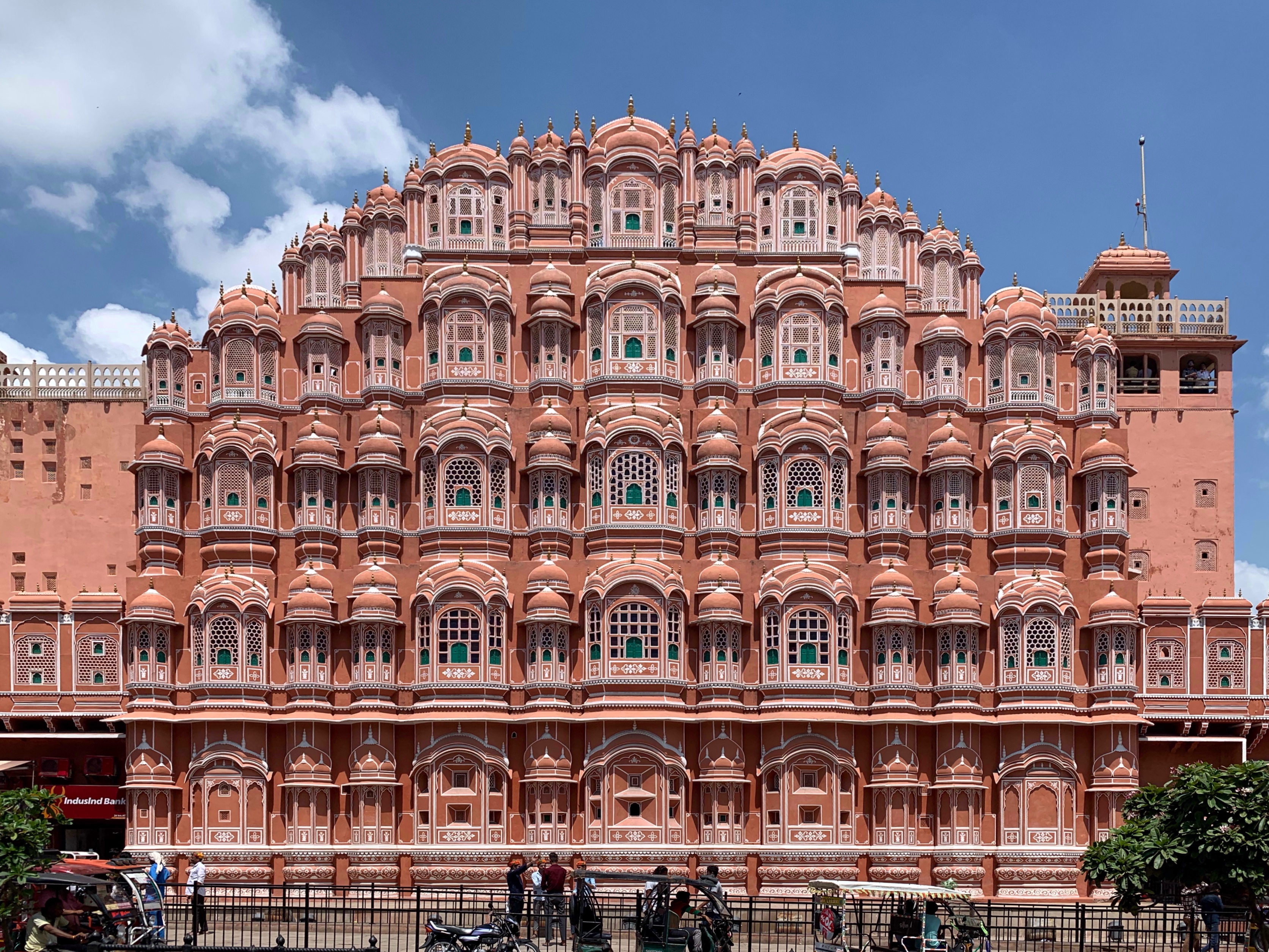
    Hava Mahal is a five-storey palace of pink sandstone in the old city of Jaipur. Its 953 small windows let the royal ladies watch the street unseen.

    Hava Mahal, usually spelled Hawa Mahal and meaning Palace of Winds, is one of the most recognisable buildings in India: a five-storey facade of pink sandstone with 953 small latticed windows, rising in the old city of Jaipur like a giant honeycomb or the crown of the god Krishna. It was built in 1799 for the ladies of the royal household, so that they could watch the street festivals without being seen, and today Hava Mahal is the symbol of Jaipur, the Pink City, and the first stop for most visitors to Rajasthan. This guide explains what Hava Mahal is, why it was built, how its windows cool it, and how to visit it.

    Quick Facts

    Item Detail
    Location Hawa Mahal Road, Badi Choupad, old city of Jaipur, Rajasthan, India
    Coordinates 26.924° N, 75.82672° E
    Name Hava Mahal, usually spelled Hawa Mahal; “Palace of Winds”
    Built 1799, by Maharaja Sawai Pratap Singh; architect Lal Chand Ustad
    Architecture 5 storeys, 953 small windows (jharokha), pink and red sandstone, about 15 m high
    Part of An extension of the City Palace complex
    Ticket 100 INR for Indian visitors, 600 INR for foreign visitors, from 1 January 2026
    Hours Opens daily at 9:00; closing time varies, check on the day
    UNESCO Not a World Heritage site in its own right; Jaipur was listed as a heritage city in 2019
    Wikidata Q836531

    Hava Mahal stands at Badi Choupad, the great crossroads of the old city of Jaipur, facing the rooftop cafes where visitors sit to look at the palace facade. The facade faces east, so it takes the morning sun, and photographs of Hava Mahal are at their best early in the morning, when the pink sandstone glows. Behind the facade, which is thin like a screen, the palace holds only a few small rooms joined by ramps, with no stairs, and a small museum on the ground floor.

    Jaipur is the capital of Rajasthan, founded in 1727 by Maharaja Sawai Jai Singh II and laid out on a grid with wide streets. In 1876 the whole city was painted pink to welcome the Prince of Wales, later King Edward VII, and the name Pink City was born. Hava Mahal is part of the City Palace complex, at the centre of the old city, near Johari Bazaar and Badi Choupad.

    Geography of Hava Mahal

    Hava Mahal stands at the centre of the old city of Jaipur, in Rajasthan, in the north-west of India, about 280 km south-west of Delhi and about 240 km west of Agra. Jaipur stands on a plateau at about 430 m, with a dry and hot climate: the summer, from April to June, often passes 40 degrees, the winter, from December to February, is cool at about 15 to 25 degrees, and the monsoon rain falls mainly from July to September.

    The old city of Jaipur is ringed by a wall with seven gates, and Hava Mahal stands on the main axis of the old city, between the City Palace and the markets. From Hava Mahal, the City Palace, Jantar Mantar, the 18th-century observatory and a UNESCO site, and Johari Bazaar, famous for jewellery and cloth, are all a few minutes on foot. The other sights of Jaipur, Amber Fort about 11 km to the north, Jal Mahal, the palace in the lake, and Jaigarh Fort, are all day trips from the old city.

    The facade of Hava Mahal faces east, and that direction decides the best time to see it. In the morning the sun strikes the pink sandstone directly, and the colour glows. In the late afternoon the sun moves to the west, the facade darkens, and the rooftop cafes opposite become the place to watch the sunset. The palace stands on Badi Choupad, a wide crossroads, so the facade can be seen whole from the street, which is rare in the narrow lanes of the old city.

    The ground under Jaipur is dry and high, and the city was planned on a grid, so the streets around Hava Mahal are wide and straight by the standards of an Indian old city. The palace’s position, at the meeting point of the City Palace, the markets and the main road, is the reason it became the symbol of the city: it is the building that every visitor passes, whether they come to shop, to see the palace or to watch a festival.

    The old city of Jaipur was laid out on a grid, with wide streets and a wall with seven gates, and Hava Mahal stands on the main axis of that grid. The plan was drawn by the founder, Sawai Jai Singh II, and it is still easy to read: the City Palace at the centre, the markets along the main roads, and the great crossroads of Badi Choupad where Hava Mahal stands. The grid makes the old city easier to walk than most Indian old cities, and the palace is the landmark that orients every walk.

    Badi Choupad, the crossroads at the foot of Hava Mahal, is one of the widest open spaces in the old city. The facade can be seen whole from the street, which is rare in the narrow lanes of the old city, and the rooftop cafes opposite exist because of that open view. The crossroads is also a market: stalls sell cloth, jewellery, souvenirs and street food, and the area is crowded in the evening, when the shops light up and the palace facade darkens.

    To the north of the old city, the land rises towards Amber Fort, about 11 km away, and the hills around Amber hold Jaigarh Fort and the old capital before Jaipur was founded. The plateau of Jaipur, at about 430 m, gives the city its dry air and its wide skies, and the pink sandstone of the city comes from the same land. The old city, the forts on the hills and the lake palace of Jal Mahal belong to one landscape, and Hava Mahal stands at the centre of it.

    A view of Hawa Mahal, Jaipur, Rajasthan

    A view of Hawa Mahal, Jaipur, Rajasthan — CC BY-SA 3

    History of Hava Mahal

    A viewing platform for the ladies of the court

    Hava Mahal was built in 1799 by Maharaja Sawai Pratap Singh, about 70 years after his grandfather, Maharaja Sawai Jai Singh II, founded the city of Jaipur. The palace was designed by the architect Lal Chand Ustad, as an extension of the City Palace, for the ladies of the royal household alone. The palace was not a residence and not a temple: it was a place from which to watch the city.

    Under the purdah custom of the Rajput court, the ladies of the royal household could not appear in public. Hava Mahal solved this with 953 small windows, called jharokha, fitted with fine stone lattice: from inside, the ladies could watch the festivals, the processions and the street life below without anyone seeing them. At the same time, the hundreds of small windows create a Venturi effect, as the wind passes through the openings and cools the inside of the palace, like a natural air-conditioning system in the hot Rajasthan summer. The name Palace of Winds comes from this effect.

    The crown of Krishna

    The five-storey facade of Hava Mahal was designed to look like the crown of the god Krishna, whom Maharaja Sawai Pratap Singh worshipped. The five storeys narrow as they rise, with the top storey the smallest, forming a softly curved pyramid. The pink and red sandstone is the characteristic material of Jaipur, the same colour as the whole city, and the facade’s colour is the reason the palace is photographed so often.

    Inside, Hava Mahal is far simpler than its splendid outside: small rooms, narrow corridors and ramps in place of stairs, a design that suited the movement of the ladies in traditional dress. The ground floor today holds a small museum with objects about the history of the palace and the Jaipur court. On the top storey, visitors look out over the old city of Jaipur, with its pink roofs and Badi Choupad below.

    Hava Mahal was restored many times in the 20th and 21st centuries, including a large restoration in the 2000s. In 2019 Jaipur was listed by UNESCO as a World Heritage city, and Hava Mahal is one of the characteristic buildings of that heritage city, although the palace itself holds no UNESCO listing of its own. The restoration work has kept the sandstone facade standing in the middle of a busy crossroads, where traffic, dust and heat wear at the stone every day.

    The restoration of Hava Mahal in the 2000s, and the small museum on the ground floor, turned the palace from a royal viewing platform into a public monument. The museum displays objects about the history of the palace and the Jaipur court, and it gives visitors the story of the building before they climb the ramps. The palace’s place in the City Palace complex is part of that story: Hava Mahal was never a separate palace, but an extension of the royal household, built so that the ladies of the court could take part in the life of the city without leaving the palace.

    Timeline

    • 1727: Maharaja Sawai Jai Singh II founds the city of Jaipur.
    • 1799: Maharaja Sawai Pratap Singh builds Hava Mahal; the architect is Lal Chand Ustad.
    • 1876: Jaipur is painted pink to welcome the Prince of Wales, and the name Pink City is born.
    • 20th century: Hava Mahal is restored many times and opens to visitors.
    • 2019: Jaipur is listed by UNESCO as a World Heritage city.
    • 1 January 2026: The Rajasthan government revises the ticket prices for monuments, including Hava Mahal.

    Travel in Hava Mahal

    The best time to visit Jaipur is from November to February, when the weather is cool at 15 to 25 degrees, dry and good for walking in the old city. March is also fine, but it grows hotter, and April to June is the hottest season, with temperatures often above 40 degrees, so avoid sightseeing outdoors at midday. The monsoon, from July to September, cools the heat but can flood parts of the old city.

    Hava Mahal is at its best early in the morning: the facade faces east and takes the sun, the pink sandstone glows, and Badi Choupad is not yet crowded. Arrive before 9:00 to queue for a ticket or book online through the OBMS portal of Rajasthan Tourism, then look at the facade from the opposite side before going inside. In the late afternoon the light moves to the west, the facade darkens, and the rooftop cafes opposite are the place to watch the sunset.

    The ticket for Hava Mahal, under the revision by the Rajasthan government from 1 January 2026, is 100 INR for Indian visitors and 600 INR for foreign visitors, with a discount for students who show a card. Confirm the current price at the gate, because the list can change. Tickets are sold at the counter and online through the OBMS portal of Rajasthan Tourism. A combined Jaipur ticket, covering several monuments of the city, is also available.

    Inside Hava Mahal, visitors follow the ramps up through each storey, past small rooms with latticed windows looking down on the street. The ground floor holds the small museum, and the upper storeys hold empty rooms with finely carved lattice window frames, which are the main place for photographs. Allow about one to one and a half hours for the visit inside; most visitors spend longer outside, looking at the facade from the street and from the cafes opposite.

    Looking at Hava Mahal from outside

    For many visitors, the most memorable experience of Hava Mahal is not inside but opposite: the rooftop cafes along Hawa Mahal Road give a straight view of the 953-window facade, especially beautiful in the morning when the sun strikes the pink stone. These cafes are busy at peak hours, so come early or book a table ahead in the tourist season. Badi Choupad, right at the foot of the palace, is part of the experience too: stalls sell cloth, jewellery, souvenirs and street food, and the area is very crowded in the evening, so keep belongings safe and agree prices before buying.

    Hava Mahal sits in the walkable part of the old city, so combine the visit with the City Palace, Jantar Mantar and Johari Bazaar in the same morning or the same day. From Delhi, take a train or a bus for about five to six hours to Jaipur; Jaipur airport has domestic flights from Delhi, Mumbai and other large cities. From the airport to the old city takes about 30 to 40 minutes by taxi. Inside the old city, walking, tuk-tuk or cycle rickshaw is easiest, because large cars move with difficulty in the narrow streets.

    The east facade of Hawa Mahal in Jaipur

    The east facade of Hawa Mahal in Jaipur — CC BY-SA 4

    Highlights of Hava Mahal

    The highlights of Hava Mahal are the five-storey facade with its 953 windows, the ramps and viewing rooms inside, and the small museum on the ground floor. The facade, of pink and red sandstone, with finely carved lattice jharokha windows, narrowing towards the top like the crown of Krishna, is one of the most photographed facades in India. The ramps and viewing rooms show that Hava Mahal was built to be used, not only to be looked at: the royal ladies walked the ramps, stopped at the lattice windows and watched the street festivals without being seen.

    The small museum on the ground floor displays objects about the history of the palace, the Jaipur court and Rajput architecture, a short stop that helps visitors understand the building before climbing the ramps. The City Palace stands right beside Hava Mahal, a complex of courtyards, museums and collections of weapons and royal dress. Jantar Mantar, a few minutes on foot, is a giant stone observatory built in 1734 under Sawai Jai Singh II, a UNESCO World Heritage site with the largest stone sundial in the world. Amber Fort, about 11 km north of the old city, holds the Sheesh Mahal, the Palace of Mirrors, and looks over Maota Lake, and it is the most popular half-day trip from Jaipur.

    Frequently Asked Questions

    Where is Hava Mahal?

    On Hawa Mahal Road, Badi Choupad, in the old city of Jaipur, Rajasthan, India, facing the rooftop cafes and near the City Palace and Jantar Mantar.

    When was Hava Mahal built?

    In 1799, by Maharaja Sawai Pratap Singh, the grandson of the founder of Jaipur. The architect was Lal Chand Ustad.

    Why does Hava Mahal have 953 windows?

    So that the ladies of the royal household could watch the street festivals without being seen, under the purdah custom, and so that the wind passing through the windows would cool the palace, which is the origin of the name Palace of Winds.

    How much is the ticket for Hava Mahal?

    Under the revision from 1 January 2026, the ticket is 100 INR for Indian visitors and 600 INR for foreign visitors. Ask at the gate for the current list, since prices are revised from time to time.

    Is Hava Mahal a UNESCO World Heritage site?

    No, the palace itself holds no UNESCO listing of its own. But Jaipur was listed by UNESCO as a heritage city in 2019, and Hava Mahal is one of the characteristic buildings of that city.

    What is the Wikidata code for Hava Mahal?

    Q836531, for Hava Mahal, a palace in Jaipur, Rajasthan, India, at 26.924° N, 75.82672° E.

    Verified

    Checked 20 November 2026. The figures in this article, from the 1799 building and the 953 windows to the 2019 listing of Jaipur and the ticket prices from 1 January 2026, were matched against the sources below, and the spelling note records that the registry keyword file gives “hava mahal” while the standard spelling is “hawa mahal”.

    Sources

    • Hava Mahal built 1799 by Maharaja Sawai Pratap Singh, architect Lal Chand Ustad, 5 storeys, 953 small windows (jharokha), pink and red sandstone, crown of Krishna, built for the ladies of the royal household under purdah, wind cooling effect: https://en.wikipedia.org/wiki/Hawa_Mahal
    • Ticket prices from 1/1/2026: 100 INR for Indian visitors, 600 INR for foreign visitors, student discount; combined Jaipur ticket; online booking through the OBMS portal of Rajasthan Tourism; from 2026 travel guides matched against the Rajasthan government notice
    • Jaipur founded 1727 by Sawai Jai Singh II, painted pink in 1876 to welcome the Prince of Wales, UNESCO listed the city in 2019: https://en.wikipedia.org/wiki/Jaipur
    • India on the UNESCO list of States Parties: https://whc.unesco.org/en/statesparties/in
    • Coordinates 26.924° N, 75.82672° E, Wikidata Q836531: Wikidata API, checked 20 November 2026
    • Taj Mahal, Sheesh Mahal, Kathmandu and Lahore: TheTerraAtlas registry, checked 20 November 2026
    • Keywords: batch8-en-keywords.json, TA-L4-hawa-mahal, checked 20 November 2026; the registry keyword file records “hava mahal” as the main keyword and notes that the standard spelling “hawa mahal” did not appear in that measurement round

    Not Yet Verified

    • Opening hours: 2026 guides give different closing times, 9:00-17:00, 9:00-18:30 or 9:00-16:30; this article gives only the 9:00 opening and daily opening, and says to check the closing time on the day.
    • The ticket prices of 100 and 600 INR follow the revision from 1/1/2026 as reported by 2026 travel guides matched against the Rajasthan government notice; the OBMS portal was not read directly in this round, so check the price list at the gate before going.
    • The height of the palace, about 15 m, follows travel guides; some sources give other figures.
    • The combined Jaipur ticket and the student discount change with each revision; check at the ticket counter.
    • The name of the architect, Lal Chand Ustad, follows Wikipedia; some sources give Lal Chand Ustad or Lal Chand.

    Illustrations

    • Hero: Hava Mahal is a five-storey palace of pink sandstone in the old city of Jaipur. Free image: https://upload.wikimedia.org/wikipedia/commons/7/7e/Hava_mahal%2C_Jaipur%2C_India.jpg — CC BY-SA 4.0.
    • In body, view: A view of Hawa Mahal, Jaipur, Rajasthan. Free image: https://upload.wikimedia.org/wikipedia/commons/c/cb/A_view_of_Hawa_Mahal%2C_Jaipur%2C_Rajasthan.JPG — CC BY-SA 3.
    • In body, view: The east facade of Hawa Mahal in Jaipur. Free image: https://upload.wikimedia.org/wikipedia/commons/4/41/East_facade_Hawa_Mahal_Jaipur_from_ground_level_%28July_2022%29_-_img_01.jpg — CC BY-SA 4.
  • タージマハル — ヤムナー川のほとりに立つ白い霊廟:シャー・ジャハーンの愛とムガル建築の頂点

    タージマハル — ヤムナー川のほとりに立つ白い霊廟:シャー・ジャハーンの愛とムガル建築の頂点

    タージマハルは、インド北部アグラのヤムナー川南岸に立つ白大理石の霊廟である。タージマハルは、ムガル帝国第5代皇帝シャー・ジャハーンが1631年に亡くなった最愛の妃ムムターズ・マハルをしのんで建てた建造物で、1983年にユネスコ世界遺産に登録された。

    白い大理石のドームは、朝には淡い桃色に、昼にはまぶしい白に、夕方には金色に染まる。川の対岸から眺めると、水面に映る姿まで含めて一枚の絵になる。2007年には世界の人々の投票で新・世界七不思議の一つに選ばれた。満月の夜には、月光を受けた白い姿が川面に映る。

    内部には二つの石棺が並ぶが、どちらも象徴的なもので、実際の遺体は地下の墓室に眠る。完璧な左右対称のなかで、皇帝自身の棺だけが対称を破っている点も、訪れる人の心をとらえる。

    クイックプロフィール

    項目 内容
    名称 タージマハル(Taj Mahal)
    位置 インド・ウッタル・プラデーシュ州アグラ、ヤムナー川南岸
    座標 北緯27.175度、東経78.0419度
    建設 1632年から1653年、中心の霊廟は1648年ごろ完成
    発注者 ムガル帝国第5代皇帝シャー・ジャハーン
    設計 ウスタード・アフマド・ラーホーリー
    高さ 73メートル(地面からドーム頂点まで)
    材料 マクラーナ産の白大理石、赤砂岩
    世界遺産 1983年登録、文化遺産基準(i)、登録番号252、面積22.44ヘクタール
    来訪者 2022年度から2023年度にかけて年間約500万人
    Wikidata Q9141

    タージマハルの地理

    ヤムナー川の南岸とアグラの街

    霊廟は、ヤムナー川の南岸に立つ。川の流れは北側で大きく曲がり、建物の正面は川に向かって開けている。対岸のメヘターブ・バーグからは、川越しに全体像を望むことができ、夕日を浴びた姿はとくに美しいとされる。

    アグラは首都ニューデリーの南およそ200キロメートルに位置する。ヤムナー高速道路を使えば、車で3時間もかからない。かつてムガル帝国の都だったこの街には、世界遺産のアグラ城塞も残る。

    城塞からは霊廟までおよそ1.6キロメートルしか離れていない。川沿いの道をたどれば、城塞の窓から白いドームが望める。晩年の皇帝がその窓から眺め続けた景色が、いまも目の前に広がる。

    300メートルの石の台座と四分庭園

    敷地全体は、長さおよそ300メートル、高さ9メートル近い石の台座の上に広がる。赤砂岩の正門をくぐると、ペルシャ式の四分庭園チャールバーグが霊廟まで続く。四つの区画は水路で分けられ、イスラムの伝承における楽園の四つの川を象徴する。

    中心軸に沿って細長い池が伸び、風のない朝には正面の姿がほぼ完全な形で水面に映る。左右対称の設計は庭園にも徹底され、植栽と水路と歩道がすべて鏡合わせに配置されている。

    四隅には高さ40メートルを超える尖塔が立つ。わずかに外側へ傾けて建てられており、万が一倒れても霊廟の外側へ倒れるよう計算された。白いドームと赤い建物の対比が、敷地全体の色彩のリズムを作る。

    デリーからアグラへ:川と平野の風景

    アグラ周辺は、ガンジス平野の西端に広がる平坦な土地である。ヤムナー川は街の東側を流れ、川岸の土手には緑が残る。乾季には川の水位が下がり、対岸の土手がよく見える。

    モンスーンの時期には、川の水かさが増し、庭園の池にも雨が満ちる。白い大理石は雨上がりにいっそう鮮やかに見える。川霧の立ちこめる冬の朝は、ドームが霧のなかから浮かび上がる幻想的な光景になる。

    周辺の村々では、大理石細工の工房が今も営まれている。職人の手で刻まれる花の模様は、17世紀の技法を受け継ぐものだ。川と平野と職人の街が、霊廟の背景を作っている。

    霊廟を取り巻く川岸の眺め

    川の北岸に立つと、霊廟の正面が川面とともに一枚の絵になる。南岸の庭園からは、川の流れと対岸の緑が一続きの風景になる。どちらから見ても、水辺の立地が建物の魅力を高めている。

    周辺の川岸には、かつてのムガル時代の庭園跡が点在する。メヘターブ・バーグはその一つで、月夜の庭園として知られた。川岸の遊歩道からは、霊廟と川と空の三層の景色が楽しめる。

    アグラの気候と訪れる季節

    アグラの気候は、夏の酷暑と冬の朝霧が対照的である。夏の日中は40度を超えることもあり、屋外の散策には早朝の時間が適する。冬は朝晩が冷え込み、川霧が立ちこめる日が多い。

    霧の朝は視界が限られるが、霧が晴れる瞬間に白い姿が現れる光景は格別だ。雨期のモンスーンには夕立が多く、雨上がりの大理石は色が深まる。観光のベストシーズンは、暑さが和らぐ10月から3月ごろとされる。

    この時期は空気が澄み、川岸の散歩にも適する。乾季の青空を背景にした白いドームは、写真の色がいっそう鮮やかになる。季節ごとに表情を変える点も、繰り返し訪れる人を飽きさせない理由だ。

    赤砂岩の建物群と川岸の広がり

    霊廟の両脇には、赤砂岩のモスクと迎賓館が対になって立つ。西側がモスクで、東側が同じ意匠の迎賓館である。赤と白の対比が、敷地全体の色彩設計を完成させる。

    川岸の土手からは、霊廟とモスクと庭園が一続きの景色になる。敷地の外側にもムガル時代の庭園跡が残り、川沿いの緑が街のなかの静けさを保つ。川の流れと赤い建物と白いドームが、川岸の風景の三つの層を作る。

    周辺の道は、観光客でにぎわう通りと、静かな住宅地が隣り合う。土産物店が並ぶ通りを抜けると、突然川岸の開けた景色に出会う。街の喧騒と川岸の静けさの落差が、訪れる人の印象に残る。

    ピエトラ・ドゥーラの花模様の風景。

    ピエトラ・ドゥーラの花模様の風景。 — CC BY 4

    タージマハルの歴史

    妃の死と皇帝の誓い

    ムムターズ・マハルは1631年、第14子を産んだのち38歳で亡くなった。伝承によれば、臨終の床で夫にふさわしい墓を建てるよう願った。皇帝はその言葉を、誰も想像しなかった規模で実現した。

    帝国の最良の職人が集められ、ペルシャやトルコ、中央アジアからも技術者が招かれた。白大理石はラージャスターンのマクラーナから運ばれ、象の隊列が何年もかけて石材を運んだという記録が残る。

    建設は1632年に始まり、中心の霊廟は1648年ごろに完成した。付属の建物や庭園を含めた全体の完成は1653年ごろとされる。20年を超える歳月と莫大な費用が、一つの墓に注がれた。

    大理石、宝石、そして書道

    表面は単なる白ではない。半貴石を象嵌するピエトラ・ドゥーラの技法で、瑪瑙や翡翠、トルコ石、珊瑚の花模様が壁面に描かれる。近くで見ると、石の花びら一枚一枚が別の石でできていることがわかる。

    門と正面に刻まれたアラビア文字の書道は、クルアーンの一節である。高い位置の文字ほど大きく彫られており、下から見上げるとすべての文字が同じ大きさに見える工夫が施された。

    中央のドームは地面から73メートルに達し、正方形の基部の上にのる。四つの面はほぼ同一の意匠で、どの方角から見ても正面に見える。内部の二つの石棺は象徴的なもので、実際の遺体は地下の墓室に安置されている。

    廃位された皇帝と最後のまなざし

    1658年、息子アウラングゼーブが父を廃位した。皇帝はアグラ城塞に8年間幽閉され、川の向こうの霊廟を眺めて余生を送った。1666年に亡くなると、妃の隣に葬られた。

    皇帝の棺は、もともと一人用に設計された霊廟の対称性を唯一破るものである。そのずれこそが、この建物の物語を語る。愛の記念碑として始まり、喪失と幽閉の記憶を抱えて完成した。

    年表

    年 出来事
    1631年 ムムターズ・マハルが死去する
    1632年 霊廟の建設が始まる
    1648年ごろ 中心の霊廟が完成する
    1653年ごろ 庭園と付属建物を含め全体が完成する
    1658年 シャー・ジャハーンが廃位されアグラ城塞に幽閉される
    1666年 皇帝が死去し妃の隣に葬られる
    1983年 ユネスコ世界遺産に登録される
    2007年 新・世界七不思議の一つに選ばれる

    世界遺産への道と保存の取り組み

    19世紀のイギリス統治期には、建物の修復が進められた。庭園の植栽も整えられ、今日の姿の基礎ができた。独立後のインドでは、考古調査局が管理を引き継ぎ、保存と公開の両立を図ってきた。

    大気汚染による大理石の黄変は、長年の課題である。周辺の工場の規制や、敷地近くでの車両の制限が導入された。大理石の表面は定期的に洗浄され、白さを保つ努力が続けられている。

    1983年の世界遺産登録は、こうした保存の歩みを世界に認めたものだった。登録基準は文化遺産(i)で、建築の傑作としての価値が評価された。登録面積は22.44ヘクタールである。

    新・世界七不思議と現代の評価

    2007年、世界中の人々の投票で新・世界七不思議の一つに選ばれた。古代の七不思議にならう企画で、現代の人々が選ぶ世界の名所として名を連ねた。この結果は、インドの観光の象徴としての地位をさらに高めた。

    ユネスコは、同廟を「インドにおけるイスラム美術の宝石であり、世界中で賞賛される傑作」と表現している。建築史の教科書では、ムガル建築の頂点として紹介される。ペルシャ、インド、イスラムの伝統が融合した点が、評価の核にある。

    現代では年間約500万人が訪れる。インド国内からの参拝者と、世界中からの観光客が、同じ白い姿を眺める。愛の物語と建築の美しさが、時代を超えて人を集め続けている。

    タージマハルの観光

    朝と夕方、二つの顔

    早朝の入場は、日の出前の30分から始まる。朝の光が大理石を淡い桃色に染める時間は、写真を撮る人に人気がある。夕方は日没の30分前までで、金色に変わるドームを眺める最後の時間になる。

    金曜日は休館日である。週末の混雑を避けたい場合は、平日の早朝がねらい目だ。入場にはチケットが必要で、オンラインでの購入もできる。料金は国籍や区分によって異なるため、公式サイトで最新情報を確認するのが確実だ。

    内部の見学と庭園の散策

    内部は薄暗く、石棺のまわりに透かし彫りの大理石の柵がめぐる。内部の写真撮影は制限されることがある。内部の滞在は短時間で、庭園と建物の外観をゆっくり楽しむ人の方が多い。

    庭園の池のほとりは、正面の姿を水面とともに見る定番の場所だ。南側の正門から入ると、門の枠越しに霊廟が見える仕掛けがある。庭園を一周すると、四つの区画と水路の対称美が実感できる。

    アグラ城塞と川の対岸をめぐる

    アグラ城塞は、霊廟と並ぶ世界遺産で、川沿いの道をたどればすぐ着く。城塞の窓からは、1.6キロメートル先の白いドームが望める。晩年の皇帝が見たのと同じ景色を、ここで確かめられる。

    川の対岸のメヘターブ・バーグは、夕日の名所である。日が沈むころ、川面に映る霊廟の影が長く伸びる。イティマード・ウッダウラー廟は「小さなタージマハル」と呼ばれ、同じ川沿いに立つ。アグラ観光は、霊廟と城塞と川岸の三つを組み合わせると充実する。

    写真撮影のポイントと心得

    正面の姿を水面とともに撮るなら、庭園の池のほとりが定番である。早朝は水面が穏やかで、反射が最も鮮明になる。夕方は金色に染まるドームを、川の対岸から狙うのがよい。

    正門をくぐると、門の枠越しに霊廟が見える。額縁のような構図は、多くの人が最初に撮る一枚だ。内部では撮影が制限される場合があるため、現地の掲示と係員の指示に従う。

    敷地内では、ほかの来訪者の妨げにならないよう配慮する。三脚の使用は制限されることがある。写真よりもまず、自分の目で白い姿を眺める時間を取るのがおすすめだ。

    白大理石のドームと四つの尖塔の風景。

    白大理石のドームと四つの尖塔の風景。 — CC BY-SA 2

    タージマハルの見どころ

    白大理石のドームと四つの尖塔

    高さ73メートルのドームは、玉ねぎ形の優美な曲線で知られる。ドームの頂点には金の装飾がのり、青空を背景に白さがいっそう際立つ。近くで見ると、大理石の表面に細かい模様が刻まれている。

    四隅の尖塔は40メートルを超え、わずかに外傾している。倒壊時の安全を考えた設計は、17世紀の技術者の知恵を示す。ドームと尖塔の組み合わせが、遠くからでもわかる姿を作っている。

    ピエトラ・ドゥーラの花模様

    壁面の花模様は、半貴石を大理石にはめ込む技法で作られた。瑪瑙の赤、翡翠の緑、トルコ石の青が、白い下地の上で花を咲かせる。近くで見なければ、絵の具で描いたものと区別がつかないほど精密だ。

    模様の題材は、インドの庭園に咲く花々である。花びら一枚に複数の石が使われ、色の濃淡が表現される。17世紀の職人技は、400年後のいまも色あせていない。

    書道と対称の美学

    アラビア文字の書道は、門と正面の黒大理石に刻まれた。文字の大きさは高さに応じて調整され、下から見ると均一に見える。書道と建築が一体となった装飾は、ムガル建築の特徴である。

    建物の四面はほぼ同一で、どこから見ても正面になる。庭園の水路と植栽まで対称に配置され、敷地全体が一つの幾何学図形のようだ。唯一の非対称である皇帝の棺が、その完璧さのなかで物語を語る。

    メヘターブ・バーグからの夕景

    川の対岸の庭園からは、霊廟の正面全体が見渡せる。夕方になると、大理石が金色から桃色へと色を変える。川面の反射とあわせて、最も絵になる瞬間だ。

    庭園はかつて月夜の庭園として知られ、満月の夜には白い姿が川に映ったという。いまは夕日の名所として多くの人が訪れる。霊廟を正面から見る庭園の池とは異なる、川越しの眺めがここにある。

    メヘターブ・バーグから望む夕日のタージマハル。

    メヘターブ・バーグから望む夕日のタージマハル。 — CC BY-SA 4

    アグラの職人と大理石細工

    周辺の工房では、大理石への象嵌細工が今も続けられている。職人の手元では、半貴石を切り、磨き、白い石にはめ込む作業が見られる。小さな置物から大きな飾り板まで、技法は霊廟と同じである。

    工房を訪ねると、400年続く技術の継承が実感できる。アクバル廟やシーシュ・マハルなど、アグラのほかのムガル建築も、同じ職人文化のなかで生まれた。

    赤砂岩のモスクと迎賓館

    西側のモスクは、赤砂岩の壁面に白大理石の象嵌が施された建物である。祈りの場として今も使われ、内部は礼拝の時間に静けさに包まれる。東側の迎賓館は、モスクと対称の姿で立ち、対称美を完成させる役割を担う。

    二つの建物があることで、中央の霊廟の白さがいっそう際立つ。赤と白のコントラストは、敷地全体の設計意図である。庭園の緑と川の青が加わり、四つの色が一枚の絵を作る。

    タージマハルの西側に立つ赤砂岩のモスク。

    タージマハルの西側に立つ赤砂岩のモスク。 — CC BY 4

    正門の額縁に収まる一枚

    赤砂岩の正門は、単なる入口ではない。門のアーチをくぐると、正面に白いドームが額縁のなかに収まる仕掛けがある。歩みを進めるほど、姿が大きくなる。

    門の内部は薄暗く、光のトンネルを抜けた先に白い輝きが現れる。設計者の意図した驚きが、400年後のいまも訪れる人をとらえる。門を出るとき、振り返ってもう一度眺める人も多い。

    タージマハルの大門の姿。

    タージマハルの大門の姿。 — CC BY 4

    庭園の水路と四季の花

    四分庭園の水路は、楽園の四つの川を象徴する。細い水路に水が流れ、区画ごとに異なる植栽が配置される。春には花が咲き、夏には木陰が涼しさを運ぶ。

    水路の水は、霊廟の正面の池へとつながる。池の水面が、建物の姿を映す鏡になる。風のない朝の反射は、庭園設計の意図が最もよく伝わる瞬間だ。

    植栽は時代とともに手を入れられ、いまの姿は19世紀以降の整備を受け継ぐ。花と水と石の三つの要素が、乾いた平野のなかに楽園の情景を作る。庭園を歩く時間は、建物を見る時間と同じくらい大切だ。

    月夜の大理石と保存の白さ

    満月の夜、敷地が特別に開かれることがある。月光を受けた大理石は、昼とは違う柔らかい輝きを放つ。月夜の観覧は人数が限られ、川の対岸の庭園から眺める人も多い。

    大理石の白さを保つため、表面の洗浄が定期的に行われている。大気汚染による黄変を防ぐため、周辺の工場への規制や車両の制限も導入された。保存の努力があってこそ、400年後のいまも白い輝きが保たれている。

    石の表面には、細かい結晶のきらめきがある。近くで見ると、石そのものが光を含んでいるように見える。遠くから見た白さと、近くで見た質感の違いも、訪れる人の楽しみだ。

    よくある質問

    タージマハルとは何ですか

    ムガル皇帝シャー・ジャハーンが、1631年に亡くなった妃ムムターズ・マハルのために建てた白大理石の霊廟である。1632年に着工し、中心の霊廟が1648年ごろに姿を現した。

    1983年にユネスコ世界遺産に登録され、2007年に新・世界七不思議の一つに選ばれた。白大理石のドームと四つの尖塔、ペルシャ式の四分庭園が、ムガル建築の頂点として世界に知られている。

    タージマハルの内部はどうなっていますか

    内部には妃と皇帝の二つの石棺が並ぶが、どちらも象徴的なもので、実際の遺体は地下の墓室にある。内部は薄暗く、透かし彫りの大理石の柵が石棺を囲む。写真撮影は制限される場合があるため、現地の案内に従うのがよい。

    タージマハルの歴史を教えてください

    1631年に妃が亡くなり、1632年に建設が始まった。中心の霊廟は1648年ごろ、全体は1653年ごろに完成した。

    1658年に皇帝は息子に廃位され、アグラ城塞に幽閉された。1666年に亡くなり、妃の隣に葬られた。1983年に世界遺産に登録された。

    タージマハルの大きさはどれくらいですか

    ドームの頂点までの高さは73メートルである。四隅の尖塔は40メートルを超える。敷地の石の台座は長さおよそ300メートル、高さ9メートル近い。白大理石はラージャスターンのマクラーナから運ばれた。

    タージマハルのチケットはどう買えますか

    チケットは現地の窓口とオンラインの両方で購入できる。料金は国籍や区分によって異なるため、購入前に公式サイトで確認するのが確実だ。

    金曜日は休館日である。入場は日の出の30分前から日没の30分前までで、早朝の時間帯は比較的空いている。オンライン購入では入場の待ち時間を短くできる場合がある。

    タージマハルへの行き方はどうなっていますか

    アグラはニューデリーの南およそ200キロメートルにある。ヤムナー高速道路を使えば車で3時間もかからない。鉄道でアグラ駅に着いてから車で向かう方法もある。

    市内ではアグラ城塞から川沿いに1.6キロメートルほどで、対岸のメヘターブ・バーグへは橋を渡る。デリーからの日帰りも可能だが、朝と夕方の二つの顔を見るなら一泊するのがおすすめだ。

    検証済み

    ここに記した年号と数値は、ユネスコ世界遺産センターの登録情報とブリタニカの解説を2026年11月17日に突き合わせて確かめた。登録は1983年12月9日、基準は文化遺産(i)、登録番号は252、面積は22.44ヘクタールである。建設は1632年に始まり、中心の霊廟は1648年ごろ、全体は1653年ごろに完成した。設計者はウスタード・アフマド・ラーホーリーで、高さは73メートル、尖塔は40メートルを超える。

    座標は北緯27.175度、東経78.0419度で、アグラ城塞からの距離はおよそ1.6キロメートル、ニューデリーからの距離はおよそ200キロメートルである。2022年度から2023年度の来訪者は年間約500万人と記録されている。敷地の石の台座は長さおよそ300メートル、高さ9メートル近く、尖塔は40メートルを超えることも、同じ資料で確認した。

    情報源

    未検証

    入場料の具体的な金額は区分や時期によって変わるため、この記事では示していない。チケットのオンライン購入の手順も公式サイトで確認する必要がある。皇帝が黒大理石の第二の霊廟を計画したという伝承は、裏づける史料がなく、伝承としてのみ伝わっている。敷地内の植栽の種類や庭園の修復の詳細も、公式の記録を確認できていない。

    月夜の特別観覧の開催日や人数も時期によって変わるため、公式サイトでの確認が必要である。夜間の観覧は満月の前後に限られることが多い。

    Illustrations

    • Hero: タージマハルの外観。Free image: https://upload.wikimedia.org/wikipedia/commons/6/68/Taj_Mahal%2C_Agra%2C_India.jpg?utm_source=commons.wikimedia.org&utm_campaign=imageinfo&utm_content=original — CC BY-SA 4.
    • In body, 白大理石のドームと四つの尖塔: 白大理石のドームと四つの尖塔の風景。Free image: https://upload.wikimedia.org/wikipedia/commons/a/a0/Agra_31_-Red_Fort%2C_Jasmine_Tower%2842262965311%29.jpg?utm_source=commons.wikimedia.org&utm_campaign=imageinfo&utm_content=original — CC BY-SA 2.
    • In body, ピエトラ・ドゥーラの花模様: ピエトラ・ドゥーラの花模様の風景。Free image: https://upload.wikimedia.org/wikipedia/commons/0/0b/Taj_Mahal_Eternal%2C_Agra%2C_India.jpg?utm_source=commons.wikimedia.org&utm_campaign=imageinfo&utm_content=original — CC BY 4.
    • In body, メヘターブ・バーグからの夕景: メヘターブ・バーグから望む夕日のタージマハル。Free image: https://upload.wikimedia.org/wikipedia/commons/a/ab/Sunset_from_Mehtab_Bagh.jpg — CC BY-SA 4.
    • In body, 赤砂岩のモスクと迎賓館: タージマハルの西側に立つ赤砂岩のモスク。Free image: https://upload.wikimedia.org/wikipedia/commons/6/6d/Taj_Mahal_Mosque_2%2C_Agra%2C_India.jpg — CC BY 4.
    • In body, 正門の額縁に収まる一枚: タージマハルの大門の姿。Free image: https://upload.wikimedia.org/wikipedia/commons/6/6f/Taj_Mahal%2C_The_Great_Gate%2C_Agra%2C_India.jpg — CC BY 4.
  • Taj Mahal — das Marmorgrab der ewigen Liebe in Agra

    Taj Mahal — das Marmorgrab der ewigen Liebe in Agra

    Das Taj Mahal ist ein Mausoleum aus weißem Marmor in Agra in Indien. Shah Jahan ließ es für seine Frau Mumtaz Mahal erbauen.

    Das Taj Mahal erkennt fast jeder an einem einzigen Bild: eine weiße Kuppel, die sich in einem langen Wasserbecken spiegelt, vier kleine Türme an den vier Ecken. Es steht in der Stadt Agra im Bundesstaat Uttar Pradesh, am Südufer des Flusses Yamuna. Der Mogulkaiser Shah Jahan ließ das Grabmal für seine geliebte Frau Mumtaz Mahal errichten, und mehr als dreieinhalb Jahrhunderte später ist es das bekannteste Wahrzeichen Indiens in den Augen der Welt.

    Dieser Artikel beschreibt, wo das Taj Mahal steht, wie es gebaut wurde und was Besucher wissen müssen. Alle Angaben zu Zahlen und Daten beruhen auf geprüften Quellen, die am Ende des Artikels aufgelistet sind.

    Steckbrief

    Angabe Wert
    Lage Südufer des Flusses Yamuna, Stadt Agra, Bundesstaat Uttar Pradesh, Indien
    Koordinaten 27,175° N, 78,0419° O
    Bauwerk Mausoleum aus weißem Marmor im Mogulstil
    Bauherr Mogulkaiser Shah Jahan, zum Gedenken an Kaiserin Mumtaz Mahal
    Bauzeit 1632–1653, Hauptgrabmal etwa 1648 fertiggestellt
    Hauptarchitekt Ustad Ahmad Lahori
    Höhe 73 m vom Boden bis zur Spitze der Kuppel
    Hauptmaterial Weißer Marmor aus Makrana in Rajasthan, roter Sandstein für die Nebengebäude
    UNESCO-Welterbe Anerkennung 1983, Kulturerbe-Kriterium (i), Nummer 252
    Besucher Fast 5 Millionen im Geschäftsjahr 2022–23
    Wikidata Q-ID Q9141
    GeoNames Keine Angabe in den geprüften Quellen
    URL auf Deutsch /de/asien/indien/agra/taj-mahal/

    Die UNESCO hat das Taj Mahal als Juwel der islamischen Kunst in Indien und als eines der weltweit am meisten bewunderten Meisterwerke beschrieben. Im Jahr 2007 wurde es zu einem der sieben neuen Weltwunder gewählt. Hinter dem Ruhm steht eine traurige Geschichte: Ein Kaiser baute ein Grabmal für seine Frau und wurde am Ende seines Lebens von seinem eigenen Sohn im Fort von Agra gefangen gehalten.

    Von dort blickte er jeden Tag über den Fluss zum Taj Mahal, bis er starb. Diese Geschichte gehört zum Bauwerk dazu und erklärt, warum es mehr ist als ein schönes Gebäude.

    Geografie

    Das Taj Mahal steht am Südufer des Flusses Yamuna. Vom Fort von Agra, etwa 1,6 Kilometer westlich, konnte der Kaiser entlang des Flussufers direkt zum Grabmal seiner Frau blicken. Umgekehrt sieht man vom Garten Mehtab Bagh am Nordufer die gesamte Hauptfassade des Taj Mahal, die sich im Wasser spiegelt.

    Das ist einer der schönsten Blickwinkel überhaupt, besonders bei Sonnenuntergang. Die Frage Taj Mahal wo stellen deutsche Reisende oft zuerst, und die Antwort ist einfach: in Agra, etwa 200 Kilometer südlich von Neu-Delhi, am Fluss Yamuna.

    Die gesamte Anlage steht auf einer etwa 300 Meter langen Steinplattform, die fast 9 Meter über dem umliegenden Gelände liegt. Vom Haupttor aus rotem Sandstein erstreckt sich ein Garten im Charbagh-Stil bis zum Fuß des Grabmals. Charbagh bedeutet Vierergärten und ist eine Gartenform der persischen und mogulischen Architektur.

    Vier Gartenflächen werden durch Wasserkanäle getrennt, die für die vier Flüsse des Paradieses in der islamischen Tradition stehen. Entlang der Hauptachse liegt ein langes Wasserbecken, in dem sich die Fassade des Grabmals an windstillen Morgen fast vollkommen spiegelt.

    Agra liegt etwa 200 Kilometer südlich von Neu-Delhi und ist über die Yamuna-Schnellstraße in weniger als drei Stunden mit dem Auto zu erreichen. Die Stadt war einst die Hauptstadt des Mogulreichs und besitzt neben dem Taj Mahal auch das Fort von Agra, das ebenfalls UNESCO-Welterbe ist. Die Lage am Fluss war für den Bau entscheidend: Der Marmor kam über den Fluss, und der Fluss selbst gehört zum Bild des Bauwerks. Wer das Taj Mahal von innen sehen will, betritt zuerst den Garten und geht die lange Achse entlang, bis die Fassade vor einem steht.

    Die Yamuna ist mit 1.376 Kilometern der längste Nebenfluss des Ganges und nach der Abflussmenge sein zweitgrößter Zufluss. Sie entspringt dem Yamunotri-Gletscher in etwa 4.500 Metern Höhe am Südwesthang der Bandarpunch-Gipfel im Himalaya von Uttarakhand. Von dort fließt sie durch Delhi und Mathura nach Agra und weiter bis Prayagraj, wo sie am Triveni Sangam in den Ganges mündet. Ihr Einzugsgebiet umfasst 366.223 Quadratkilometer, also gut 40 Prozent des gesamten Gangesbeckens.

    Das Taj Mahal ist weit mehr als ein einzelnes Grabmal: Es ist das Herzstück einer Anlage von 17 Hektar, also 42 Acres, die von einer zinnenbewehrten Mauer auf drei Seiten begrenzt wird. Die erhaltene Anlage misst 561,2 mal 300,84 Meter und gliedert sich in fünf Teile: die Flussterrasse mit dem Grabmal, der Moschee und dem Gästehaus, den Charbagh-Garten, den Vorhof Jilaukhana, das Basarviertel Taj Ganji und den Mondlichtgarten Mehtab Bagh am Nordufer. Das Gelände fällt in Terrassen von Süden nach Norden zum Fluss hin ab, sodass sich der Blick vom Tor aus Stufe um Stufe öffnet. Der Fluss selbst wurde in die Planung einbezogen: Nach der Deutung der Archäologischen Behörde Indiens galt die Yamuna als einer der Flüsse des Paradieses und damit als Teil des Gartens.

    Die Flussterrasse, auf der das Grabmal steht, ist 300 Meter lang, 111,89 Meter breit und 8,7 Meter hoch. Das Grabmal selbst ist ein quadratischer Block von 56,9 Metern Seitenlänge, dessen äußere Kuppel 44,4 Meter hoch ist und dessen innere Kuppel 24,35 Meter misst. Die vier Minarette an den Ecken sind 43,02 Meter hoch und neigen sich leicht nach außen. So ergibt sich ein Bauwerk, dessen Maße in jedem Teil aufeinander abgestimmt sind und das vom Fluss aus wie aus einem einzigen Stein gemeißelt wirkt.

    Der Charbagh-Garten ist mit 296,31 mal 296,31 Metern fast ein vollkommenes Quadrat und bildet den Vordergrund für den klassischen Blick auf das Grabmal. Das große Tor aus rotem Sandstein, die Darwaza-i Rauza, ist 41,2 Meter lang, 34 Meter breit und 23,07 Meter hoch und rahmt das Grabmal für jeden Besucher wie ein Gemälde. Die Moschee im Westen misst 56,6 mal 23,38 Meter und wird im Osten vom Gästehaus gespiegelt, sodass die Anlage im Gleichgewicht bleibt. Südlich des Gartens liegt der Vorhof Jilaukhana mit Unterkünften für die Diener des Grabmals und zwei Nebengräbern, dahinter das alte Basarviertel Taj Ganji.

    Am Nordufer liegt der Mehtab Bagh, der Mondlichtgarten, dessen Breite genau der Breite der übrigen Anlage entspricht. Von hier aus sieht man die gesamte Hauptfassade, die sich im Wasser spiegelt, ohne dass Besucherströme den Blick stören. Agra selbst liegt in der fruchtbaren Schwemmlandebene zwischen Yamuna und Ganges, dem Ganges-Yamuna-Doab, dessen Böden seit Jahrhunderten Landwirtschaft und Städte tragen. Diese Ebene erklärt auch die Lage der Stadt: Der Fluss brachte den Marmor für den Bau, versorgte die Gärten mit Wasser und verband Agra mit Delhi und den Städten flussaufwärts.

    Das Taj Mahal und seine Spiegelung im Fluss Yamuna

    Das Taj Mahal und seine Spiegelung im Fluss Yamuna — CC BY 2

    Der Mondlichtgarten Mehtab Bagh am Nordufer der Yamuna

    Der Mondlichtgarten Mehtab Bagh am Nordufer der Yamuna — CC BY-SA 3

    Der Charbagh-Garten mit dem Wasserbecken und dem Blick auf das Grabmal

    Der Charbagh-Garten mit dem Wasserbecken und dem Blick auf das Grabmal — CC BY-SA 3

    Geschichte des Taj Mahal

    Ein Versprechen an die verstorbene Frau

    Mumtaz Mahal, die geliebte Frau Shah Jahans, starb im Jahr 1631 bei der Geburt ihres vierzehnten Kindes im Alter von 38 Jahren. Der Überlieferung nach bat sie ihren Mann, ihr ein würdiges Grabmal zu bauen. Shah Jahan hielt dieses Versprechen auf eine Weise, die niemand erwartet hatte: Er holte die besten Künstler des Reiches sowie Handwerker aus Persien, der Türkei und Zentralasien, um ein Bauwerk zu errichten, das bis heute als Höhepunkt der Mogularchitektur gilt. Die Frage Taj Mahal was ist das beantwortet sich aus dieser Geschichte: Es ist kein Palast und kein Tempel, sondern ein Mausoleum, ein Grabmal aus Liebe.

    Marmor, Edelsteine und Kalligrafie

    Das Taj Mahal ist nicht einfach nur weiß. Die Marmoroberfläche ist mit Halbedelsteinen eingelegt, darunter Achat, Jade, Türkis und Koralle, in der Technik der Pietra dura, die Blumen und Ranken an den Wänden bildet. Die arabischen Kalligrafien am Tor und an der Fassade sind Verse aus dem Koran.

    Sie wurden so gemeißelt, dass die Buchstaben nach oben hin immer größer werden, damit sie von unten gesehen alle gleich groß wirken. Diese Edelsteine und die Kalligrafie zeigen, dass das Taj Mahal auch ein Werk der islamischen Kunst ist. Der Islam prägt das Bauwerk in seiner Geometrie, in seinen Versen und in der Ausrichtung der Anlage.

    Die zentrale Kuppel ist 73 Meter hoch, gemessen vom Boden bis zur Spitze, und sitzt auf einem quadratischen Grabmalblock mit vier fast identischen Seiten. Vier kleine Türme von mehr als 40 Metern Höhe stehen an den vier Ecken der Plattform und neigen sich leicht nach außen. Das war eine kluge Berechnung der alten Baumeister: Wenn ein Turm fällt, fällt er vom Grabmal weg und nicht darauf.

    Die beiden Marmorgräber im Inneren, von Mumtaz Mahal und von Shah Jahan selbst, sind nur symbolische Gräber. Die wirklichen Särge liegen in der Grabkammer darunter, wie es der islamischen Tradition entspricht.

    Der gefangene Kaiser und der letzte Blick

    Im Jahr 1658 stürzte Prinz Aurangzeb seinen Vater. Shah Jahan wurde die letzten acht Jahre seines Lebens im Fort von Agra gefangen gehalten, in einem Zimmer mit direktem Blick über den Fluss zum Taj Mahal. Er starb im Jahr 1666 und wurde neben seiner Frau begraben.

    Sein Grab ist das Einzige, was die vollkommene Symmetrie des Grabmals bricht, weil die Anlage ursprünglich nur für eine Person geplant war. Das Innere des Taj Mahal erzählt diese Geschichte in Stein: Zwei Gräber stehen nebeneinander, eines davon war nie vorgesehen.

    Die Legende erzählt, Shah Jahan habe ein zweites Taj Mahal aus schwarzem Marmor am anderen Flussufer bauen wollen, gegenüber dem weißen Grabmal. Es gibt keinen historischen Beweis für diesen Plan, und die meisten Forscher halten ihn für eine später ausgeschmückte Geschichte. Was wirklich geschah: Nach dem Niedergang des Mogulreichs wurde das Taj Mahal viele Jahrzehnte vernachlässigt, Pflanzen wuchsen über die Anlage und Edelsteine wurden aus den Wänden gestohlen.

    In der britischen Kolonialzeit ließ die Verwaltung den Garten und die Bauten restaurieren. Nach der Unabhängigkeit Indiens im Jahr 1947 übernahm die Archäologische Behörde Indiens die Verwaltung des Grabmals als nationales Denkmal. Im Jahr 1983 nahm die UNESCO das Taj Mahal in die Welterbeliste auf, und 2007 wurde es zu einem der sieben neuen Weltwunder gewählt.

    Heute besuchen mehrere Millionen Menschen das Grabmal jedes Jahr, allein im Geschäftsjahr 2022–23 verzeichnete die Archäologische Behörde fast 5 Millionen Besucher. Mit dem Ruhm kommen auch Sorgen um den Erhalt: Rauch, Staub, die Verschmutzung des Flusses Yamuna und die riesigen Besuchermengen lassen die Marmoroberfläche mit der Zeit verfärben. Das Gebiet um das Grabmal ist deshalb für Fahrzeuge und umweltschädliche Fabriken gesperrt. Diese Maßnahmen gehören zum heutigen Taj Mahal genauso wie seine Schönheit.

    Zeitleiste

    Jahr Ereignis
    1631 Mumtaz Mahal stirbt, Shah Jahan beschließt den Bau des Grabmals
    1632 Baubeginn des Taj Mahal
    Etwa 1648 Hauptgrabmal fast fertiggestellt
    1653 Gesamte Anlage vollendet
    1658 Aurangzeb stürzt Shah Jahan, der Kaiser wird im Fort von Agra gefangen gehalten
    1666 Shah Jahan stirbt und wird neben seiner Frau begraben
    1947 Unabhängigkeit Indiens, das Taj Mahal wird von der Archäologischen Behörde verwaltet
    1983 UNESCO-Anerkennung als Welterbe
    2007 Wahl zu einem der sieben neuen Weltwunder
    2019 Besuchszeit am Tag auf drei Stunden pro Besuch begrenzt

    Pietra-dura-Einlegearbeit mit Pflanzenmotiv am Taj Mahal

    Pietra-dura-Einlegearbeit mit Pflanzenmotiv am Taj Mahal — CC BY-SA 4

    Das Kenotaph von Shah Jahan im Inneren des Taj Mahal

    Das Kenotaph von Shah Jahan im Inneren des Taj Mahal — CC BY-SA 3

    Reisen zum Taj Mahal

    Beste Reisezeit

    Die beste Reisezeit ist von Oktober bis März, wenn Agra kühl ist und der Himmel klar. Von November bis Februar kann es morgens dichten Nebel geben, in dem das Grabmal verschwommen erscheint. Manche Besucher lieben diesen Anblick, andere sind enttäuscht, weil sie keine klaren Fotos bekommen. Im Sommer von April bis Juni ist Agra glühend heiß, oft über 40 Grad Celsius, dafür ist es deutlich leerer.

    Der frühe Morgen ist die schönste Zeit für das Taj Mahal: Der Marmor färbt sich bei Sonnenaufgang zartrosa, die Menschenmassen sind noch klein und das Licht fällt schräg durch dünnen Nebel. Am späten Nachmittag, wenn die Sonne untergeht, wird der Stein warmgelb und dann honigfarben. Mittags blendet der weiße Stein in der grellen Sonne und es ist am vollsten.

    Öffnungszeiten und Tickets

    Das Taj Mahal öffnet 30 Minuten vor Sonnenaufgang und schließt 30 Minuten vor Sonnenuntergang. Freitags ist es geschlossen, weil die Moschee auf dem Gelände für das Gebet genutzt wird. Da die Öffnungszeiten an Sonnenaufgang und Sonnenuntergang hängen, ändern sie sich mit den Jahreszeiten. Tickets für das Taj Mahal kann man online kaufen, was sich lohnt, weil die Schalter am Westtor und am Osttor oft lange Schlangen haben.

    Das Südtor dient nur als Ausgang. Besucher dürfen drei Stunden bleiben. Große Rucksäcke, Essen und Stative dürfen nicht mit hinein, und auf der Marmorplattform trägt man Schuhüberzüge oder geht barfuß.

    Die Kosten für das Taj Mahal richten sich nach der Herkunft der Besucher: Ausländische Gäste zahlen 1.100 Rupien, Bürger aus SAARC- und BIMSTEC-Staaten 540 Rupien, indische Bürger 50 Rupien. Der Zutritt zum Hauptgrabmal kostet zusätzlich 200 Rupien, Kinder unter 15 Jahren sind frei. Wer Tickets für das Taj Mahal online kauft, erhält einen kleinen Nachlass.

    Die Preise können sich ändern, deshalb sollte man sie vor der Reise auf der offiziellen Seite des Taj Mahal prüfen. Das Taj Mahal heute ist eines der meistbesuchten Bauwerke der Welt, und die Onlinebuchung spart am Morgen oft eine Stunde Wartezeit.

    Wie lange bleiben

    Für das Taj Mahal selbst reicht ein halber Tag, doch Agra verdient mehr Zeit. Am besten kommt man am späten Nachmittag an, sieht das Grabmal bei Sonnenuntergang vom Garten Mehtab Bagh und besucht es am nächsten Morgen kurz nach Sonnenaufgang, wenn das Licht am schönsten ist.

    Danach bleibt Zeit für das Fort von Agra und das Viertel Taj Ganj. Wer nur einen Tag in Agra hat, sollte den frühen Morgen für das Grabmal reservieren und den Nachmittag für das Fort nutzen. Zwei Tage in Agra erlauben zusätzlich einen Ausflug nach Fatehpur Sikri.

    Anreise und Mobilität

    Agra liegt etwa 200 Kilometer von Neu-Delhi entfernt. Am schnellsten geht es mit dem Auto über die Yamuna-Schnellstraße in weniger als drei Stunden. Der Zug von Neu-Delhi nach Agra Cantt braucht mit den schnellen Zügen etwa zwei Stunden. Vom Bahnhof oder Busbahnhof in Agra fährt man mit Tuk-Tuk oder Taxi etwa 20 bis 30 Minuten zum Taj Mahal.

    Benzinfahrzeuge dürfen nicht bis an das Denkmal heranfahren. Besucher steigen an einem Parkplatz außerhalb der Sperrzone aus und gehen zu Fuß oder fahren mit einem Elektrofahrzeug zum Tor. Abends ist der Garten Mehtab Bagh am anderen Ufer des Yamuna der schönste Ort, um das Taj Mahal bei Sonnenuntergang zu sehen. In manchen Nächten um den Vollmond ist das Denkmal mit sehr begrenzten Tickets auch nachts geöffnet, den Kalender und die Buchung findet man auf der offiziellen Seite.

    Essen und Unterkunft

    Agra bietet Unterkünfte für jedes Budget, von einfachen Gästehäusern nahe dem Viertel Taj Ganj bis zu Hotels mit Dachterrassen und Blick auf das Grabmal. Taj Ganj, direkt südlich des Denkmals, versammelt viele Restaurants, Souvenirläden und kleine Hotels und ist bequem zu Fuß zum Osttor am frühen Morgen. Die Küche von Agra ist bekannt für Petha, eine süße Süßigkeit aus Wintermelone, und für Mogulgerichte wie Biryani und Kebab.

    Wer am Abend ankommt, kann in Taj Ganj essen und am nächsten Morgen früh zum Tor gehen. Die Stadt Agra selbst ist laut und lebhaft, und die Ruhe der Gartenanlage des Taj Mahal wirkt nach dem Trubel draußen umso stärker.

    Das Taj Mahal bei Sonnenaufgang in warmem Licht

    Das Taj Mahal bei Sonnenaufgang in warmem Licht — CC BY 2

    Graben und Mauern des Forts von Agra

    Graben und Mauern des Forts von Agra — CC BY-SA 4

    Fatehpur Sikri, die alte Stadt Kaiser Akbars

    Fatehpur Sikri, die alte Stadt Kaiser Akbars — CC BY-SA 3

    Sehenswürdigkeiten

    Das Hauptgrabmal ist das Herz der Anlage: ein Block aus weißem Marmor mit einer Kuppel von 73 Metern Höhe, vier kleinen Türmen an den Ecken, einer Fassade mit eingelegten Halbedelsteinen und arabischer Kalligrafie. Im Inneren stehen die beiden symbolischen Marmorgräber von Mumtaz Mahal und Shah Jahan. Das Licht im Inneren ist gedämpft, und die Steinmetzarbeiten wirken aus der Nähe noch feiner als von außen. Wer das Taj Mahal von innen erlebt, versteht, warum die Handwerker aus Persien, der Türkei und Zentralasien geholt wurden: Jedes Detail ist für die Nähe gemacht, nicht nur für den Blick aus der Ferne.

    Der Charbagh-Garten ist der zweite große Teil der Anlage. Vier Gartenflächen mit Wasserkanälen und einem langen Becken spiegeln das Grabmal, und der Weg entlang der Hauptachse am frühen Morgen gehört zu den schönsten Spaziergängen Indiens. Das Haupttor, die Darwaza-i Rauza, ist ein großes Tor aus rotem Sandstein mit weißem Marmor.

    Es ist das erste Bild des Taj Mahal für jeden Besucher: Durch den Torbogen erscheint das Grabmal vollständig und gerahmt, als wäre es ein Gemälde. Die Moschee im Westen und das Gästehaus im Osten sind zwei Bauten aus rotem Sandstein, die einander spiegeln und die Anlage im Gleichgewicht halten.

    Das Fort von Agra liegt etwa 1,6 Kilometer vom Taj Mahal entfernt und ist ebenfalls UNESCO-Welterbe. Hier wurde Shah Jahan die letzten acht Jahre seines Lebens gefangen gehalten, und vom Balkon des Kaisers blickt man zum Taj Mahal hinüber. Der Garten Mehtab Bagh am Nordufer des Yamuna, gegenüber dem Grabmal, ist der beste Ort für den Sonnenuntergang und für Fotos der gesamten Anlage.

    Fatehpur Sikri, die alte Stadt des Kaisers Akbar etwa 40 Kilometer von Agra entfernt, ist ebenfalls UNESCO-Welterbe und eignet sich für einen halben Tagesausflug. Wer das Taj Mahal als UNESCO-Welterbe besucht, sollte auch das Fort sehen, weil die beiden Stätten zusammen die Geschichte der Mogulkaiser erzählen.

    Das Haupttor Darwaza-i Rauza aus rotem Sandstein

    Das Haupttor Darwaza-i Rauza aus rotem Sandstein — CC BY-SA 4

    Häufige Fragen

    Wann wurde das Taj Mahal gebaut?
    Der Bau begann 1632, das Hauptgrabmal war um 1648 fast fertig und die gesamte Anlage wurde um 1653 vollendet. Kaiser Shah Jahan ließ es zum Gedenken an seine Frau Mumtaz Mahal bauen, die 1631 gestorben war.

    Wie hoch ist das Taj Mahal?
    Das Taj Mahal ist 73 Meter hoch, gemessen vom Boden bis zur Spitze der zentralen Kuppel. Die vier kleinen Türme an den Ecken sind mehr als 40 Meter hoch.

    Wann wurde das Taj Mahal UNESCO-Welterbe?
    Das Taj Mahal wurde 1983 als UNESCO-Welterbe anerkannt, nach dem Kulturerbe-Kriterium (i), mit der Nummer 252. Als UNESCO-Welterbe Taj Mahal ist es bis heute eines der bekanntesten Welterbestätten der Welt.

    Warum ist das Taj Mahal freitags geschlossen?
    Freitag ist der Hauptgebetstag der Woche für Muslime, und die Moschee auf dem Gelände ist in Betrieb. Deshalb ist das Denkmal freitags für allgemeine Besucher geschlossen und nur für das Gebet geöffnet.

    Was kosten die Tickets für das Taj Mahal?
    Ausländische Gäste zahlen 1.100 Rupien, Bürger aus SAARC- und BIMSTEC-Staaten 540 Rupien, indische Bürger 50 Rupien, der Zutritt zum Hauptgrabmal kostet zusätzlich 200 Rupien, Kinder unter 15 Jahren sind frei. Die Preise können sich ändern, man sollte sie vor der Reise auf der offiziellen Seite des Taj Mahal prüfen.

    Ist das Taj Mahal ein Palast?
    Nein, das Taj Mahal ist kein Palast, sondern ein Mausoleum, also ein Grabmal. Die Frage nach dem Taj Mahal Palast entsteht, weil das Bauwerk so prächtig wirkt. Es diente nie als Wohnsitz, sondern wurde als Grabmal für Mumtaz Mahal und später auch für Shah Jahan gebaut.

    Geprüfte Fakten

    Die Angaben in diesem Artikel tragen das Prüfdatum 20.11.2026. Das Taj Mahal wurde 1632 begonnen, das Hauptgrabmal war um 1648 fast fertig und die gesamte Anlage wurde um 1653 vollendet. Die Kuppel ist 73 Meter hoch, die vier Türme sind mehr als 40 Meter hoch.

    Die Anlage steht auf einer etwa 300 Meter langen Plattform, die fast 9 Meter hoch ist. Die UNESCO nahm das Grabmal 1983 nach dem Kriterium (i) mit der Nummer 252 in die Welterbeliste auf, die Fläche der Stätte beträgt 22,44 Hektar. Im Geschäftsjahr 2022–23 kamen fast 5 Millionen Besucher.

    Mumtaz Mahal starb 1631 im Alter von 38 Jahren, Shah Jahan wurde 1658 gestürzt und starb 1666 im Fort von Agra. Das Fort liegt etwa 1,6 Kilometer westlich, Agra liegt etwa 200 Kilometer südlich von Neu-Delhi. Die Koordinaten 27,175° N und 78,0419° O sowie die Wikidata Q-ID Q9141 stammen aus dem Register von TheTerraAtlas.

    Die Yamuna ist 1.376 Kilometer lang, entspringt dem Yamunotri-Gletscher in etwa 4.500 Metern Höhe und mündet bei Prayagraj in den Ganges. Die Anlage umfasst 17 Hektar, die erhaltene Anlage misst 561,2 mal 300,84 Meter, und der Charbagh-Garten ist 296,31 mal 296,31 Meter groß. Die Flussterrasse ist 300 Meter lang und 8,7 Meter hoch, die äußere Kuppel misst 44,4 Meter und die innere Kuppel 24,35 Meter. Das große Tor ist 41,2 Meter lang und 23,07 Meter hoch, die Moschee misst 56,6 mal 23,38 Meter, und die Minarette sind 43,02 Meter hoch.

    Wer weiterlesen will, findet in Agra weitere Bauwerke aus der Mogulzeit: das Sheesh Mahal, das Grabmal des Itimad-ud-Daulah und das Akbar-Mausoleum.

    Quellen und Prüfdatum

    • UNESCO-Anerkennung 1983, Datum der Eintragung 9.12.1983, Kriterium (i), Nummer 252, Fläche 22,44 Hektar: UNESCO Welterbezentrum — https://whc.unesco.org/en/list/252/
    • Bauzeit 1632–1648 für das Hauptgrabmal, Vollendung um 1653, Hauptarchitekt Ustad Ahmad Lahori, Bauherr Shah Jahan zum Gedenken an Mumtaz Mahal: UNESCO Welterbezentrum — https://whc.unesco.org/en/list/252/
    • Höhe 73 m, Türme über 40 m, weißer Marmor aus Makrana, Plattform 300 m lang und fast 9 m hoch, Charbagh-Garten: Wikipedia, Taj Mahal — https://en.wikipedia.org/wiki/Taj_Mahal
    • Öffnungszeiten, Eintrittspreise, Drei-Stunden-Grenze: offizielle Seite — https://www.tajmahal.gov.in/
    • Besucher fast 5 Millionen im Geschäftsjahr 2022–23: Wikipedia, Taj Mahal — https://en.wikipedia.org/wiki/Taj_Mahal
    • Yamuna: Länge 1.376 km, Quelle Yamunotri-Gletscher etwa 4.500 m, Mündung in den Ganges bei Prayagraj, Einzugsgebiet 366.223 km²: Wikipedia, Yamuna — https://en.wikipedia.org/wiki/Yamuna
    • Anlage 17 Hektar, fünf Teile, Flussterrasse 300 mal 111,89 Meter und 8,7 Meter hoch, Charbagh 296,31 mal 296,31 Meter, Tor 41,2 mal 34 Meter und 23,07 Meter hoch, Moschee 56,6 mal 23,38 Meter, Minarette 43,02 Meter, äußere Kuppel 44,4 Meter, innere Kuppel 24,35 Meter: Taj Mahal, Architecture and Dimensions — https://www.scribd.com/document/51655667/Taj-Mahal
    • Prüfdatum aller Angaben: 20.11.2026.

    Nicht geprüft

    • Eintrittspreise und Öffnungszeiten wurden aus Zusammenstellungen übernommen, die die offizielle Seite des Taj Mahal im Oktober und November 2026 abgeglichen haben. Die Seite selbst wurde für diesen Artikel nicht direkt geöffnet, deshalb sollten Preise und Regeln vor der Reise dort geprüft werden.
    • Die Besucherzahl von fast 5 Millionen bezieht sich auf das Geschäftsjahr 2022–23, neuere Zahlen der Archäologischen Behörde wurden nicht abgeglichen.
    • Der Kalender für nächtliche Besuche um den Vollmond und die Zahl der Tickets pro Nacht wurden nicht auf der offiziellen Seite geprüft und stehen deshalb nicht im Haupttext.
    • Die Legende vom schwarzen Taj Mahal am anderen Flussufer hat keinen historischen Beweis und wird im Artikel nur als Legende erwähnt.
    • Eine GeoNames-Nummer für das Taj Mahal steht in den geprüften Quellen nicht, deshalb nennt der Steckbrief keine.

    Illustrations

    • Hero: Das Taj Mahal in Agra mit seinem Spiegelbecken. Free image: https://upload.wikimedia.org/wikipedia/commons/7/74/Taj_Mahal%2C_Agra%2C_India_edit2.jpg — CC BY-SA 4.
    • In body, Sonnenaufgang: Das Taj Mahal bei Sonnenaufgang in warmem Licht. Free image: https://upload.wikimedia.org/wikipedia/commons/8/83/Sunrise_at_Taj_%286451225953%29.jpg — CC BY 2.
    • In body, Spiegelung in der Yamuna: Das Taj Mahal und seine Spiegelung im Fluss Yamuna. Free image: https://upload.wikimedia.org/wikipedia/commons/0/0e/Taj_Mahal_reflection_on_Yamuna_river%2C_Agra.jpg — CC BY 2.
    • In body, Mehtab Bagh: Mehtab Bagh, der Mondlichtgarten am Nordufer, mit Blick auf die gesamte Hauptfassade. Free image: https://upload.wikimedia.org/wikipedia/commons/5/5d/Mehtab_Bagh_1.jpg — CC BY-SA 3.
    • In body, Charbagh-Garten: Der Charbagh-Garten, dessen langes Wasserbecken das Grabmal an windstillen Morgen spiegelt. Free image: https://upload.wikimedia.org/wikipedia/commons/3/30/Agra-Taj_Mahal-View_from_the_Mughal_garden_reflecting_pond-20131019.jpg — CC BY-SA 3.
    • In body, Pietra dura: Pietra dura, die Einlegearbeit aus Achat, Jade, Türkis und Koralle mit Blumen- und Rankenmotiven. Free image: https://upload.wikimedia.org/wikipedia/commons/9/9a/India_Taj_Mahal_%2806%29.jpg — CC BY-SA 4.
    • In body, Grabmäler im Inneren: Die symbolischen Marmorgräber von Mumtaz Mahal und Shah Jahan im Inneren des Grabmals. Free image: https://upload.wikimedia.org/wikipedia/commons/f/f2/Cenotaph_of_Shah_Jahan.jpg — CC BY-SA 3.
    • In body, Fort von Agra: Das Fort von Agra, 1,6 Kilometer westlich, ebenfalls UNESCO-Welterbe. Free image: https://upload.wikimedia.org/wikipedia/commons/e/e7/20191204_Moat_and_walls_of_Agra_Fort_0925_6582.jpg — CC BY-SA 4.
    • In body, Fatehpur Sikri: Fatehpur Sikri, die alte Stadt Akbars, etwa 40 Kilometer von Agra entfernt. Free image: https://upload.wikimedia.org/wikipedia/commons/3/37/Fatehpur-Fatehpur_Sikri_India0006.JPG — CC BY-SA 3.
    • In body, Darwaza-i Rauza: Die Darwaza-i Rauza, das Tor aus rotem Sandstein, das das Grabmal wie ein Gemälde rahmt. Free image: https://upload.wikimedia.org/wikipedia/commons/a/af/20191204_Great_Gate%2C_Taj_Mahal_0620_6532_DxO.jpg — CC BY-SA 4.
  • Taj Mahal — el mausoleo de mármol blanco que un emperador levantó por amor

    Taj Mahal — el mausoleo de mármol blanco que un emperador levantó por amor

    El Taj Mahal, mausoleo de mármol blanco junto al Yamuna, es el símbolo de la India. Esta guía cuenta su historia, su arquitectura y cómo visitarlo.

    Hay imágenes que el mundo entero reconoce al instante, y la del Taj Mahal es una de ellas: una cúpula blanca que se refleja en un estanque largo, cuatro torres esbeltas en las esquinas y un jardín dividido en cuatro partes que conduce la mirada hacia el edificio. Pero la fotografía no cuenta lo que se siente al estar allí al amanecer, cuando el mármol se tiñe de rosa pálido y el monumento parece flotar sobre la niebla del río. Tampoco cuenta que detrás de esa perfección hay una historia de duelo: un emperador que perdió a su esposa y decidió recordarla con el edificio más bello que su imperio podía construir.

    El Taj Mahal se levanta en Agra, en el estado de Uttar Pradesh, en la orilla sur del río Yamuna. Lo mandó construir el emperador mogol Shah Jahan en memoria de su esposa Mumtaz Mahal, fallecida en 1631.

    La UNESCO lo describió como “la joya del arte islámico en la India y una de las obras maestras más admiradas del mundo”, y en 2007 fue elegido como una de las nuevas siete maravillas del mundo. Tres siglos y medio después de su construcción, sigue siendo la imagen que el mundo asocia con la India, y cada año lo visitan varios millones de personas.

    Ficha rápida

    Dato Información
    Ubicación Orilla sur del río Yamuna, Agra, Uttar Pradesh, India
    Coordenadas 27,175° N, 78,0419° E
    Tipo de construcción Mausoleo de mármol blanco, arquitectura mogola
    Mandado construir por El emperador mogol Shah Jahan, en memoria de su esposa Mumtaz Mahal
    Años de construcción 1632–1653 (el mausoleo principal se terminó hacia 1648)
    Arquitecto principal Ustad Ahmad Lahori
    Altura 73 m (del suelo a la punta de la cúpula)
    Material principal Mármol blanco de Makrana, en Rajastán; arenisca roja en los edificios secundarios
    Patrimonio de la UNESCO Inscrito en 1983, criterio cultural (i), referencia 252
    Visitantes Casi 5 millones en el año fiscal 2022–23
    Código Wikidata Q9141

    El conjunto del Taj Mahal ocupa una plataforma de piedra de unos 300 metros de largo y casi 9 metros de altura sobre el terreno circundante. Desde la gran puerta de arenisca roja, un jardín de estilo charbagh, dividido en cuatro partes según la tradición persa y mogola, se extiende hasta el pie del mausoleo.

    Cuatro parterres quedan separados por canales de agua que representan los cuatro ríos del paraíso en la tradición islámica. A lo largo del eje central corre un estanque alargado donde la fachada del mausoleo se refleja casi a la perfección en las mañanas sin viento.

    Geografía del Taj Mahal

    El Taj Mahal se alza en la orilla sur del río Yamuna, el gran río que atraviesa el norte de la India. Desde el Fuerte de Agra, situado a unos 1,6 kilómetros hacia el oeste, el emperador podía mirar directamente hacia el mausoleo de su esposa siguiendo la orilla del río. En sentido contrario, desde el jardín de Mehtab Bagh, en la orilla norte, el visitante contempla la fachada completa del monumento reflejada en el agua: uno de los ángulos más hermosos para verlo, sobre todo al atardecer.

    Agra se encuentra a unos 200 kilómetros al sur de Nueva Delhi, la capital de la India. Por la autopista Yamuna Expressway, el trayecto en coche dura menos de tres horas, y el tren rápido desde la estación de Nueva Delhi hasta la estación de Agra Cantt tarda unas dos horas.

    Agra fue capital del imperio mogol, y además del Taj Mahal conserva el Fuerte de Agra, también Patrimonio Mundial de la UNESCO. Esa historia imperial se respira en toda la ciudad: palacios de arenisca roja, tumbas de nobles y bazares que llevan siglos vendiendo lo mismo, mármol, telas y dulces.

    El río Yamuna no es un simple decorado del monumento: es parte de su sentido. El mausoleo se construyó mirando al río, y su plataforma elevada lo protege de las crecidas. Al amanecer, la niebla que sube del agua envuelve la base del edificio y hace que la cúpula parezca suspendida en el aire.

    Al atardecer, el sol bajo tiñe el mármol de un dorado cálido que se refleja en la corriente. Por eso los dos momentos más buscados para visitar el Taj Mahal son la primera hora de la mañana y la última de la tarde, cuando la luz convierte la piedra en algo cambiante.

    El clima de Agra marca profundamente la visita. De octubre a marzo, el tiempo es fresco y el cielo despejado, y esa es la temporada más agradable para recorrer el conjunto.

    Entre noviembre y febrero puede aparecer una niebla espesa por la mañana que oculta el monumento entre velos blancos: a algunos visitantes les encanta esa aparición gradual, a otros les frustra no poder fotografiarlo con nitidez. De abril a junio, el verano de Agra es abrasador y las temperaturas superan a menudo los 40 grados, aunque a cambio los recintos están mucho menos concurridos.

    Alrededor del Taj Mahal se extiende una zona de protección donde el tráfico de vehículos contaminantes está restringido. Los coches de gasolina y diésel no pueden acercarse al monumento: los visitantes bajan en el aparcamiento situado fuera de la zona restringida y continúan a pie o en un vehículo eléctrico hasta la puerta. Esa medida, unida a los controles sobre las fábricas cercanas, intenta frenar el oscurecimiento del mármol, que sufre con el humo, la contaminación del río y la presión de millones de visitantes al año.

    La ciudad de Agra se organiza en torno a su pasado mogol, pero también es una ciudad viva y ruidosa, con mercados, talleres de incrustación de mármol y barrios que trabajan para el turismo. El barrio de Taj Ganj, justo al sur del monumento, concentra hoteles pequeños, restaurantes y tiendas de recuerdos, y resulta cómodo para caminar hasta la puerta este a primera hora de la mañana. Quien se aleja un poco de esa zona encuentra la Agra cotidiana: calles estrechas, templos, mezquitas y una vida de barrio que poco tiene que ver con las postales.

    Vista del río de Taj Mahal

    Vista del río de Taj Mahal — CC BY-SA 3

    El Taj Mahal al amanecer, en Agra

    El Taj Mahal al amanecer, en Agra — CC BY-SA 4

    El conjunto del Taj Mahal ocupa 17 hectáreas, con el mausoleo como pieza central de un recinto amurallado que incluye una mezquita y una casa de huéspedes, rodeado de jardines formales. El río Yamuna pasa junto a la orilla sur del recinto, y el mausoleo se levanta en su orilla derecha, mirando al agua. Agra, la ciudad que lo acoge, se encuentra a unos 230 kilómetros al sureste de Nueva Delhi y a 330 kilómetros al oeste de Lucknow, la capital de Uttar Pradesh, y forma parte de la región histórica de Braj.

    Agra tiene alrededor de 1,6 millones de habitantes y es la cuarta ciudad más poblada de Uttar Pradesh. La llanura del Yamuna en la que se asienta es una tierra baja y fértil, regada por el río y sus afluentes, donde el calor del verano y la niebla del invierno marcan el ritmo de la vida. Esa niebla, que en diciembre y enero puede cubrir el monumento durante horas, forma parte de la geografía del lugar tanto como el mármol: el Taj Mahal no se ve igual dos días seguidos.

    El mármol blanco del mausoleo procede de Makrana, en Rajastán, a cientos de kilómetros de Agra, y llegó hasta la obra por río y por carretera, en carretas tiradas por bueyes. La arenisca roja de la gran puerta y de la mezquita, en cambio, procede de canteras mucho más cercanas, y su color contrasta con el blanco del mausoleo en cada fotografía del conjunto. Esa combinación de piedra blanca y piedra roja, traída de lugares distintos, es la primera lección de geografía que da el monumento: un edificio construido con materiales de todo el norte de la India.

    La zona de protección que rodea el monumento limita el tráfico contaminante y la industria cercana, porque el humo oscurece el mármol blanco. Esa franja protegida, conocida como la zona del trapecio del Taj, abarca la ciudad y sus alrededores y regula las emisiones de las fábricas. Sin esa protección, el monumento que hoy se ve blanco amarillearía en pocos años, y por eso la conservación del aire forma parte de la visita tanto como la del mármol.

    Historia del Taj Mahal

    Una promesa a la esposa perdida

    Mumtaz Mahal, la esposa amada de Shah Jahan, murió en 1631 al dar a luz a su decimocuarto hijo, a los 38 años. Según la tradición, antes de morir pidió a su esposo que le construyera un mausoleo digno de su memoria. Shah Jahan cumplió esa promesa de una forma que nadie habría imaginado: reunió a los mejores artesanos de su imperio, junto con maestros procedentes de Persia, Turquía y Asia Central, para levantar una obra que todavía hoy se considera la cumbre de la arquitectura mogola.

    La construcción comenzó en 1632. El mausoleo principal quedó prácticamente terminado hacia 1648, y todo el conjunto se completó hacia 1653, tras más de veinte años de trabajo.

    Miles de obreros, canteros, calígrafos e incrustadores participaron en la obra, y los materiales llegaron desde todos los rincones del imperio y más allá: el mármol blanco de las canteras de Makrana, en Rajastán; las piedras semipreciosas de Persia, Rusia y Afganistán; la arenisca roja de las canteras cercanas. El resultado no fue solo un edificio, sino una ciudad de talleres y oficios reunidos para un solo propósito.

    Mármol, piedras preciosas y caligrafía

    El Taj Mahal no es blanco de una manera plana. Su superficie de mármol está incrustada con piedras semipreciosas, ágata, jade, turquesa y coral, mediante la técnica de la pietra dura, que dibuja flores y arabescos sobre la piedra. Las inscripciones en caligrafía árabe que recorren la puerta y la fachada son versos del Corán, tallados con un truco de perspectiva: las letras son cada vez más grandes a medida que suben, de modo que, vistas desde el suelo, todas parecen tener el mismo tamaño.

    La cúpula central se eleva 73 metros desde el suelo hasta la punta de su remate, y se asienta sobre un bloque cuadrado de cuatro fachadas casi idénticas. Las cuatro torres de las esquinas, de más de 40 metros de altura, se inclinan ligeramente hacia fuera, un cálculo prudente de los constructores: si una torre llegara a caer, caería lejos del mausoleo y no sobre él. En el interior, las dos tumbas de mármol de Mumtaz Mahal y de Shah Jahan son solo cenotafios simbólicos; los cuerpos reales descansan en una cripta inferior, según la tradición islámica.

    El conjunto se diseñó como una unidad perfecta. La mezquita de arenisca roja, al oeste, y la casa de huéspedes, al este, se enfrentan en simetría exacta para equilibrar la composición.

    El jardín, la puerta monumental y el estanque forman un eje que ordena todo el recorrido del visitante: cada paso acerca la imagen del mausoleo, que primero se ve enmarcada por el arco de la puerta y luego crece hasta llenar la vista. Esa coreografía del espacio es parte de la genialidad del lugar y explica por qué la primera visión del Taj Mahal, a través de la puerta, emociona a tantos viajeros.

    El arquitecto principal fue Ustad Ahmad Lahori, un maestro de origen persa al servicio de la corte mogola. Su nombre se asocia a la obra en las crónicas de la época, aunque el Taj Mahal fue, como todas las grandes obras imperiales, un trabajo colectivo de cientos de artesanos. La UNESCO, al inscribirlo en 1983, destacó precisamente esa síntesis: arquitectura, jardinería, caligrafía e incrustación de piedras reunidas en un solo conjunto, con una ejecución que no se ha vuelto a igualar en la India mogola.

    El emperador prisionero y la última mirada

    En 1658, el príncipe Aurangzeb derrocó a su padre. Shah Jahan pasó los ocho últimos años de su vida prisionero en el Fuerte de Agra, en una estancia desde la que se veía el Taj Mahal al otro lado del río.

    Murió en 1666 y fue enterrado junto a su esposa. Su tumba es el único elemento que rompe la simetría perfecta del mausoleo, porque el edificio se había diseñado para una sola persona.

    Cuenta la leyenda que Shah Jahan quiso construir un segundo Taj Mahal, de mármol negro, en la orilla opuesta del río, frente al mausoleo blanco. No existe ninguna prueba histórica de ese plan, y la mayoría de los historiadores lo considera una historia adornada con el paso del tiempo. Lo que sí es cierto es que, tras la decadencia del imperio mogol, el Taj Mahal quedó abandonado durante décadas: la vegetación invadió los jardines y las piedras preciosas de las paredes fueron arrancadas por ladrones.

    Durante el periodo colonial británico, las autoridades restauraron los jardines y los edificios, y tras la independencia de la India en 1947, el monumento quedó bajo la gestión del Servicio Arqueológico de la India (ASI) como monumento nacional. En 1983, la UNESCO lo inscribió en la Lista del Patrimonio Mundial, con el criterio cultural (i) y la referencia 252.

    En 2007 fue elegido como una de las nuevas siete maravillas del mundo. Hoy recibe varios millones de visitantes al año: solo en el año fiscal 2022–23, las cifras del ASI registraron casi 5 millones de visitas, de las que más de 300.000 correspondieron a visitantes extranjeros.

    La fama convive con la preocupación por la conservación. El humo, la contaminación del Yamuna y la afluencia masiva oscurecen poco a poco la superficie del mármol, y las autoridades han limitado el tráfico y la industria en los alrededores.

    En 2019, el tiempo de visita diurno se limitó a tres horas por entrada, una medida que busca repartir la afluencia y reducir el desgaste del monumento. El Taj Mahal sigue siendo, a la vez, un símbolo universal y un edificio frágil que necesita cuidados constantes.

    Cronología del Taj Mahal

    Año Acontecimiento
    1631 Muere Mumtaz Mahal; Shah Jahan decide construirle un mausoleo
    1632 Comienzan las obras del Taj Mahal
    Hacia 1648 El mausoleo principal queda prácticamente terminado
    1653 Se completa todo el conjunto
    1658 Aurangzeb derroca a Shah Jahan; el emperador queda prisionero en el Fuerte de Agra
    1666 Muere Shah Jahan y es enterrado junto a su esposa
    1947 Independencia de la India; el Taj Mahal pasa a gestionarlo el ASI
    1983 La UNESCO lo inscribe en la Lista del Patrimonio Mundial
    2007 Elegido como una de las nuevas siete maravillas del mundo
    2019 La visita diurna se limita a tres horas por entrada

    Vista de Taj Mahal

    Vista de Taj Mahal — CC BY-SA 4

    La mezquita del complejo del Taj Mahal

    La mezquita del complejo del Taj Mahal — CC BY-SA 3

    Turismo en el Taj Mahal

    Cuándo visitar el Taj Mahal

    La mejor época para visitar el Taj Mahal va de octubre a marzo, cuando Agra es fresca y el cielo está despejado. Entre noviembre y febrero puede haber niebla densa por la mañana, y el monumento aparece y desaparece entre velos blancos: hay quien disfruta de esa imagen y quien se decepciona por no poder fotografiarlo con nitidez. El verano, de abril a junio, es durísimo en Agra, a menudo por encima de los 40 grados, pero a cambio el recinto está mucho menos concurrido.

    La mañana temprano es el momento en que el Taj Mahal se muestra más hermoso: el mármol se vuelve rosado con la salida del sol, la multitud todavía no ha llegado y la luz que atraviesa la niebla fina hace que el mausoleo parezca flotar. Al final de la tarde, cuando el sol se pone, la piedra se vuelve dorada y luego color miel.

    Al mediodía, el mármol blanco brilla hasta deslumbrar bajo el sol fuerte, y es también la hora de mayor afluencia. Quien pueda elegir, que apunte al amanecer: es el Taj Mahal más íntimo y fotogénico.

    Horarios y entradas del Taj Mahal

    El Taj Mahal abre desde 30 minutos antes de la salida del sol hasta 30 minutos antes de la puesta del sol, y cierra los viernes, el día de la oración principal de la semana musulmana, porque la mezquita del recinto sigue en uso. Como el horario depende del sol, las horas exactas cambian con la estación.

    Conviene reservar la entrada en línea con antelación, porque las taquillas de las puertas oeste y este suelen tener colas largas. La puerta sur se usa solo como salida. Cada visita diurna está limitada a tres horas, y hay que recordar que en la plataforma de mármol se camina con fundas para los zapatos o descalzo, y que las mochilas grandes, la comida y los trípodes no pueden entrar.

    Según la tarifa oficial, la entrada general para visitantes extranjeros es de 1.100 rupias, para ciudadanos de la SAARC y de BIMSTEC de 540 rupias y para ciudadanos indios de 50 rupias; entrar al mausoleo principal suma 200 rupias, y los menores de 15 años entran gratis. Los precios pueden cambiar, por lo que conviene comprobarlos en su web oficial antes del viaje. Comprar la entrada en línea suele salir algo más barata y evita la cola de taquilla en las mañanas de temporada alta.

    Cómo llegar al Taj Mahal

    Agra está a unos 200 kilómetros de Nueva Delhi. La forma más rápida es la autopista Yamuna Expressway en coche, en menos de tres horas. El tren desde la estación de Nueva Delhi hasta Agra Cantt tarda unas dos horas en los servicios rápidos.

    Desde la estación o la terminal de autobuses de Agra, un tuk-tuk o un taxi tarda entre 20 y 30 minutos hasta la zona del monumento. Como los coches de gasolina y diésel no pueden entrar en la zona restringida, el visitante baja en el aparcamiento exterior y continúa a pie o en vehículo eléctrico hasta la puerta.

    Por la noche, el jardín de Mehtab Bagh, al otro lado del Yamuna, es el mejor lugar para ver el Taj Mahal al atardecer, con el monumento recortado contra el cielo y reflejado en el río. Algunas noches de luna llena, el recinto abre para visitas nocturnas con un número muy limitado de entradas: es necesario consultar el calendario y reservar con antelación en la web oficial. Esa visita nocturna, con el mármol iluminado por la luna, es una de las experiencias más especiales que ofrece el lugar.

    Dónde dormir y qué comer cerca del Taj Mahal

    Agra ofrece alojamiento para todos los presupuestos, desde hostales sencillos cerca de Taj Ganj hasta hoteles de lujo con terrazas que miran al mausoleo. Taj Ganj, justo al sur del recinto, concentra restaurantes, tiendas de recuerdos y hoteles pequeños, y permite llegar a pie a la puerta este a primera hora de la mañana. La cocina de Agra es famosa por el petha, un dulce de calabaza traslúcido y suave, y por los platos mogoles como el biryani y los kebabs, que se encuentran en los restaurantes del barrio y en los comedores de los hoteles.

    Detalle de la incrustación de mármol del mausoleo del Taj Mahal

    Detalle de la incrustación de mármol del mausoleo del Taj Mahal — CC BY-SA 2

    Lugares destacados del Taj Mahal

    El mausoleo principal. Es el bloque de mármol blanco con la cúpula de 73 metros, cuatro torres en las esquinas, la fachada incrustada de piedras semipreciosas y caligrafía árabe. En su interior se encuentran los dos cenotafios de mármol de Mumtaz Mahal y Shah Jahan, mientras los cuerpos reales descansan en la cripta inferior.

    El jardín charbagh. Es el jardín dividido en cuatro partes, con canales de agua y el estanque alargado donde se refleja el mausoleo. Recorrer su eje central a primera hora de la mañana, con la niebla todavía baja, es una experiencia que ningún visitante olvida.

    La puerta principal (Darwaza-i Rauza). Es la gran puerta de arenisca roja incrustada de mármol blanco. Al cruzar su arco aparece la primera imagen completa del Taj Mahal, enmarcada por la puerta como si fuera un cuadro: el mausoleo surge de pronto, entero, al final del jardín.

    La mezquita (al oeste) y la casa de huéspedes (al este). Son dos edificios de arenisca roja enfrentados en simetría, que equilibran la composición de todo el conjunto y enmarcan el mausoleo entre dos masas cálidas de piedra roja.

    El Fuerte de Agra. Se encuentra a unos 1,6 kilómetros del Taj Mahal y también es Patrimonio Mundial de la UNESCO. Fue la residencia de los emperadores mogoles y el lugar donde Shah Jahan pasó prisionero sus ocho últimos años, mirando hacia el mausoleo desde el balcón imperial.

    Mehtab Bagh. Es el jardín de la orilla norte del Yamuna, frente al Taj Mahal, el mejor mirador para el atardecer y para fotografiar el conjunto completo con el río en primer plano.

    Fatehpur Sikri. Es la ciudad construida por el emperador Akbar, a unos 40 kilómetros de Agra, también Patrimonio Mundial de la UNESCO, adecuada para una excursión de medio día. Su gran mezquita y sus palacios de arenisca roja muestran otra cara del arte mogol, anterior al Taj Mahal.

    La tumba de Itmad-ud-Daulah. Es un mausoleo más pequeño y anterior, a menudo llamado el “pequeño Taj”, que se visita en la misma jornada que el Taj Mahal y muestra los orígenes de la incrustación de mármol.

    La tumba de Itmad-ud-Daulah, el pequeño Taj de Agra
    La tumba de Itmad-ud-Daulah, el pequeño Taj de Agra — CC BY-SA 4

    Su visita ayuda a entender cómo evolucionó el arte funerario mogol hasta culminar en el gran mausoleo del Yamuna. La ficha de la tumba de Itmad-ud-Daulah recoge su historia y su arquitectura.

    La tumba de Akbar. Se encuentra en Sikandra, en las afueras de Agra, y es el mausoleo del emperador que fundó la grandeza mogola. Visitar la tumba de Akbar completa el recorrido por la dinastía que construyó el Taj Mahal, del abuelo al nieto.

    El Sheesh Mahal. Es el palacio de los espejos del Fuerte de Agra, una sala decorada con miles de pequeños espejos que reflejan la luz de las velas. El Sheesh Mahal muestra el lujo íntimo de la corte mogola, muy distinto de la solemnidad blanca del mausoleo.

    Preguntas frecuentes sobre el Taj Mahal

    ¿Cuándo se construyó el Taj Mahal?

    Las obras comenzaron en 1632, el mausoleo principal quedó prácticamente terminado hacia 1648 y todo el conjunto se completó hacia 1653. El emperador Shah Jahan lo mandó construir en memoria de su esposa Mumtaz Mahal, fallecida en 1631.

    ¿Cuánto mide el Taj Mahal?

    73 metros desde el suelo hasta la punta de la cúpula central. Las cuatro torres de las esquinas miden más de 40 metros de altura.

    ¿Cuándo lo declaró Patrimonio Mundial la UNESCO?

    En 1983, con el criterio cultural (i) y la referencia 252. La fecha de inscripción fue el 9 de diciembre de 1983.

    ¿Por qué cierra el Taj Mahal los viernes?

    El viernes es el día de la oración principal de la semana musulmana y la mezquita del recinto sigue en uso. Por eso el monumento cierra a los visitantes generales ese día y solo abre para la oración.

    ¿Cuánto cuesta la entrada al Taj Mahal?

    Las tarifas citadas corresponden a la tarifa oficial publicada en la web oficial del Taj Mahal (extranjeros, ciudadanos de la SAARC y BIMSTEC, ciudadanos indios y suplemento del mausoleo principal, con gratuidad para menores de 15 años). La web oficial advierte de que pueden cambiar, por lo que conviene comprobarlas allí antes de viajar.

    ¿Cuál es el mejor momento del día para ver el Taj Mahal?

    El amanecer: el mármol se vuelve rosa, la multitud aún no ha llegado y la luz es la mejor para fotografiar. El atardecer desde el jardín de Mehtab Bagh, al otro lado del río, también es muy hermoso, cuando la piedra se vuelve dorada.

    Verificado

    Toda la información numérica sobre el Taj Mahal procede de las fuentes citadas abajo, consultadas el 17/11/2026 y revisadas para la edición española el 20/11/2026. La UNESCO inscribió el Taj Mahal en 1983, con el criterio (i) y la referencia 252, y su superficie protegida es de 22,44 hectáreas. La construcción duró de 1632 a 1653, con el mausoleo principal terminado hacia 1648, y el arquitecto principal fue Ustad Ahmad Lahori.

    La altura es de 73 metros, las torres superan los 40 metros, el mármol blanco procede de Makrana y la plataforma mide unos 300 metros de largo y casi 9 metros de altura. Las visitas alcanzaron casi 5 millones en el año fiscal 2022–23. Coordenadas 27,175° N, 78,0419° E y código Wikidata Q9141, según el registro de TheTerraAtlas.

    Fuentes y fecha de verificación (20/11/2026)

    • UNESCO, inscripción en 1983, fecha 9/12/1983, criterio (i), referencia 252, superficie 22,44 ha: Centro del Patrimonio Mundial de la UNESCO — https://whc.unesco.org/en/list/252/ ; https://whc.unesco.org/document/162860
    • Construcción 1632–1648 (mausoleo principal), conjunto completo hacia 1653, Ustad Ahmad Lahori como arquitecto principal: UNESCO — https://whc.unesco.org/en/list/252/
    • Altura 73 m, torres de más de 40 m, mármol blanco de Makrana, plataforma de 300 m y casi 9 m, jardín charbagh: Wikipedia “Taj Mahal” — https://en.wikipedia.org/wiki/Taj_Mahal ; Britannica — https://www.britannica.com/place/Taj-Mahal
    • Horarios (30 minutos antes del amanecer hasta 30 minutos antes del atardecer, cierre los viernes), tarifas (extranjeros 1.100 rupias, SAARC/BIMSTEC 540, indios 50, mausoleo principal +200, menores de 15 años gratis) y límite de tres horas: web oficial tajmahal.gov.in — https://www.tajmahal.gov.in/
    • Visitantes, casi 5 millones en el año fiscal 2022–23 (ASI: 4,84 millones, más de 300.000 extranjeros): Wikipedia “Taj Mahal” — https://en.wikipedia.org/wiki/Taj_Mahal
    • Shah Jahan prisionero en el Fuerte de Agra 1658–1666, fallecido en 1666 y enterrado junto a su esposa; la leyenda del Taj Mahal negro carece de pruebas: Wikipedia “Taj Mahal” — https://en.wikipedia.org/wiki/Taj_Mahal
    • Elegido como una de las nuevas siete maravillas del mundo en 2007: Wikipedia “Taj Mahal” — https://en.wikipedia.org/wiki/Taj_Mahal
    • Coordenadas y código Wikidata Q9141: registro de TheTerraAtlas (entities-p1.json), verificado mediante la API de Wikidata el 17/11/2026
    • Enlaces internos: tumba de Itmad-ud-Daulah (enlace de reserva) · tumba de Akbar (enlace de reserva) · Sheesh Mahal (enlace de reserva)

    Sin verificar

    • Las tarifas y los horarios se recopilaron a partir de páginas que contrastaron la web oficial tajmahal.gov.in en octubre y noviembre de 2026, pero no se abrió directamente la web oficial para la última comprobación: conviene verificarlos en tajmahal.gov.in antes de publicar, porque pueden cambiar.
    • La cifra de visitantes de “casi 5 millones” corresponde al año fiscal 2022–23 (hasta febrero de 2023); la cifra del año más reciente no se ha contrastado con la última publicación del ASI.
    • El calendario de visitas nocturnas en torno a la luna llena y el número de entradas de cada sesión no se han consultado en la web oficial, por lo que no se detallan en el artículo.
    • La leyenda del Taj Mahal de mármol negro en la orilla opuesta del río no tiene pruebas históricas; el artículo la menciona solo como leyenda.

    Illustrations

    • Hero: Vista de Taj Mahal. Free image: https://upload.wikimedia.org/wikipedia/commons/1/1d/Taj_Mahal_%28Edited%29.jpeg — CC BY-SA 4.
    • In body, río: Vista del río de Taj Mahal. Free image: https://upload.wikimedia.org/wikipedia/commons/4/41/Taj_Mahal_and_Yamuna_river_view_from_Agra_Fort.jpg — CC BY-SA 3.
    • In body, vista: Vista de Taj Mahal. Free image: https://upload.wikimedia.org/wikipedia/commons/0/06/Panorama_Taj_Mahal_Evening.jpg — CC BY-SA 4.
    • cúpula: La cúpula principal del Taj Mahal. Free image: https://upload.wikimedia.org/wikipedia/commons/a/ae/Taj_Mahal_Dome_View_Front.JPG — Prabhat114, CC BY-SA 3.
    • minarete: Uno de los cuatro minaretes del Taj Mahal. Free image: https://upload.wikimedia.org/wikipedia/commons/b/ba/Minaret_of_Taj_Mahal.jpg — AJ12119, CC BY-SA 4.
    • Mehtab Bagh: El Taj Mahal visto desde los jardines de Mehtab Bagh. Free image: https://upload.wikimedia.org/wikipedia/commons/a/ab/View_of_Taj_Mahal_from_Mehtab_Bagh_gardens.jpg — LittleDwangs, CC BY-SA 4.
    • Fuerte de Agra: El Taj Mahal visto desde el Fuerte de Agra. Free image: https://upload.wikimedia.org/wikipedia/commons/d/d1/Taj_Mahal_as_viewed_from_Agra_Fort%2C_India.jpg — Sindugab, CC BY-SA 4.
    • cúpula central: La cúpula central del Taj Mahal vista desde el sur. Free image: https://upload.wikimedia.org/wikipedia/commons/7/71/Central_Dome_-Southern_View–Taj_Mahal-_Agra_2014-05-14_3794.JPG — Gangulybiswarup, CC BY 3.
    • In body, amanecer: El Taj Mahal al amanecer, en Agra. Free image: https://upload.wikimedia.org/wikipedia/commons/e/e4/Sunrise_at_Taj_Mahal%2C_Agra.jpg — Sachinghai09, CC BY-SA 4.
    • In body, mezquita: La mezquita del complejo del Taj Mahal. Free image: https://upload.wikimedia.org/wikipedia/commons/0/01/Taj_Mahal_Mosque.jpg — Dey.sandip, CC BY-SA 3.
    • In body, incrustación de mármol: Detalle de la incrustación de mármol del mausoleo del Taj Mahal. Free image: https://upload.wikimedia.org/wikipedia/commons/0/01/Detail_of_Marble_Carving_and_Inlay_-Mausoleum–Taj_Mahal–Agra–Uttar_Pradesh–India%2812650273685%29.jpg — Adam63, CC BY-SA 2.
    • In body, la tumba de Itmad-ud-Daulah: La tumba de Itmad-ud-Daulah, el pequeño Taj de Agra. Free image: https://upload.wikimedia.org/wikipedia/commons/2/2e/Itmad_ud_Daulah_10.jpg — CC BY-SA 4.
  • Taj Mahal — The White Marble Tomb on the Yamuna

    Taj Mahal — The White Marble Tomb on the Yamuna

    The Taj Mahal is a building almost everyone recognises from a single image: a white dome reflected in a long pool, four slender towers standing at the corners. The Taj Mahal stands in the city of Agra, in the Indian state of Uttar Pradesh, on the south bank of the Yamuna River. The Mughal emperor Shah Jahan built it to remember his beloved wife Mumtaz Mahal, and more than three and a half centuries later it is still the greatest symbol of India in the eyes of the world.

    UNESCO has described the Taj Mahal as the jewel of Muslim art in India and one of the universally admired masterpieces of the world’s heritage. In 2007 it was voted one of the New7Wonders of the World. Behind the fame is a sad story: an emperor built a tomb for his wife, and at the end of his life his own son locked him in Agra Fort, where he looked across the river at the Taj Mahal every day until he died.

    Quick Facts About the Taj Mahal

    Fact Detail
    Location South bank of the Yamuna River, Agra, Uttar Pradesh, India
    Coordinates 27.175° N, 78.0419° E
    Type Tomb of white marble, Mughal architecture
    Built by Mughal emperor Shah Jahan, in memory of empress Mumtaz Mahal
    Built 1632–1653 (main tomb completed about 1648)
    Chief architect Ustad Ahmad Lahori
    Height 73 m (from the ground to the top of the dome finial)
    Main material White marble from Makrana, Rajasthan; red sandstone for the secondary buildings
    UNESCO site Inscribed 1983, cultural criterion (i), ref 252
    Visitors Nearly 5 million in the financial year 2022–23
    Wikidata Q9141

    The Taj Mahal is not a palace and not a temple. It is a tomb, and everything about it, from the garden to the calligraphy, was designed as a vision of paradise for the woman buried inside. The main tomb was nearly finished by about 1648, and the whole complex was completed in 1653, more than twenty years after building began.

    Geography: The Taj Mahal and the Yamuna River

    The Taj Mahal stands on the south bank of the Yamuna River. From Agra Fort, about 1.6 kilometres to the west, the emperor could look straight across the river to the tomb of his wife along the bank. From the other side, from the Mehtab Bagh garden on the north bank, visitors see the whole front of the Taj Mahal reflected in the water, one of the finest views of the building, above all at sunset.

    The whole complex stands on a stone platform about 300 metres long and nearly 9 metres high. From the main gate of red sandstone, a charbagh garden, the four-part garden of Persian and Mughal architecture, stretches to the foot of the tomb. Four garden beds are divided by water channels, standing for the four rivers of paradise in the Islamic tradition. Along the central axis runs a long pool, where the face of the tomb is reflected almost perfectly on calm mornings.

    Agra lies about 200 kilometres south of the capital, New Delhi, and the Yamuna Expressway covers the journey in under three hours. The city was once the capital of the Mughal empire, and besides the Taj Mahal it holds Agra Fort, which is also a UNESCO World Heritage site. The river is part of the story of both buildings, and the view between them, fort to tomb, is one of the most famous lines of sight in India.

    The climate of Agra is extreme by the standards of most visitors. Summers are very hot, winters are cool with morning fog that can hide the dome until late morning, and the monsoon brings rain from about June to September. The best light for the marble is early morning and late afternoon, when the white stone turns gold and pink, and the reflection pool is calmest at dawn.

    The Great Gate of the Taj Mahal, the red sandstone entrance to the tomb complex

    The Great Gate of the Taj Mahal, the red sandstone entrance to the tomb complex — CC BY 4

    The charbagh garden of the Taj Mahal, with the main gateway

    The charbagh garden of the Taj Mahal, with the main gateway — CC BY 3

    History of the Taj Mahal

    A Promise to a Wife Who Died

    Mumtaz Mahal, the beloved wife of Shah Jahan, died in 1631 while giving birth to her fourteenth child, at the age of 38. By tradition, she asked her husband to build her a tomb worthy of her. Shah Jahan kept that promise in a way nobody expected: he gathered the finest craftsmen of the empire, with artisans from Persia, Turkey and Central Asia, to raise a building that is still seen as the peak of Mughal architecture.

    Building began in 1632, a year after her death. The work drew on the whole empire: marble from Makrana in Rajasthan, carried by elephants and oxen; red sandstone for the gate and the secondary buildings; and semi-precious stones from across Asia for the inlay. The labour force was enormous, and the building site on the Yamuna became a small city of its own for two decades.

    Marble, Jewels and Calligraphy

    The Taj Mahal is not white in a flat way. The marble surface is inlaid with semi-precious stones, agate, jade, turquoise and coral, in the pietra dura technique, forming flowers and leaves that wind across the walls. The Arabic calligraphy carved on the gate and the front of the tomb quotes verses from the Qur’an, cut so that the letters grow larger as they rise, so that seen from below every letter seems the same size.

    The central dome rises 73 metres from the ground to the top of its finial, sitting on a square tomb block whose four faces are almost identical. Four minarets more than 40 metres high stand at the corners of the platform, leaning slightly outwards, a wise calculation by the builders: if a tower fell, it would fall away from the tomb rather than onto it. The two marble tombs inside, of Mumtaz Mahal and of Shah Jahan himself, are only symbolic; the real bodies lie in the crypt below, following Islamic tradition.

    The garden is part of the meaning. The charbagh, with its four water channels, is a garden of paradise, and the long pool on the central axis turns the tomb into a reflection, a building that seems to float on water. The red sandstone mosque on one side and its matching guest house on the other frame the white tomb in perfect symmetry.

    Arabic calligraphy carved in marble on the Taj Mahal

    Arabic calligraphy carved in marble on the Taj Mahal — CC0

    A close-up of one of the four minarets of the Taj Mahal

    A close-up of one of the four minarets of the Taj Mahal — CC BY-SA 4

    The red sandstone mosque beside the Taj Mahal

    The red sandstone mosque beside the Taj Mahal — CC BY 4

    The Imprisoned Emperor and His Last View

    In 1658 Prince Aurangzeb overthrew his father. Shah Jahan was kept prisoner in Agra Fort for the last eight years of his life, in a room that looked straight across the river to the Taj Mahal. He died in 1666 and was buried beside his wife, and his tomb is the one thing that breaks the perfect symmetry of the building, because the tomb was first designed for one person only.

    Legend says that Shah Jahan once wanted to build a second Taj Mahal in black marble on the far bank, facing the white tomb. No historical evidence confirms that plan, and most scholars treat it as a story embroidered later. What is true is that after the Mughal empire faded, the Taj Mahal was left alone for many decades, with plants growing wild and jewels stripped from its walls. Under British colonial rule the gardens and buildings were restored, and after India became independent in 1947 the tomb was managed by the Archaeological Survey of India (ASI) as a national monument.

    In 1983 UNESCO put the Taj Mahal on the World Heritage List, and in 2007 it was voted one of the New7Wonders of the World. Today the tomb receives several million visitors a year, and in the financial year 2022–23 the ASI recorded nearly 5 million visits. Alongside the fame are worries about conservation: smoke, dust, pollution of the Yamuna River and the huge number of visitors slowly stain the marble, and the area around the tomb has been closed to polluting vehicles and factories.

    The Taj Mahal seen from Agra Fort across the Yamuna River

    The Taj Mahal seen from Agra Fort across the Yamuna River — CC BY-SA 4

    Timeline of the Taj Mahal

    Year Event
    1631 Mumtaz Mahal dies; Shah Jahan decides to build her a tomb
    1632 Building of the Taj Mahal begins
    About 1648 The main tomb is nearly complete
    1653 The whole complex is finished
    1658 Aurangzeb overthrows Shah Jahan; the emperor is kept prisoner in Agra Fort
    1666 Shah Jahan dies and is buried beside his wife
    1947 After Indian independence, the ASI manages the Taj Mahal as a national monument
    1983 UNESCO inscribes the Taj Mahal on the World Heritage List
    2007 The Taj Mahal is voted one of the New7Wonders of the World

    Travel to the Taj Mahal

    When to Go

    The best time to visit the Taj Mahal is from November to February, when the weather is cool and the skies are clear. Mornings can be foggy in December and January, and the fog sometimes hides the dome until late morning, so an afternoon visit is often clearer in midwinter. March to May is very hot, and the monsoon from about June to September brings rain and humidity.

    The Taj Mahal is closed on Fridays, when it is open only for prayers, so plan the visit for another day. The building is open from sunrise to sunset on the other six days, and the full moon nights, when the tomb is open for a few evenings each month, are the most sought-after visits of all. Check the official site of the Archaeological Survey of India before travelling, because moonlight visiting dates and rules change.

    How Many Days

    The Taj Mahal itself takes half a day, and Agra deserves a full day. One morning suits the tomb itself, arriving at sunrise for the calmest light and the thinnest crowds. The afternoon suits Agra Fort, about 1.6 kilometres to the west, where Shah Jahan spent his last years looking at the tomb, and the Mehtab Bagh garden across the river suits sunset. Many visitors come from Delhi for a single day, but staying a night in Agra allows both the sunrise and the sunset views.

    The Taj Mahal seen from Mehtab Bagh garden across the Yamuna River

    The Taj Mahal seen from Mehtab Bagh garden across the Yamuna River — CC BY-SA 4

    Getting Around

    Agra is about 200 kilometres south of Delhi, and the Yamuna Expressway covers the journey in under three hours by car or bus. Trains from Delhi take about two hours to Agra Cantt station, and the city itself is crossed by auto-rickshaws and taxis. The area around the Taj Mahal is closed to polluting vehicles, and visitors walk the last stretch or take an electric shuttle from the parking area to the gate.

    Eating and Staying

    Agra is famous for petha, the soft sweet made from ash gourd, and for Mughlai food from the kitchens of the old empire. The restaurants near the Taj Mahal serve north Indian food, and the old city around the fort has small eateries that have fed travellers for generations. Staying near the east gate puts the tomb within walking distance for the sunrise visit, and staying in the old city suits those who want to see Agra Fort and the bazaars as well.

    Agra holds more than the Taj Mahal, and a second day in the city is well spent. The tomb of Itimad-ud-Daulah, known as the Baby Taj, was built a few years before the Taj Mahal and its pietra dura inlay is often seen as the model for the greater tomb.

    Fatehpur Sikri, the red sandstone city built by the emperor Akbar about 40 kilometres west of Agra, is a whole abandoned capital, and it is also a UNESCO World Heritage site. The tomb of Akbar at Sikandra, just outside Agra, is the other great Mughal tomb of the city. Together the three sites tell the story of the Mughal empire in Agra, from Akbar to Shah Jahan, and they are the reason the city deserves more than a single day.

    The tomb of Itimad-ud-Daulah in Agra, known as the Baby Taj

    The tomb of Itimad-ud-Daulah in Agra, known as the Baby Taj — CC BY-SA 4

    Highlights of the Taj Mahal

    • The main dome rises 73 metres from the ground to the top of its finial, and it is the single most famous silhouette in India. The dome sits on a high drum, and its shape, an onion dome on a square block, became the model for Mughal tombs that followed.
    • The pietra dura inlay covers the white marble with flowers and leaves in agate, jade, turquoise and coral. The inlay is so fine that the petals seem painted, and the technique, learned from Florence, was perfected by the craftsmen of the Mughal court.
    • The calligraphy on the gate and the tomb quotes verses from the Qur’an, cut so that the letters grow larger as they rise. Seen from below, every letter seems the same size, a trick of perspective that shows the care of the builders.
    • The four minarets stand more than 40 metres high at the corners of the platform, leaning slightly outwards. If a tower ever fell, it would fall away from the tomb, a piece of engineering foresight that has kept the tomb safe for centuries.
    • The charbagh garden divides the ground before the tomb into four beds crossed by water channels, standing for the four rivers of paradise. The long pool on the central axis reflects the tomb almost perfectly on calm mornings.
    • The mosque and the guest house stand in red sandstone on either side of the tomb, framing the white marble in symmetry. The mosque is still used for prayers, and the Taj Mahal is closed to visitors on Fridays for that reason.
    • Agra Fort stands about 1.6 kilometres to the west, and it is also a UNESCO World Heritage site. Inside the fort stands the Sheesh Mahal, the palace of mirrors. Shah Jahan spent the last eight years of his life prisoner there, in a room with a view of the tomb across the river.
    • Mehtab Bagh is the garden on the north bank of the Yamuna, directly opposite the tomb. It gives the best sunset view of the Taj Mahal, with the whole front of the building reflected in the river.
    • The marble tombs inside are only symbolic cenotaphs, of Mumtaz Mahal and of Shah Jahan himself. The real bodies lie in the crypt below, following Islamic tradition, and the tomb of Shah Jahan is the one element that breaks the symmetry of the building.

    FAQ About the Taj Mahal

    Where is the Taj Mahal?
    The Taj Mahal stands in Agra, in the Indian state of Uttar Pradesh, on the south bank of the Yamuna River, about 200 kilometres south of New Delhi. Agra Fort stands about 1.6 kilometres to the west, on the same bank of the river.

    Who built the Taj Mahal?
    The Mughal emperor Shah Jahan built the Taj Mahal in memory of his wife Mumtaz Mahal, who died in 1631. The chief architect was Ustad Ahmad Lahori, and craftsmen came from Persia, Turkey and Central Asia as well as from across the Mughal empire.

    How long did it take to build the Taj Mahal?
    Building began in 1632 and the whole complex was finished in 1653, more than twenty years later. The main tomb was nearly complete by about 1648, and the garden, gate and secondary buildings took the remaining years.

    What is inside the Taj Mahal?
    Inside the tomb stand two marble cenotaphs, of Mumtaz Mahal and of Shah Jahan, which are only symbolic. The real bodies lie in the crypt below, following Islamic tradition, and the tomb of Shah Jahan is the one element that breaks the perfect symmetry of the building.

    Why is the Taj Mahal closed on Fridays?
    The Taj Mahal is closed to visitors on Fridays because the mosque beside the tomb is used for prayers. It is open from sunrise to sunset on the other six days of the week.

    How tall is the Taj Mahal?
    The Taj Mahal is 73 metres high from the ground to the top of the dome finial. The four minarets at the corners of the platform are each more than 40 metres high.

    Verified

    The heart of this Taj Mahal article is the building itself, so the check on 20 November 2026 began with the measurements and dates that define it. The height of 73 metres, the minarets of more than 40 metres, the platform of about 300 metres long and nearly 9 metres high, the building dates of 1632–1653, the near-completion of the main tomb in about 1648, the death of Mumtaz Mahal in 1631 at the age of 38, the overthrow of Shah Jahan in 1658, his death in 1666, the UNESCO inscription of 1983 under criterion (i) with reference 252, the New7Wonders vote of 2007, the distance of about 1.6 kilometres to Agra Fort, the distance of about 200 kilometres to Delhi, and the visitor figure of nearly 5 million in the financial year 2022–23 are all confirmed in the sources below. The coordinates 27.175° N, 78.0419° E and the Wikidata identifier Q9141 come from the TheTerraAtlas registry entry for this entity.

    Sources

    • UNESCO, Taj Mahal, inscribed 1983 — https://whc.unesco.org/en/list/252/
    • Archaeological Survey of India, Taj Mahal — https://asi.nic.in
    • Incredible India, official tourism site — https://www.incredibleindia.org
    • Taj Mahal official site — https://www.tajmahal.gov.in
    • Wikipedia, Taj Mahal — https://en.wikipedia.org/wiki/Taj_Mahal
    • Britannica, Taj Mahal — https://www.britannica.com/topic/Taj-Mahal
    • Vietnamese reference article, facts only, checked 17 November 2026 — ~/workspace/theterraatlas-articles/taj-mahal.vi.md

    Not Yet Verified

    • The story of a second Taj Mahal in black marble on the far bank has no historical evidence and is treated in this article as a legend, not a fact.
    • Ticket prices for the Taj Mahal and the exact opening hours differ between travel sites and have not been matched against the official site of the Archaeological Survey of India, so this article gives no ticket price.
    • The number of workers who built the Taj Mahal differs widely between sources, so no figure is given in this article.
    • The exact dates of moonlight visiting change each month, so check the official site before travelling.
    • The precise cost of building the Taj Mahal is given very differently in different sources, so no cost figure is stated in this article.

    Illustrations

    • Hero: Taj Mahal. Free image: https://upload.wikimedia.org/wikipedia/commons/6/65/Taj_Mahal_Sunset.jpg — GFDL 1.2.
    • In body, Great Gate: The Great Gate of the Taj Mahal, the red sandstone entrance to the tomb complex. Free image: https://upload.wikimedia.org/wikipedia/commons/6/6f/Taj_Mahal%2C_The_Great_Gate%2C_Agra%2C_India.jpg — CC BY 4.
    • In body, charbagh garden: The charbagh garden of the Taj Mahal, with the main gateway. Free image: https://upload.wikimedia.org/wikipedia/commons/8/8e/Charbagh_Garden_with_Main_Gateway_-Northern_View–Taj_Mahal_Complex-_Agra_2014-05-14_3927.JPG — CC BY 3.
    • In body, calligraphy: Arabic calligraphy carved in marble on the Taj Mahal. Free image: https://upload.wikimedia.org/wikipedia/commons/3/33/Taj_Mahal_Calligraphy_%2822825377807%29.jpg — CC0.
    • In body, minaret: A close-up of one of the four minarets of the Taj Mahal. Free image: https://upload.wikimedia.org/wikipedia/commons/7/7d/Taj_Mahal_Minaret_Close-up.jpg — CC BY-SA 4.
    • In body, mosque: The red sandstone mosque beside the Taj Mahal. Free image: https://upload.wikimedia.org/wikipedia/commons/6/6d/Taj_Mahal_Mosque_2%2C_Agra%2C_India.jpg — CC BY 4.
    • In body, Agra Fort view: The Taj Mahal seen from Agra Fort across the Yamuna River. Free image: https://upload.wikimedia.org/wikipedia/commons/d/d1/Taj_Mahal_as_viewed_from_Agra_Fort%2C_India.jpg — CC BY-SA 4.
    • In body, Mehtab Bagh: The Taj Mahal seen from Mehtab Bagh garden across the Yamuna River. Free image: https://upload.wikimedia.org/wikipedia/commons/f/f6/View_of_Taj_from_Mehtab_Bagh_01.jpg — CC BY-SA 4.
    • In body, tomb of Itimad-ud-Daulah: The tomb of Itimad-ud-Daulah in Agra, known as the Baby Taj. Free image: https://upload.wikimedia.org/wikipedia/commons/8/8a/Itimad-ud-Daulah_Tomb.jpg — CC BY-SA 4.
  • Akbar’s Tomb — lăng mộ của hoàng đế vĩ đại nhất triều Mughal

    Akbar’s Tomb — lăng mộ của hoàng đế vĩ đại nhất triều Mughal

    Akbar’s Tomb (tiếng Hindi: अकबर का मकबरा) là lăng mộ của hoàng đế Akbar Đại đế (1542–1605) ở Sikandra, ngoại ô thành phố Agra, bang Uttar Pradesh, Ấn Độ — cách Taj Mahal khoảng 10 km về phía tây bắc. Đây là một trong những công trình lăng mộ Mughal quan trọng nhất Ấn Độ: một tòa nhà bốn tầng bằng đá sa thạch đỏ và đá cẩm thạch trắng, nằm giữa một khu vườn charbagh rộng lớn, với cổng chính chạm khắc 99 danh hiệu của Thượng đế.

    Akbar là hoàng đế vĩ đại nhất của đế chế Mughal — trị vì từ năm 1556 tới năm 1605, mở rộng đế chế ra khắp Bắc Ấn, và nổi tiếng với chính sách khoan dung tôn giáo. Ông bắt đầu xây lăng mộ cho chính mình khi còn sống, và con trai Jahangir hoàn thành công trình sau khi ông qua đời. Bài này giới thiệu địa lý, lịch sử và kinh nghiệm tham quan Akbar’s Tomb cho người đi lần đầu.

    Hồ sơ nhanh

    Mục Số liệu
    Tên Akbar’s Tomb (Lăng mộ Akbar)
    Vị trí Sikandra, ngoại ô Agra, bang Uttar Pradesh, Ấn Độ — cách trung tâm Agra khoảng 10 km về phía tây bắc
    Loại Lăng mộ Mughal
    Xây dựng Khởi công khoảng năm 1605 bởi Akbar, hoàn thành năm 1613 bởi Jahangir
    UNESCO Không phải Di sản Thế giới (Taj Mahal ở Agra là Di sản Thế giới, 1983, mã 252)
    Điểm nhấn Tòa lăng bốn tầng bằng đá sa thạch đỏ và cẩm thạch trắng; cổng chính chạm 99 danh hiệu của Thượng đế; vườn charbagh; bốn tháp nhỏ ở bốn góc
    Vé vào cửa Có phí (do Cơ quan Khảo cổ Ấn Độ quản lý) — kiểm tra bảng giá hiện hành trước khi đi
    Tọa độ 27,220556° N, 77,950556° E
    Mã Wikidata Q416646

    Akbar’s Tomb nằm ở Sikandra, một khu vực ngoại ô Agra trên tuyến đường chính từ Agra đi Delhi (quốc lộ NH-19 ngày nay). Từ Taj Mahal đi tới lăng mất khoảng 20–30 phút đi xe; từ Pháo đài Agra (Agra Fort) mất khoảng 25 phút. Lăng nằm trong một khu vườn lớn có tường bao quanh, với cổng chính ở phía nam và khu vực đỗ xe ở phía ngoài cổng.

    Khu vực Sikandra còn có hai công trình đáng thăm khác, đều nằm gần lăng Akbar: lăng mộ của Mariam-uz-Zamani (vợ của Akbar, mẹ của Jahangir) — xây sau khi bà mất năm 1623 — và Kanch Mahal, một cung điện nhỏ bằng đá sa thạch đỏ. Cả ba công trình đều nằm trong bán kính vài km và thường được thăm cùng nhau trong một buổi.

    Địa lý

    Agra là thành phố ở bang Uttar Pradesh, miền Bắc Ấn Độ, bên bờ sông Yamuna — cách Delhi khoảng 230 km về phía nam (khoảng 3–4 giờ đi tàu hoặc ô tô). Agra nổi tiếng thế giới với Taj Mahal, nhưng thành phố còn có nhiều di tích Mughal quan trọng khác: Pháo đài Agra, Fatehpur Sikri (cách Agra khoảng 40 km) và lăng mộ Akbar ở Sikandra.

    Lăng Akbar nằm trên một khu đất cao ở Sikandra, trong một khu vườn charbagh — vườn bốn phần theo truyền thống Ba Tư, chia bởi các kênh nước và lối đi — với diện tích khoảng 48 ha. Tòa lăng chính nằm ở trung tâm khu vườn, trên một bệ đá cao, với bốn tháp nhỏ (minaret) ở bốn góc của tầng trệt. Xung quanh là vườn cây, bãi cỏ và các công trình phụ, trong đó có khu nhà của những người trông coi lăng mộ qua các thế hệ.

    Khí hậu Agra là khí hậu cận nhiệt đới khô: mùa đông (tháng 11–2) mát mẻ và dễ chịu, là mùa du lịch tốt nhất; mùa hè (tháng 3–6) nóng gắt, nhiệt độ thường trên 40°C; mùa mưa (tháng 7–9) ẩm và mưa nhiều. Akbar’s Tomb đẹp nhất vào buổi sáng sớm mùa đông — ánh nắng xiên qua cổng chính, vườn cây xanh và không khí mát mẻ, ít khách hơn buổi trưa.

    Lăng mộ Akbar's Tomb

    Lăng mộ Akbar’s Tomb — CC BY-SA 4

    Lịch sử

    Akbar Đại đế (1542–1605)

    Akbar lên ngôi hoàng đế Mughal năm 1556, khi mới 13 tuổi, và trị vì gần 50 năm — triều đại dài nhất và thịnh vượng nhất của đế chế Mughal. Dưới thời Akbar, đế chế mở rộng ra khắp Bắc Ấn, từ Kabul tới Bengal; ông cải cách thuế khóa, xây dựng thủ đô mới Fatehpur Sikri, và nổi tiếng với chính sách khoan dung tôn giáo — ông bãi bỏ thuế Jizya đối với người không theo Hồi giáo, kết hôn với các công chúa Rajput, và tổ chức các cuộc tranh luận tôn giáo tại Ibadat Khana (Nhà Thờ) ở Fatehpur Sikri.

    Akbar bắt đầu xây lăng mộ cho mình ở Sikandra vào khoảng năm 1605 — theo truyền thống của các hoàng đế Mughal, người ta xây lăng mộ khi còn sống. Nhưng ông qua đời cùng năm đó, khi công trình mới chỉ bắt đầu. Con trai và người kế vị của ông, Jahangir, tiếp tục và hoàn thành lăng mộ năm 1613, với một số thay đổi so với thiết kế ban đầu của Akbar.

    Kiến trúc của lăng mộ

    Lăng Akbar là một công trình độc đáo trong kiến trúc Mughal: thay vì mái vòm lớn như Taj Mahal hay lăng Humayun, tòa lăng có dạng kim tự tháp bốn tầng thu nhỏ dần lên trên, xây bằng đá sa thạch đỏ với các chi tiết trang trí bằng đá cẩm thạch trắng. Tầng trệt là một khối vuông lớn với cổng vòm; ba tầng trên thu nhỏ dần; tầng cao nhất là một sân thượng mở với một nhà bia bằng cẩm thạch trắng ở trung tâm — nơi đặt bia mộ (cenotaph) của Akbar.

    Cổng chính ở phía nam của khu vườn là một công trình ấn tượng: cổng vòm lớn bằng đá sa thạch đỏ, trang trí bằng đá cẩm thạch trắng với các dòng chữ khắc 99 danh hiệu của Thượng đế (Asma-ul-Husna) — một chi tiết cho thấy ảnh hưởng của truyền thống Hồi giáo trong kiến trúc Mughal. Bốn tháp nhỏ ở bốn góc của tòa lăng — một chi tiết kiến trúc sau này được phát triển thành bốn tháp lớn ở Taj Mahal.

    Thi hài của Akbar được chôn trong một hầm mộ dưới tầng trệt — theo truyền thống Hồi giáo, mộ thật nằm dưới đất, đơn giản và không trang trí, trong khi bia mộ (cenotaph) trên tầng cao nhất được chạm khắc tinh xảo bằng đá cẩm thạch. Đây là cách bố trí phổ biến của các lăng mộ Mughal, cũng thấy ở Taj Mahal.

    Sikandra sau thời Mughal

    Sau thời Jahangir, lăng Akbar vẫn được chăm sóc bởi các hoàng đế Mughal sau này, nhưng dần suy tàn cùng với đế chế. Vào thế kỷ 18, khu vực Sikandra rơi vào tay các thế lực địa phương, và lăng mộ bị bỏ hoang một thời gian. Dưới thời thuộc địa Anh, Cơ quan Khảo cổ Ấn Độ (Archaeological Survey of India, ASI) tiếp quản và trùng tu khu di tích.

    Ngày nay, Akbar’s Tomb là một trong những điểm tham quan quan trọng của Agra, nhưng ít khách hơn nhiều so với Taj Mahal — vì vậy thăm lăng vào buổi sáng sớm là trải nghiệm yên tĩnh và thư giãn, khác hẳn với sự đông đúc ở Taj Mahal. Khu vườn charbagh với nhiều cây xanh cũng là nơi sinh sống của nhiều loài chim và khỉ — hãy cẩn thận với khỉ khi mang theo đồ ăn.

    Dòng thời gian

    Năm Sự kiện
    1542 Akbar ra đời
    1556 Akbar lên ngôi hoàng đế Mughal, khi 13 tuổi
    1569–1585 Akbar xây thủ đô mới Fatehpur Sikri
    1605 Akbar qua đời; lăng mộ ở Sikandra bắt đầu được xây
    1613 Jahangir hoàn thành lăng mộ của cha
    1623 Mariam-uz-Zamani, vợ của Akbar, qua đời; lăng mộ của bà được xây gần đó
    1983 Taj Mahal và Pháo đài Agra được UNESCO công nhận Di sản Thế giới (mã 252 và 251) — Akbar’s Tomb không nằm trong danh sách
    Hiện nay Akbar’s Tomb do Cơ quan Khảo cổ Ấn Độ quản lý, là điểm tham quan quan trọng của Agra

    Lăng mộ Akbar's Tomb

    Lăng mộ Akbar’s Tomb — CC BY-SA 4

    Du lịch

    Nên đi khi nào và đi như thế nào

    Akbar’s Tomb mở cửa hằng ngày, thường từ 6:00 tới 18:00 — hãy kiểm tra giờ hiện tại trước khi đi, vì giờ có thể thay đổi theo mùa. Thời gian đẹp nhất là mùa đông (tháng 11–2): trời mát, nắng đẹp, vườn cây xanh. Buổi sáng sớm (ngay khi mở cửa) là thời gian tốt nhất — ánh sáng đẹp, ít khách, và khỉ còn chưa hoạt động nhiều.

    Đi tới lăng Akbar: từ Taj Mahal hoặc Pháo đài Agra đi taxi hoặc xe tuk-tuk mất khoảng 20–30 phút. Nhiều tour Agra trong ngày bao gồm lăng Akbar cùng với Taj Mahal và Pháo đài Agra — hãy hỏi rõ lịch trình vì một số tour chỉ dừng ở lăng trong thời gian ngắn. Đi từ Delhi tới Agra bằng tàu cao tốc Gatimaan Express hoặc Yamuna Expressway (khoảng 3–4 giờ) rồi thăm lăng trong ngày là lịch trình phổ biến.

    Vé vào cửa: có phí, do ASI quản lý — vé cho khách quốc tế cao hơn vé cho khách Ấn Độ, theo quy định chung của các di tích ASI. Bài này không ghi giá cụ thể vì giá vé có thể thay đổi — kiểm tra bảng giá hiện hành trước khi đi.

    Tòa lăng, cổng chính và khu vườn

    Tòa lăng chính là công trình quan trọng nhất: bốn tầng bằng đá sa thạch đỏ, thu nhỏ dần lên trên, với các chi tiết trang trí bằng đá cẩm thạch trắng. Hãy đi vòng quanh tòa lăng để ngắm kiến trúc từ bốn phía — mỗi phía có cổng vòm và họa tiết khác nhau. Lên tầng cao nhất, nhà bia bằng cẩm thạch trắng ở trung tâm là nơi đặt bia mộ của Akbar, với các dòng chữ khắc tinh xảo.

    Cổng chính ở phía nam là công trình đáng ngắm thứ hai: cổng vòm lớn với 99 danh hiệu của Thượng đế được khắc bằng đá cẩm thạch trắng trên nền đá sa thạch đỏ. Hãy dành thời gian ngắm cổng từ phía ngoài khu vườn — đây là một trong những góc chụp ảnh đẹp nhất của lăng.

    Khu vườn charbagh xung quanh lăng là một khu vườn Ba Tư cổ điển: bốn phần vườn chia bởi các kênh nước và lối đi, với cây xanh, bãi cỏ và hoa. Đi dạo trong vườn vào buổi sáng sớm — khi chim hót và không khí mát mẻ — là một trong những trải nghiệm thư giãn nhất ở Agra.

    Lăng Mariam và Kanch Mahal

    Lăng mộ của Mariam-uz-Zamani — vợ của Akbar, mẹ của Jahangir — nằm cách lăng Akbar khoảng 1 km về phía tây. Lăng được xây bằng đá sa thạch đỏ, nhỏ hơn lăng Akbar nhưng có kiến trúc tinh tế, với các họa tiết trang trí bằng đá cẩm thạch. Mariam-uz-Zamani, tên thật là Heer Kunwari, là công chúa Rajput — cuộc hôn nhân của bà với Akbar là một phần trong chính sách liên minh với các vương quốc Rajput của Akbar.

    Kanch Mahal — một cung điện nhỏ bằng đá sa thạch đỏ với các chi tiết trang trí bằng gạch men — nằm gần lăng Akbar, và được cho là nơi ở của hoàng hậu hoặc nơi nghỉ ngơi của hoàng gia khi tới thăm lăng. Cả hai công trình đều có thể thăm cùng với lăng Akbar trong một buổi.

    Kết hợp tham quan

    Lăng Akbar kết hợp tốt nhất với một ngày thăm Agra đầy đủ: buổi sáng sớm thăm Taj Mahal (lúc mở cửa, ít khách nhất), buổi trưa thăm Pháo đài Agra, buổi chiều thăm lăng Akbar ở Sikandra và lăng Mariam gần đó. Nếu có thêm một ngày, hãy thăm Fatehpur Sikri (cách Agra khoảng 40 km về phía tây) — thủ đô bỏ hoang do Akbar xây dựng, được UNESCO công nhận Di sản Thế giới năm 1986.

    Địa danh nổi bật

    Tòa lăng bốn tầng là công trình quan trọng nhất: đá sa thạch đỏ với đá cẩm thạch trắng, bốn tầng thu nhỏ dần lên trên, nhà bia bằng cẩm thạch trắng trên tầng cao nhất với bia mộ của Akbar.

    Cổng chính phía nam là cổng vòm lớn với 99 danh hiệu của Thượng đế được khắc bằng đá cẩm thạch trắng — một trong những cổng lăng mộ đẹp nhất Ấn Độ.

    Khu vườn charbagh là vườn bốn phần theo truyền thống Ba Tư, rộng khoảng 48 ha, với cây xanh, bãi cỏ và nhiều loài chim.

    Lăng Mariam-uz-Zamani (cách lăng Akbar khoảng 1 km) là lăng mộ của vợ Akbar — công trình bằng đá sa thạch đỏ với kiến trúc tinh tế, đáng thăm cùng với lăng Akbar.

    Câu hỏi thường gặp

    Akbar’s Tomb được xây khi nào?
    Akbar bắt đầu xây lăng mộ cho mình vào khoảng năm 1605, khi còn sống. Sau khi ông qua đời cùng năm đó, con trai Jahangir hoàn thành công trình năm 1613.

    Akbar’s Tomb có phải Di sản Thế giới UNESCO không?
    Không — Akbar’s Tomb không phải Di sản Thế giới. Ở Agra, Taj Mahal (1983, mã 252) và Pháo đài Agra (1983, mã 251) là Di sản Thế giới; Fatehpur Sikri, thủ đô do Akbar xây, được công nhận năm 1986.

    Lăng Akbar cách Taj Mahal bao xa?
    Khoảng 10 km về phía tây bắc, ở Sikandra — đi taxi hoặc tuk-tuk mất khoảng 20–30 phút từ Taj Mahal.

    Có gì đặc biệt ở kiến trúc lăng Akbar?
    Tòa lăng có dạng kim tự tháp bốn tầng thu nhỏ dần, khác với mái vòm lớn của Taj Mahal hay lăng Humayun. Cổng chính chạm khắc 99 danh hiệu của Thượng đế, và bốn tháp nhỏ ở bốn góc tòa lăng là tiền thân của bốn tháp lớn ở Taj Mahal.

    Vào Akbar’s Tomb có mất vé không?
    Có phí, do Cơ quan Khảo cổ Ấn Độ (ASI) quản lý — vé cho khách quốc tế cao hơn vé cho khách Ấn Độ. Kiểm tra bảng giá hiện hành trước khi đi.

    Mã Wikidata của Akbar’s Tomb là gì?
    Q416646 — Akbar’s Tomb, lăng mộ Mughal ở Sikandra, Agra, Ấn Độ. Registry ghi đúng mã này.


    Đã kiểm chứng + ngày kiểm chứng: 18/11/2026. Mọi số liệu năm tháng, địa chỉ trong bài đều có nguồn liệt kê dưới đây.

    Nguồn + ngày kiểm chứng (18/11/2026)

    • Akbar trị vì 1556–1605; lăng mộ ở Sikandra bắt đầu xây khoảng năm 1605, hoàn thành năm 1613 bởi Jahangir; tòa lăng bốn tầng bằng đá sa thạch đỏ và cẩm thạch trắng, bốn tháp nhỏ ở bốn góc, cổng chính chạm 99 danh hiệu của Thượng đế; lăng Mariam-uz-Zamani xây sau khi bà mất năm 1623, cách lăng Akbar khoảng 1 km; lăng cách Taj Mahal khoảng 10 km: các hướng dẫn du lịch Agra cập nhật năm 2026
    • UNESCO: Taj Mahal được công nhận năm 1983, mã 252, tiêu chí (i); Pháo đài Agra 1983, mã 251; Fatehpur Sikri 1986 — Akbar’s Tomb không phải Di sản Thế giới: whc.unesco.org (đối chiếu trong các đợt trước; bài 44 đã xác nhận Taj Mahal 1983, mã 252)
    • Mã Wikidata Q416646 (Akbar’s Tomb, P31 lăng mộ Q162875, P17 Ấn Độ Q668, P131 Agra Q42941, tọa độ 27,2206/77,9506): tra trực tiếp Wikidata API (wbgetentities) ngày 18/11/2026 — khớp registry, không cần sửa.
    • Từ khóa: 1/1 từ khóa của registry đã xác định (gom-nhom-4182 EN: chính “akbars tomb”).

    Chưa kiểm chứng

    • Giờ mở cửa (thường 6:00–18:00): theo các hướng dẫn du lịch tổng hợp, chưa đối chiếu với trang chính thức của ASI — giờ có thể thay đổi theo mùa.
    • Giá vé vào cửa: bài không ghi giá cụ thể — kiểm tra bảng giá hiện hành của ASI trước khi đi (vé khách quốc tế cao hơn vé khách Ấn Độ).
    • Diện tích khu vườn charbagh (khoảng 48 ha): con số theo các hướng dẫn du lịch; các nguồn ghi khác nhau.
    • Năm khởi công lăng mộ (khoảng năm 1605): các nguồn ghi khác nhau về năm Akbar bắt đầu xây lăng — bài ghi “khoảng năm 1605” theo đa số nguồn.

    Từ khóa: akbars tomb.

    Illustrations

    • Hero: Hình ảnh Akbar’s Tomb. Free image: https://upload.wikimedia.org/wikipedia/commons/5/5e/Akbar%27s_Tomb_-Agra_-Uttar_Pradesh_-IMG_2116.jpg — CC BY-SA 4.
    • In body, Akbar’s Tomb: Lăng mộ Akbar’s Tomb. Free image: https://upload.wikimedia.org/wikipedia/commons/a/a4/Akbar%27s_Tomb_-Agra–Uttar_Pradesh-_001.jpg — CC BY-SA 4.
    • In body, Akbar’s Tomb: Lăng mộ Akbar’s Tomb. Free image: https://upload.wikimedia.org/wikipedia/commons/5/56/Akbar%27s_Tomb_002.jpg — CC BY-SA 4.