Tours of Germany and Austria: From Vienna to Munich by Way of Salzburg and the Rhine
Tours of germany and austria join two German speaking neighbours in a single journey. The route runs from the palaces of Vienna to the castles of Bavaria.
The journey links the imperial grandeur of Vienna with the romantic castles of Bavaria and the lakes of the Alps, and it is the most searched two country route in central Europe. Tours of germany and austria usually start in Vienna, run west through Salzburg and Hallstatt, and cross into Germany at Munich, before turning north to Rothenburg and the Rhine Valley. This article follows tours of germany and austria through their geography, their history and their practical planning, from the Danube to the Rhine and from Mozart to Ludwig the Second.
An ideal journey lasts ten to fourteen days, with four or five days in Austria and six or seven days in Germany. Tours of germany and austria suit a traveller who wants both faces of the German speaking world, the Habsburg splendour of Vienna and Salzburg and the fairytale castles, timber towns and river valleys of Germany. Late spring and early autumn give the best weather, when the crowds thin and the vineyards along the Danube and the Rhine turn gold.
Quick Facts
| Fact | Detail |
|---|---|
| Full name | Tours of Germany and Austria, a two country journey through Austria and Germany |
| Focus keyword | tours of germany and austria |
| Usual start | Vienna in Austria, or Munich in Germany, depending on the route |
| Main stops | Vienna, Salzburg, Hallstatt, Munich, Neuschwanstein, Rothenburg ob der Tauber, the Rhine Valley |
| Ideal length | Ten to fourteen days for the full journey through both countries |
| Transport | Cross border trains, tour coaches and self drive on the motorways |
| Language | German is the main language in both countries, and English works in hotels, restaurants and major sights |
| Currency | The euro in both Germany and Austria, which makes crossing the border easy |
| Time zone | Central European Time, Central European Summer Time in summer, in both countries |
| Best season | Late spring from May to June and early autumn from September to October |
| Wikidata | None, because this is a route page and routes carry no single Wikidata item or set of coordinates |
| UNESCO setting | Austria holds 12 inscribed properties and Germany holds 55, and many stops on the route are listed |
Geography of Tours of Germany and Austria
The Alps and the Two Rivers
The geography of tours of germany and austria begins with the Alps, the mountain range that runs through both countries and shapes the whole journey. In the south of Austria the Alps form deep valleys, clear mountain lakes and high passes, while in the north of Germany the land opens into plains, forests and wide river valleys. The journey therefore runs from the mountain lakes of Austria to the plains and rivers of Germany, and each stretch of the road has its own landscape. A traveller who follows tours of germany and austria will see the Alps fade behind and the great rivers take over, and that change is one of the pleasures of the route.
The Danube is the great river of the Austrian half of tours of germany and austria, flowing through Vienna and the Wachau with its vineyards and old monasteries. The Danube rises in Germany, flows through Austria and continues east, and it is one of the longest rivers in Europe. In Germany the Rhine is the great river of the journey, flowing past cliffs, castles and vineyards in the Rhine Valley, a World Heritage property. The Main, the Inn and the Salzach are smaller rivers, yet each of them belongs to a stop on the route, and each of them gives its town a waterfront and a history.
The mountain lakes of Austria are among the finest landscapes on tours of germany and austria, with the Hallstätter See at Hallstatt, the Wolfgangsee near Salzburg and the Attersee in the Salzkammergut. The lakes lie between high mountains, with clear water and small villages on their shores, and they offer boat trips, walks and simple views that need no effort. In Germany the largest lake on the journey is the Chiemsee in Bavaria, called the sea of Bavaria, and the Constance lake lies on the border with Switzerland and Austria. The lakes give the journey its quiet moments, and a traveller should allow time to sit beside them.
The Wachau and the Salzkammergut
The Wachau is one of the finest landscapes on tours of germany and austria, a stretch of the Danube between Melk and Krems, with vineyards on stone terraces, old monasteries and small villages. The Wachau entered the World Heritage List in 2000 as reference 970, under criteria (ii)(iv), and it is the home of the white wine Grüner Veltliner. The towns of the Wachau keep their medieval street plans, and their houses, taverns and churches show a landscape that has grown slowly over a thousand years. A day in the Wachau, by boat or by bicycle along the river, is one of the gentlest days on the whole journey.
The Salzkammergut, with lakes such as the Hallstätter See and the Wolfgangsee, is one of the finest lake regions in Austria, and it is where the journey slows down. The villages on the lakes are small and quiet, and the mountains rise straight from the water, so a boat trip gives the best view of all. Hallstatt itself is part of the Hallstatt-Dachstein World Heritage property, listed in 1997 as reference 806, and its salt mines have worked for more than three thousand years. A traveller who stays a night in the Salzkammergut will see the lakes in the evening light, when the day visitors have gone and the water turns still.
The climate of tours of germany and austria is temperate and continental, with warm summers and cold winters, above all in the Alps. Summer days often reach the low twenties, while winter can fall below freezing and bring snow to the high valleys, and rain falls through the year with more in summer. The fine days of May and September are the best for walking and for views, and a traveller in winter should carry warm clothes and shoes with a good grip, because the mountain roads can freeze. The journey crosses several climates, from the mild Danube plain to the cool Alpine lakes and the maritime air of the Rhine, and a traveller should pack for all of them.
The Route from South to North
The land of tours of germany and austria changes clearly from south to north, and that change is part of the attraction of the journey. From Vienna in the east, the route runs west through the Wachau and Salzburg, then north through the hills of Bavaria to Munich. From Munich the route runs north through the old towns of Franconia to the Rhine Valley, and then to the great cities of western Germany. Each region has its own architecture, its own food and its own pace of life, and a traveller who notices those changes will enjoy the journey far more than one who rushes through it.
The route also crosses old borders that no longer matter, because both countries belong to the Schengen area and share the euro. A traveller can cross from Austria to Germany by train without a border check and without changing money, and that ease is one of the reasons the two country journey works so well. The border itself is invisible in the landscape, marked only by a change in the road signs and in the style of the villages. The journey therefore feels like one country with two characters, rather than two separate trips joined together.

Donaubrücke Pöchlarn, Austria — CC BY-SA 4

The Danube near Melk in the Wachau — CC BY-SA 4
History of Tours of Germany and Austria
Vienna and the Habsburgs
The history of tours of germany and austria is the history of the Habsburg Empire and the German kingdoms, two powers that shaped central Europe for many centuries. Vienna was the capital of the Habsburg Empire, one of the oldest and most powerful dynasties in Europe, ruling from the thirteenth century until 1918. The Schönbrunn Palace, the Hofburg and Saint Stephen’s Cathedral in Vienna are all legacies of the Habsburg period, and they are the most important stops on the Austrian half of tours of germany and austria. Schönbrunn entered the World Heritage List in 1996 as reference 786, under criteria (i)(iv), and its gardens are among the finest in Europe.
The Habsburgs ruled an empire that stretched across Europe and across the Atlantic, and Vienna was the city where that empire was governed. The palaces, the libraries and the museums of the city were built to show the power and the taste of the dynasty, and they still set the tone of the city today. A traveller who walks Vienna will see the empire in every square, from the Ringstrasse with its great public buildings to the coffee houses where the city talked. The Austrian half of the journey is therefore a journey through the Habsburg centuries, and it begins with the palaces that the dynasty left behind.
The fall of the empire in 1918 changed Vienna from an imperial capital into the capital of a small republic, yet the city kept its palaces and its music. The journey through Vienna today is a journey through a city that remembers its empire without ruling one, and that memory gives the city a melancholy that visitors feel. Tours of germany and austria begin here for a reason, because no other city on the route carries so much history in so small a space. A traveller should allow at least two days in Vienna, with one day for the palaces and museums and one day for the coffee houses, the parks and the old town.
Salzburg and Hallstatt
Salzburg is the birthplace of Mozart, born in 1756, and it is one of the most musical cities in the world. The city was once the home of powerful prince archbishops, who built the churches, palaces and fortress that a visitor still sees today. The Hohensalzburg Fortress, one of the largest medieval fortresses in Europe, looks down on the city from above, and the historic centre of Salzburg entered the World Heritage List in 1996 as reference 784, under criteria (ii)(iv)(vi). The Salzburg Festival, founded in 1920, is one of the most important festivals of classical music in the world, and it fills the city every summer.
Hallstatt is one of the oldest stops on tours of germany and austria, with a history of salt mining that runs for more than three thousand years. The salt mines of Hallstatt are among the oldest in the world, and the objects found there gave their name to a whole Iron Age culture, the Hallstatt culture. The village stands on the Hallstätter See, with timber houses crowded on the mountain slope, and it is part of the Hallstatt-Dachstein property, listed in 1997 as reference 806 under criteria (iii)(iv). The salt that made Hallstatt rich also made it famous, and the village is now one of the most photographed places in Europe.
The two towns show different faces of Austria, because Salzburg is a city of music and of prince archbishops, while Hallstatt is a village of miners and of salt. A traveller who visits both will understand Austria better than one who visits only Vienna, because the country is more than its capital. The road from Salzburg to Hallstatt runs through the Salzkammergut lakes, and the journey between the two towns is as fine as either town itself. Tours of germany and austria need both stops, and they need the road between them.
Bavaria and the Rhine
In Germany the history of tours of germany and austria belongs to the romantic castles of King Ludwig the Second of Bavaria, above all Neuschwanstein, built from 1869. Neuschwanstein is the most famous castle in Germany, with white towers on a hill above the valley, and it inspired the castles of many animated films. In 2025 the palaces of Ludwig the Second, including Neuschwanstein, entered the World Heritage List as reference 1726, under criterion (iv), on 12 July 2025. Rothenburg ob der Tauber is a medieval town preserved almost whole, with walls, towers and stone streets from the thirteenth century, and it shows the Germany of merchants and of craftsmen.
The Rhine Valley is the last stop on many journeys through tours of germany and austria, with castles on cliffs, vineyards and the legend of the Lorelei. The Upper Middle Rhine Valley entered the World Heritage List in 2002 as reference 1066, under criteria (ii)(iv)(v), and it is one of the finest river landscapes in Europe. The history of the Rhine Valley is the history of lords, merchants and wine growers, and the small towns along the river still keep their timber houses and their old squares. A boat trip on the Rhine from Rüdesheim to Koblenz is the best way to see the valley, because the castles and vineyards unfold from the water.
The German half of the journey is therefore a journey through the romantic century, when kings built castles for dreams and poets turned ruins into legends. Ludwig the Second built his palaces as private worlds, and the Rhine castles were rebuilt in the same spirit, as pictures of a medieval past that never quite existed. A traveller who knows that history will see the castles differently, not as old fortresses but as nineteenth century dreams in stone. Tours of germany and austria end on the Rhine for a reason, because the river carries the whole journey away in a single view.

Detail of Dadan in Leiben, Austria — CC BY-SA 4

Schönbrunn Palace in Vienna — CC BY-SA 4

The old town of Salzburg across the Salzach — CC BY-SA 3
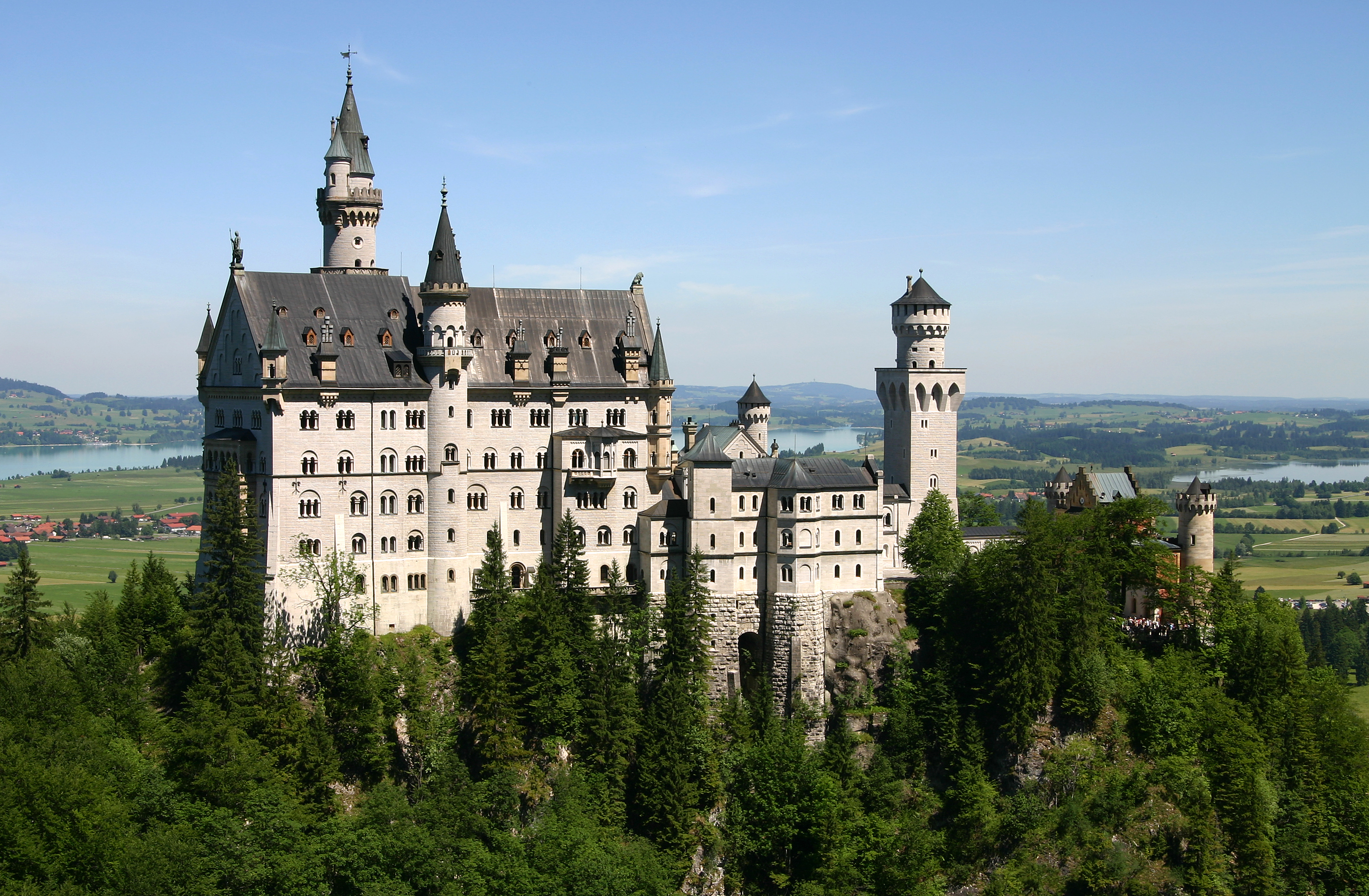
Neuschwanstein Castle in Bavaria — CC BY-SA 3
Travel to Tours of Germany and Austria
Choosing a Direction
Travel on tours of germany and austria begins with the choice of a starting point and a direction. Many travellers start in Vienna, run west through Salzburg and Hallstatt, then reach Munich and the castles of Bavaria, and end in the Rhine Valley or in Berlin. Other travellers start in Munich and run the other way, ending in Vienna with a concert or a dinner in an old coffee house.
Both directions have their own strengths, and a traveller should choose the one that fits the flights and the time available. The route works in either direction, because the trains run both ways and the towns welcome arrivals from either side.
Trains are the best way to travel on tours of germany and austria, because the rail networks of both countries are fast, punctual and linked directly to the great cities. A high speed train runs from Vienna to Salzburg in about two and a half hours, from Salzburg to Munich in about an hour and a half, and from Munich to the other cities of Germany in a few hours. A traveller who books early will find better fares, and should reserve a seat on busy summer trains. Tour coaches suit a traveller who wants a guide and no worry about timetables, while a hire car allows stops in small villages that the trains do not reach.
Staying and Eating Along the Route
Places to stay on tours of germany and austria range from hotels in historic buildings in Vienna and Salzburg to family guesthouses in Hallstatt and the small towns of Bavaria. A traveller should book early in summer, above all in Hallstatt and at Neuschwanstein, where rooms are few and demand is high. The small towns along the Rhine and in Franconia hold quiet guesthouses at softer prices than the great cities, and they make good overnight stops in the middle of the journey. A night in a small town, with dinner in a local inn, is often the most memorable night of the whole trip.
Eating is a great part of tours of germany and austria, and the foods of Austria and Germany share much yet differ in clear ways. In Austria a traveller should try Wiener Schnitzel, Sachertorte and Viennese coffee in the old coffee houses. In Germany a traveller should try sausages, roast pork, pretzels and local beer, with each region holding its own beers and its own dishes.
The vineyards along the Danube and the Rhine offer tastings of white wine, above all Grüner Veltliner from Austria and Riesling from Germany. A traveller should also try the beer gardens of Munich, where the food is simple and the atmosphere is loud and friendly.
Packing and Booking Ahead
A traveller on tours of germany and austria should prepare for changing weather, above all when crossing the Alps. Layers of clothing, good walking shoes and a light rain jacket are the essentials, and a small umbrella is worth carrying because rain can arrive at any time. The great sights, such as Schönbrunn Palace, Neuschwanstein Castle and the Hohensalzburg Fortress, should be booked ahead in summer, because the queues can be very long. Munich makes a good base for the Bavarian half of the journey, and Regensburg and Würzburg both make fine stops on the road north to the Rhine.
Notable Places in Tours of Germany and Austria
Vienna
Vienna is the most important stop on the Austrian half of tours of germany and austria, with Schönbrunn Palace, the Hofburg, Saint Stephen’s Cathedral and the old coffee houses. Vienna was once the capital of the Habsburg Empire and the musical centre of Europe, where Mozart, Beethoven and Strauss lived and worked. Two days in Vienna is the right allowance, with one day for the palaces and museums and one day for the coffee houses, the parks and the old town. The city rewards a slow pace, because its finest moments come in a coffee house or on a quiet square rather than in a queue.
Salzburg
Salzburg is the birthplace of Mozart and one of the finest cities in Austria, with the Hohensalzburg Fortress looking down on the old town and the Salzach river. The historic centre of Salzburg entered the World Heritage List in 1996, and it is where a traveller can walk the streets where Mozart was born, visit the cathedral and climb to the fortress for a view of the whole city. Salzburg is also the city of the film The Sound of Music, and many travellers come to see the places from the film. The city is small enough to walk in a day, yet rich enough to fill two.
Hallstatt
Hallstatt is the most famous lakeside village in Austria, with timber houses crowded on the mountain slope and salt mines with a history of more than three thousand years. Hallstatt is part of the Hallstatt-Dachstein World Heritage property, listed in 1997, and it is one of the most photographed places in Europe. A traveller in Hallstatt should take a boat on the lake, visit the salt mine and look down from the viewing platform on the mountain, yet should also arrive early or stay overnight, because the village is very crowded in the middle of the day. The evening, when the crowds leave, is the finest time in Hallstatt.
Munich
Munich is the capital of Bavaria and the most important stop on the German half of tours of germany and austria, with Marienplatz, the Frauenkirche and the traditional beer gardens. Munich is the city of the Oktoberfest, held every year from September to October, and it is the gateway to the castles of King Ludwig the Second. A traveller should allow at least two days in Munich, with one day for the city centre and one day for a trip to Neuschwanstein or to the Chiemsee. The city is friendly and easy to walk, and its beer gardens are the best place to rest after a day of sightseeing.
Neuschwanstein Castle
Neuschwanstein Castle is the most romantic stop on tours of germany and austria, with white towers on a hill above the valley and the Alpsee lake below. The castle was built by King Ludwig the Second from 1869 and was never finished, yet it became the symbol of Germany and the model for many castles in animated films. In 2025 the palaces of Ludwig the Second entered the World Heritage List as reference 1726. A traveller should book ahead and arrive early, because the castle is very crowded in summer, and should walk to the Marienbrücke bridge for the classic view.
The Rhine Valley
The Rhine Valley is the last stop on many journeys through tours of germany and austria, with castles on cliffs, vineyards and small towns along the river. The Upper Middle Rhine Valley entered the World Heritage List in 2002 as reference 1066, and it is one of the finest river landscapes in Europe. A traveller can take a boat on the Rhine from Rüdesheim to Koblenz, looking at castles and vineyards from the water, and stop in small towns to taste Riesling wine. The valley is at its best in the late afternoon, when the light turns gold on the cliffs and the castles stand out against the sky.

Hallstatt village and shoreline from the lake — CC BY 4

The Residenz in Munich from above — CC BY-SA 4

The Plönlein in Rothenburg ob der Tauber — CC BY-SA 4

The Lorelei on the Rhine — CC BY-SA 4

The old town and cathedral of Regensburg — CC BY-SA 4
Frequently Asked Questions
How many days do tours of germany and austria need?
Tours of germany and austria work best in ten to fourteen days, with four or five days in Austria and six or seven days in Germany. A traveller with less time can still make a shorter journey in seven days, with two days in Vienna, one day in Salzburg, one day in Hallstatt and three days in Munich with Neuschwanstein. A traveller who wants to see the Rhine Valley and Berlin as well should allow a few more days for the German half of the journey.
When is the best time of year for tours of germany and austria?
Tours of germany and austria are at their best in late spring, from May to June, and in early autumn, from September to October, when the weather is mild, the sights are less crowded and the vineyards along the Danube and the Rhine are at their finest. Summer is the high season, with the warmest weather and the largest crowds, above all in Hallstatt and at Neuschwanstein. Winter suits a traveller who wants the Christmas markets of Vienna and Munich, yet many mountain roads can freeze.
Is the train a good way to travel on tours of germany and austria?
The train is the best way to travel on tours of germany and austria, because the rail networks of both countries are fast, punctual and linked directly to the great cities. A high speed train links Vienna with Salzburg in about two and a half hours, Salzburg with Munich in about an hour and a half, and Munich with the other cities of Germany in a few hours. Booking early finds better fares, and a seat should be reserved on busy summer trains.
Do tours of germany and austria need a visa?
Germany and Austria both belong to the Schengen area, so a traveller needs only one Schengen visa for both countries. A traveller who holds a passport from a country with visa free access to Schengen can enter without a visa for a short trip. A traveller should check the present visa rules with an embassy before going, because the rules can change.
Which stops should I not miss on tours of germany and austria?
The stops that no traveller should miss on tours of germany and austria are Schönbrunn Palace in Vienna, the Hohensalzburg Fortress and the house of Mozart in Salzburg, the village of Hallstatt on its lake, Neuschwanstein Castle in Bavaria and the Rhine Valley with its castles and vineyards. A traveller who loves music should allow more time in Vienna and Salzburg, while a traveller who loves nature should allow more time in Hallstatt and the mountain lakes of the Salzkammergut.
Do tours of germany and austria suit a family with children?
Tours of germany and austria suit a family with children, because many stops, such as Neuschwanstein Castle, the salt mines of Hallstatt and the boat trips on the Rhine, appeal to children. A traveller with children should choose a slower pace, with fewer stops each day and more time to rest, and should book family rooms near the centre. Long train journeys can tire small children, so a traveller should break the journey into short stages.
Verified
The list below holds the checked facts of the journey, with the source of each one given alongside.
-
The sources behind this article were read on 22 November 2026, and every claim below was matched to them on that day.
-
Vienna was the capital of the Habsburg Empire, which ruled from the thirteenth century until 1918, and Schönbrunn Palace entered the World Heritage List in 1996 as reference 786, under criteria (i)(iv).
-
Mozart was born in Salzburg in 1756, and the historic centre of Salzburg entered the World Heritage List in 1996 as reference 784, under criteria (ii)(iv)(vi).
-
The Hallstatt-Dachstein property entered the World Heritage List in 1997 as reference 806, under criteria (iii)(iv), and the salt mines of Hallstatt have worked for more than three thousand years.
-
The Wachau entered the World Heritage List in 2000 as reference 970, under criteria (ii)(iv), and its listed area covers 18,462 hectares with a buffer of 2,837 hectares.
-
Neuschwanstein Castle was built from 1869 under King Ludwig the Second, and the palaces of Ludwig the Second entered the World Heritage List on 12 July 2025 as reference 1726, under criterion (iv).
-
The Upper Middle Rhine Valley entered the World Heritage List in 2002 as reference 1066, under criteria (ii)(iv)(v), and the listed stretch runs for 65 kilometres between Bingen and Koblenz.
-
Austria holds 12 inscribed World Heritage properties, and Germany holds 55.
Unverified
-
Train fares, hotel rates and entry prices along the route change with the season and with how early a traveller books, so no prices appear in the body of this guide and travellers must check the official lists before they go.
-
The present timetable between Vienna, Salzburg, Munich and the other cities changes with the season, so travellers must check the official timetable before they travel.
-
Room availability in Hallstatt is very limited in summer, and a traveller who arrives without a booking may find no room in the village, so the main text gives no promise about finding a bed on arrival.
-
Entry tickets for Neuschwanstein Castle sell out on busy summer days, so travellers must book ahead through the official channel and must not rely on buying a ticket at the gate.
-
The exact driving time on each stage of the route changes with traffic and with road works, so the main text gives journey times for trains rather than for cars.
Sources
-
UNESCO, Historic Centre of the City of Salzburg, reference 784: https://whc.unesco.org/en/list/784/ (checked 22 November 2026).
-
UNESCO, Hallstatt-Dachstein, reference 806: https://whc.unesco.org/en/list/806/ (checked 22 November 2026).
-
UNESCO, Wachau Cultural Landscape, reference 970: https://whc.unesco.org/en/list/970/ (checked 22 November 2026).
-
UNESCO, Upper Middle Rhine Valley, reference 1066: https://whc.unesco.org/en/list/1066/ (checked 22 November 2026).
-
UNESCO, Palaces of King Ludwig the Second of Bavaria, reference 1726: https://whc.unesco.org/en/list/1726/ (checked 22 November 2026).
-
UNESCO, Palace and Gardens of Schönbrunn, reference 786: https://whc.unesco.org/en/list/786/ (checked 22 November 2026).
-
UNESCO, States Parties page for Austria: https://whc.unesco.org/en/statesparties/at (checked 22 November 2026).
-
UNESCO, States Parties page for Germany: https://whc.unesco.org/en/statesparties/de (checked 22 November 2026).
-
TheTerraAtlas registry: for the entity TA-L5-austria-germany-tours, its parent Austria and the keyword set (checked 22 November 2026).
Illustrations
- Hero: Austria Germany. Free image: https://upload.wikimedia.org/wikipedia/commons/f/f8/Guide_through_Germany%2C_Austria-Hungary%2C_Italy%2C_Switzerland%2C_France%2C_Belgium%2C_Holland_and_England_-souvenir_of_the_North_German_Lloyd%2C_Bremen%281896%29_%2814785270923%29.jpg — No restrictions.
- In body, Tours of Germany and Austria: Donaubrücke Pöchlarn, Austria. Free image: https://upload.wikimedia.org/wikipedia/commons/e/e1/2019-05-19_%28307%29_Donaubr%C3%BCcke_P%C3%B6chlarn%2C_Austria.jpg — CC BY-SA 4.
- In body, Tours of Germany and Austria: Detail of Dadan in Leiben, Austria. Free image: https://upload.wikimedia.org/wikipedia/commons/8/8c/2019-05-19_%28318%29_Detail_of_Dadan_in_Leiben%2C_Austria.jpg — CC BY-SA 4.
- In body, Tours of Germany and Austria: Schönbrunn Palace in Vienna. Free image: https://upload.wikimedia.org/wikipedia/commons/1/1b/Palacio_de_Sch%C3%B6nbrunn%2C_Viena%2C_Austria%2C_2020-02-02%2C_DD_10.jpg — CC BY-SA 4.
- In body, Tours of Germany and Austria: The Danube near Melk in the Wachau. Free image: https://upload.wikimedia.org/wikipedia/commons/1/1c/Danube_near_Melk%2C_20210728_1544_0888.jpg — CC BY-SA 4.
- In body, Tours of Germany and Austria: The old town of Salzburg across the Salzach. Free image: https://upload.wikimedia.org/wikipedia/commons/6/6d/Old_Town_Salzburg_across_the_Salzach_river.jpg — CC BY-SA 3.
- In body, Tours of Germany and Austria: Hallstatt village and shoreline from the lake. Free image: https://upload.wikimedia.org/wikipedia/commons/3/37/Panoramic_view_of_Hallstatt_village_and_shoreline_from_lake.jpg — CC BY 4.
- In body, Tours of Germany and Austria: The Residenz in Munich from above. Free image: https://upload.wikimedia.org/wikipedia/commons/2/27/Aerial_image_of_Munich_Residenz.jpg — CC BY-SA 4.
- In body, Tours of Germany and Austria: Neuschwanstein Castle in Bavaria. Free image: https://upload.wikimedia.org/wikipedia/commons/a/ae/Castle_Neuschwanstein.jpg — CC BY-SA 3.
- In body, Tours of Germany and Austria: The Plönlein in Rothenburg ob der Tauber. Free image: https://upload.wikimedia.org/wikipedia/commons/8/88/Pl%C3%B6nlein%2C_Rothenburg_ob_der_Tauber%2C_Alemania%2C_2023-06-17%2C_DD_36.jpg — CC BY-SA 4.
- In body, Tours of Germany and Austria: The Lorelei on the Rhine. Free image: https://upload.wikimedia.org/wikipedia/commons/6/63/Aerial_image_of_the_Lorelei.jpg — CC BY-SA 4.
- In body, Tours of Germany and Austria: The old town and cathedral of Regensburg. Free image: https://upload.wikimedia.org/wikipedia/commons/6/6a/Characteristic_window_into_the_Old_Town_and_the_cathedral_of_Regensburg.jpg — CC BY-SA 4.


