Great Pyramid of Giza: The Last Wonder of the Ancient World
The Great Pyramid of Giza is the oldest and largest of the three pyramids on the Giza plateau. It is the only wonder of the ancient world still standing.
For more than 4,500 years the Great Pyramid of Giza has stood on the edge of the desert west of Cairo, and no building raised by human hands matched its height for nearly four thousand years. It was built as the tomb of the pharaoh Khufu, the second king of the Fourth Dynasty, and it still holds the record as the largest stone structure ever raised in the ancient world. The Great Pyramid of Giza draws millions of visitors a year, yet it keeps its secrets: the exact method of its construction is still debated, and a large empty space found inside it in 2017 has no agreed explanation. This guide covers the ground the Great Pyramid of Giza stands on, the king who ordered it, the way to visit it, and the places around it that complete the picture.
Quick Facts
- Pharaoh: Khufu, known in Greek as Cheops, second king of the Fourth Dynasty
- Built: about 2580–2560 BC, over roughly 20 to 30 years
- Original height: 146.6 m, the tallest human-made structure for nearly 3,800 years
- Height today: about 138.8 m, after the loss of the outer casing and the cap
- Base: 230.3 m on each side, covering about 5.3 hectares
- Stone blocks: about 2.3 million, averaging about 2.5 tonnes each
- Chambers inside: the King’s Chamber, the Queen’s Chamber, the Grand Gallery, and a subterranean chamber
- Setting: the Giza plateau, on the west bank of the Nile, about 16 km from central Cairo
- Inscribed property: Memphis and its Necropolis, UNESCO ref 86, listed in 1979
Geography of the Great Pyramid of Giza
The Great Pyramid of Giza stands on the north-east corner of the Giza plateau, on the highest ground of the ridge, where the limestone of the desert meets the green floodplain of the Nile in Egypt. The plateau rises above the river valley to the east, and from the foot of the Great Pyramid of Giza the view runs across the sprawl of modern Cairo to the river itself. The pyramid was placed deliberately on this edge, between the living city of the Nile and the desert of the dead to the west, because Egyptian belief put the realm of the dead where the sun sets. The ground under the Great Pyramid of Giza is solid limestone bedrock, levelled by the builders, and the pyramid sits on a square base cut into that rock.
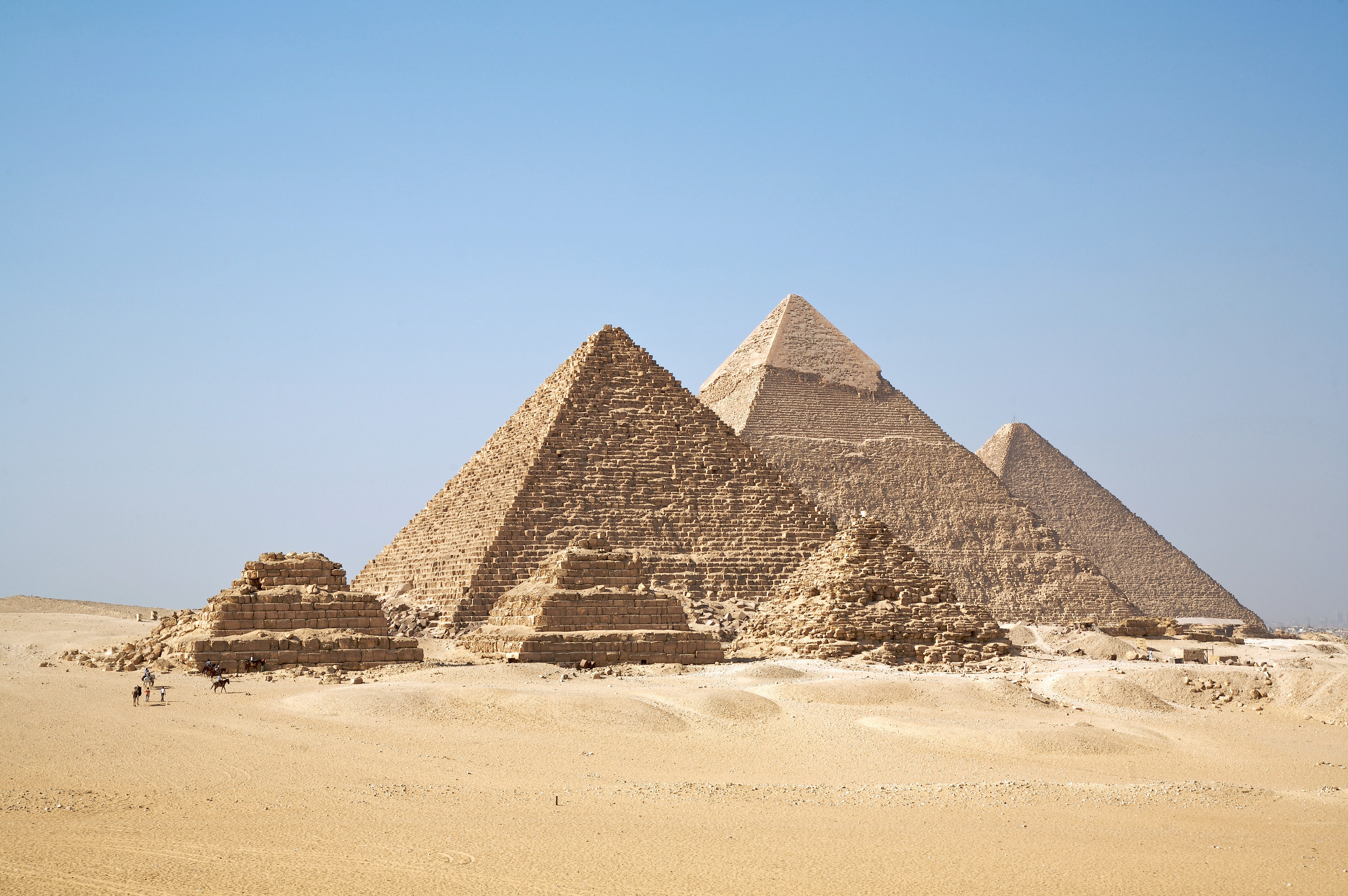
The Great Pyramid of Giza is the first of three large pyramids on the plateau, the Giza Pyramids, and the other two were built behind it to the south-west, each on slightly lower ground. The pyramid of Khafre stands to the south-west of the Great Pyramid of Giza, and the pyramid of Menkaure stands further south-west again, so that the three form a diagonal line running away from the Nile. The Great Sphinx lies to the south-east, at the end of the causeway that once linked the pyramid of Khafre to its valley temple on the river bank. The whole plateau is a necropolis, and around the three great pyramids lie the mastaba tombs of queens, princes and officials, arranged in streets of stone that form a city of the dead.
The stone of the Great Pyramid of Giza came from three places, and each kind of stone tells part of the story. The bulk of the core is local limestone, cut from quarries on the plateau itself, a short distance to the south of the pyramid. The fine white casing that once covered the whole pyramid came from Tura, on the east bank of the Nile, and it was ferried across the river and hauled up a causeway to the site.
The red granite of the King’s Chamber came from Aswan, nearly 1,000 km to the south, and the largest blocks weigh more than 50 tonnes. A canal and a harbour at the foot of the plateau, found by archaeologists in recent years, show how the stone arrived by boat when the Nile flooded.
The plateau itself was a building site for more than a century, and the ground around the Great Pyramid of Giza still shows the marks of it. The quarries to the south of the pyramid are cut in steps into the rock, and the ramps and the workers’ town to the south-east show where the stone was cut and where the men who cut it lived. The causeway that once ran from the pyramid to the valley temple on the river bank is still visible in places, and the harbour at its end, found by archaeologists, shows how the boats from Tura and Aswan came in when the Nile flooded.
The climate of the Giza plateau is desert, with hot summers and mild winters, and the Great Pyramid of Giza stands under a sun that is fierce from May to September. The plateau is dry, with almost no rain, and the wind from the west carries fine sand across the stone. Winter mornings can be cool, and the light in the late afternoon turns the limestone gold. The best light for photographs falls in the early morning and the hour before sunset, when the shadows are long and the pyramid throws a sharp triangle across the sand.

Great Pyramid of Giza — CC BY-SA 3
History of the Great Pyramid of Giza
The Great Pyramid of Giza was built for Khufu, who ruled Egypt for about 23 years in the middle of the 26th century BC, during the Old Kingdom. Khufu was the son of Sneferu, the founder of the Fourth Dynasty, and Sneferu had already built three pyramids of his own, learning by trial and error how to raise a true pyramid. The pyramid at Meidum began as a step pyramid and was filled in to make a smooth-sided one, the Bent Pyramid at Dahshur changed its angle halfway up, and the Red Pyramid at Dahshur finally achieved the true pyramid shape. Khufu inherited that knowledge, and his architects used it to build the largest pyramid ever attempted.
The construction of the Great Pyramid of Giza took about 20 to 30 years, and it was the work of a large, organised labour force rather than an army of slaves. The Greek historian Herodotus, writing two thousand years later, said that 100,000 men worked on the pyramid for 20 years, but modern archaeology tells a different story. The workers lived in a purpose-built town at Heit el-Ghurab, south-east of the plateau, where archaeologists have found bakeries, barracks, a cemetery for the workers and the bones of cattle, sheep and goats that fed them.
The workforce was probably 20,000 to 30,000 men, working in rotating gangs, and they were skilled labourers, craftsmen and farmers working during the months when the Nile flood stopped farm work. The exact method of raising the stone is still debated, and the leading ideas involve ramps of different kinds, levers, and the use of the Nile flood to bring stone to the site.
Inside the Great Pyramid of Giza, the builders left three chambers and one great corridor. The King’s Chamber sits at the heart of the pyramid, built entirely of red granite from Aswan, and it holds an empty granite sarcophagus with no lid. Above it are five low relieving chambers, stacked one on top of another to spread the weight of the stone above, and on the walls of the highest chamber the workmen painted the name of Khufu in red ochre, the direct proof that the pyramid belongs to him.
The Grand Gallery is a tall, corbelled passage that climbs at an angle of 26 degrees to the King’s Chamber, and its stepped ceiling is one of the most remarkable spaces in ancient architecture. The Queen’s Chamber, lower down, was probably never used for a burial, and the subterranean chamber, cut into the bedrock below the pyramid, was abandoned unfinished.
After Khufu, the Great Pyramid of Giza stood as the model for every pyramid that followed, but none matched its size. His son Khafre built the second pyramid, and his grandson Menkaure built the third, and then the age of the great pyramids ended as the Old Kingdom declined. The pyramid was already ancient when the Greeks made their lists of wonders, and the other six wonders, including the Colossus of Rhodes, have all disappeared, so the Great Pyramid of Giza is the only one that still stands. It stayed the tallest structure in the world until the spire of Lincoln Cathedral in the United Kingdom was finished in about 1311, nearly 3,800 years after the pyramid was built.
In the ninth century AD, the caliph al-Ma’mun ordered a tunnel cut into the north face in search of treasure, and that tunnel, known as the Robbers’ Tunnel, is still the way visitors enter the pyramid today. In 1837, the British officer Howard Vyse found the relieving chambers above the King’s Chamber and the painted name of Khufu inside them, settling the question of who the pyramid belonged to. In 1880, the archaeologist Flinders Petrie surveyed the plateau with instruments and measured the base of the Great Pyramid of Giza to within a few centimetres, showing how precisely the builders had worked.
The twentieth and twenty-first centuries have added new chapters to the story of the Great Pyramid of Giza. In 1954, archaeologists found a buried wooden boat beside the pyramid, the solar boat of Khufu, made of 1,224 pieces of cedar and reassembled over many years. In 2017, the ScanPyramids project, using muon detectors, found a large empty space above the Grand Gallery, about 30 m long, and its purpose is still unknown.
In 2025, the Grand Egyptian Museum opened on the plateau, about 2 km from the Great Pyramid of Giza, after more than twenty years of construction, and it now holds the full collection of Tutankhamun’s tomb together for the first time. The Great Pyramid of Giza itself remains what it has always been: the oldest and largest pyramid in Egypt, and the only surviving wonder of the ancient world.

Great Sphinx of Giza and Pyramid of Cheops — CC BY-SA 4
Travel to the Great Pyramid of Giza
The Great Pyramid of Giza is reached from Cairo by taxi, by ride-hailing car, or by organised tour, and the drive from the centre of the city takes about 45 minutes to an hour, depending on traffic. The plateau has its own entrance, and visitors arrive at a car park on the north-east side, from where the Great Pyramid of Giza rises directly ahead. The Cairo metro does not yet reach the plateau, and the nearest station is at Giza, from where a taxi or a minibus completes the journey. Many visitors come as part of a day tour that combines the pyramids with the Egyptian Museum or the Grand Egyptian Museum, and a guide is useful because the plateau is large and the ticket system has several parts.
The best time to visit the Great Pyramid of Giza is from October to April, when the air is cooler and the light is clear. The plateau opens in the morning and closes in the late afternoon, and the early hours are the quietest, before the tour buses arrive. Summer visits are possible, but the heat on the open plateau is strong, and visitors should carry water, wear a hat, and plan to rest in the shade.
The interior of the Great Pyramid of Giza is narrow and steep, and the passages are low, so the climb to the King’s Chamber is not suitable for anyone who dislikes enclosed spaces. Tickets for the interior are limited in number and sold separately from the plateau ticket, and they often sell out by midday.
Inside the Great Pyramid of Giza, the route enters through the Robbers’ Tunnel and climbs the Ascending Passage to the Grand Gallery, then to the King’s Chamber. The passages are lit, but the air is warm and the climb is steep, and the whole visit inside takes about 30 to 45 minutes. Photography inside the pyramid is restricted, and visitors should check the rules at the entrance.
Outside, the best viewpoint for photographs is the panoramic point to the south-west of the plateau, where all three pyramids stand in a line with the desert behind them, and camel and horse rides start from that area. Visitors who take a ride should agree the price and the route in advance, and should be clear about how long the ride lasts.
The Grand Egyptian Museum, about 2 km from the Great Pyramid of Giza, is the natural second half of a visit, and it holds the full collection of Tutankhamun’s tomb, the colossal statue of Ramses II, and the solar boat of Khufu. The museum fully opened on 1 November 2025, and tickets are sold online for timed entry. The sound and light show at the pyramids runs in the evening, with the pyramids lit against the night sky, and it is a separate ticket from the daytime visit. Visitors should allow a full day for the plateau and the museum together, and should carry water, sun protection and comfortable shoes, because the ground is uneven and the distances between the monuments are longer than they look.
Notable Places in the Great Pyramid of Giza
- The King’s Chamber. The chamber at the heart of the pyramid, built of red granite beams from Aswan, with a sarcophagus that is too large to pass through the door, so it was put in place while the pyramid was still being built. Two narrow shafts run from the chamber to the outside, and their purpose is still debated.
- The Grand Gallery. A tall corridor with a stepped, corbelled ceiling that climbs at 26 degrees to the King’s Chamber. It is 47 m long and 8.6 m high, and its purpose is still debated by archaeologists.
- The Queen’s Chamber. A smaller chamber lower in the pyramid, with a niche in its east wall and two narrow shafts. It was probably never used for a burial, and its intended purpose remains unknown.
- The Subterranean Chamber. A rough chamber cut into the bedrock below the Great Pyramid of Giza, reached by the Descending Passage from the original entrance on the north face. Work on it was abandoned, and the builders moved the burial chambers higher into the body of the pyramid.
- The Three Queens’ Pyramids. Three small pyramids on the east side of the Great Pyramid of Giza, built for queens of Khufu, including Hetepheres, his mother, and Meritites and Henutsen, his wives.
- The Solar Boat of Khufu. A wooden boat, 43.6 m long, buried in a pit beside the south face of the pyramid and found in 1954. It was reassembled from 1,224 pieces of cedar wood and is now displayed at the Grand Egyptian Museum.
- The Great Sphinx. A lion with a human head, 73 m long and 20 m high, carved from the bedrock at the south-east corner of the plateau. It guards the causeway of Khafre’s pyramid and faces the rising sun.
- The Panoramic Viewpoint. The high ground to the south-west of the plateau, where all three pyramids stand in a line. It is the best place for photographs, especially in the late afternoon.
- The Grand Egyptian Museum. The museum about 2 km from the Great Pyramid of Giza, fully opened on 1 November 2025, holding the complete collection of Tutankhamun’s tomb and the solar boat of Khufu.
Frequently Asked Questions
How tall is the Great Pyramid of Giza?
The Great Pyramid of Giza was 146.6 m tall when it was finished, and it stands about 138.8 m tall today, after the loss of its white limestone casing and its cap. It was the tallest human-made structure in the world for nearly 3,800 years, until the spire of Lincoln Cathedral in England was finished in about 1311.
Can visitors go inside the Great Pyramid of Giza?
Yes, through the Robbers’ Tunnel to the King’s Chamber, but the passages are narrow, steep and warm.
When was the Great Pyramid of Giza built?
The Great Pyramid of Giza was built for the pharaoh Khufu in about 2580–2560 BC, during the Fourth Dynasty of the Old Kingdom. It took about 20 to 30 years to build, and it is the oldest of the three large pyramids on the Giza plateau.
Who built the Great Pyramid of Giza?
The Great Pyramid of Giza was built by a workforce of about 20,000 to 30,000 skilled labourers, craftsmen and farmers, working in rotating gangs. They lived in a purpose-built town beside the plateau, and archaeologists have found their bakeries, barracks and cemetery there.
How long does a visit to the Great Pyramid of Giza take?
A visit to the plateau takes about half a day, and a full day if the Grand Egyptian Museum is included. The interior of the Great Pyramid of Giza takes about 30 to 45 minutes, and the walk between the monuments on the plateau adds another hour or two.
How do I get to the Great Pyramid of Giza from Cairo?
It is about 16 km from central Cairo, and the drive takes about 45 minutes to an hour by taxi. The nearest metro station is at Giza, from where a taxi completes the journey.
Verified
- The Great Pyramid of Giza is part of Memphis and its Necropolis, UNESCO ref 86, inscribed in 1979 under criteria (i)(iii)(vi). The property covers the pyramid fields from Giza to Dahshur, and the Great Pyramid of Giza is the only surviving wonder of the ancient world.
- Khufu ruled for about 23 years in the middle of the 26th century BC, and the Great Pyramid of Giza was built in about 2580–2560 BC. The painted name of Khufu in the highest relieving chamber, found by Howard Vyse in 1837, proves the pyramid belongs to him.
- The Great Pyramid of Giza was 146.6 m high with a base of 230.3 m on each side, and it stands about 138.8 m high today. About 2.3 million blocks were used, averaging about 2.5 tonnes each.
- The Grand Gallery is 47 m long and 8.6 m high, and it climbs at 26 degrees. The King’s Chamber is built of red granite from Aswan, nearly 1,000 km to the south, and the largest blocks weigh more than 50 tonnes.
- The Grand Egyptian Museum, about 2 km from the Great Pyramid of Giza, fully opened on 1 November 2025, and the public entered on 4 November 2025. It is the largest museum in the world dedicated to a single civilisation.
- The nearest separate inscribed property to the Great Pyramid of Giza is Historic Cairo, ref 89, about 13.4 km straight-line to the north-east, measured from the pyramid to the Citadel of Cairo.
Sources
- UNESCO World Heritage Centre, Memphis and its Necropolis, ref 86 — https://whc.unesco.org/en/list/86/
- UNESCO World Heritage Centre, Historic Cairo, ref 89 — https://whc.unesco.org/en/list/89/
- Grand Egyptian Museum, official opening 1 November 2025 — https://www.archdaily.com/1035595/the-grand-egyptian-museum-fully-opens-completing-gizas-new-cultural-landmark
- The Great Pyramid of Giza, dimensions and construction — https://en.wikipedia.org/wiki/Great_Pyramid_of_Giza
- ScanPyramids project, the large void found in 2017 — https://www.nature.com/articles/nature24639
Unverified
- The exact method used to raise the stone blocks of the Great Pyramid of Giza is still debated, and no ramp system has been proven by excavation.
- The large empty space found above the Grand Gallery in 2017, about 30 m long, has no agreed explanation, and its purpose is unknown.
- The figure of 100,000 workers given by Herodotus is an ancient claim, and modern archaeology puts the workforce at about 20,000 to 30,000 men.
- The exact length of Khufu’s reign is uncertain, and dates of about 2580–2560 BC for the construction are estimates from king lists and radiocarbon dating.
Illustrations
- Hero: Great Pyramid of Giza. Free image: https://upload.wikimedia.org/wikipedia/commons/c/c0/Sphinx_and_the_Great_Pyramid_of_Giza_panorama.jpg — CC BY-SA 3.0.
- In body, pyramid: Great Pyramid of Giza. Free image: https://upload.wikimedia.org/wikipedia/commons/a/a0/Great_Pyramid_of_Giza.jpg — CC BY-SA 3.
- In body, pyramid: Great Sphinx of Giza and Pyramid of Cheops. Free image: https://upload.wikimedia.org/wikipedia/commons/a/a2/Great_Sphinx_of_Giza_and_Pyramid_of_Cheops.jpg — CC BY-SA 4.